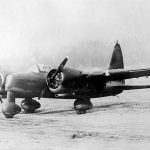
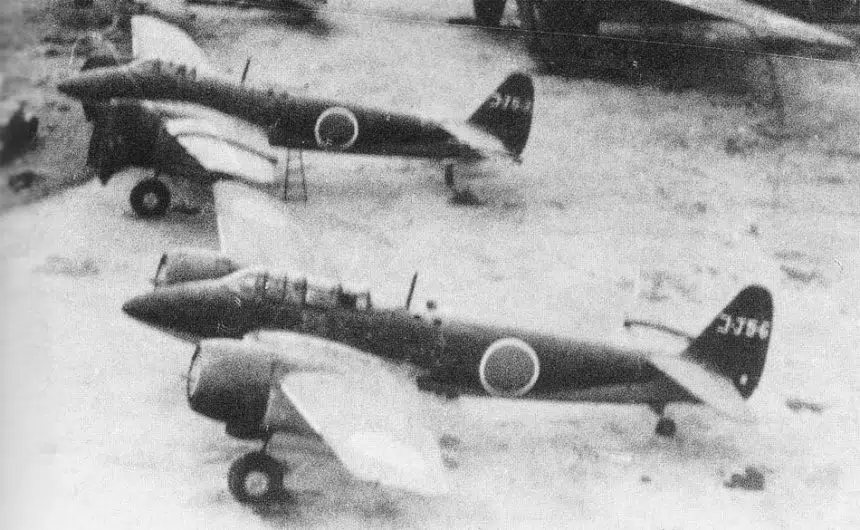


Many aircraft developed by Japanese aircraft engineers during WWII became important to Japan’s military, such as the Mitsubishi A6M Zero and the Nakajima Ki-84 Hayate. But Japan also had some issues with some of its technological efforts. One such effort was the Nakajima J5N Tenrai, a design that resulted in only six prototypes before it was abandoned. The Imperial Japanese Navy Air Service (IJNAS) ordered the development of this twin-engine heavy fighter as a new interceptor to counter improved Allied planes in the Pacific Theater. The Navy released requirements for the new aircraft in early 1943. It wanted a single-seat, twin-engine plane that could reach a top speed of about 415 mph at an altitude of 19,700 feet. The idea was to be different from earlier Japanese naval fighters. Armor plating would offer better protection, and it also needed to carry heavy weapons like cannons and bombs. Nakajima also designed a smaller three-seat J1N1 “Gekko” dedicated night fighter. The new plane was called the Nakajima J5N Tenrai, nicknamed Heavenly Thunder. It had straight wings, with engines mounted below them, and four-bladed propellers.
Design of Nakajima J5N Tenrai

The cockpit was positioned at the front of the long fuselage, providing excellent visibility. The cannons would be concentrated in the nose, and the tail had a single vertical fin. The undercarriage design included a bomb held under the belly. The chosen engines were the Nakajima Homare 21 series, 18-cylinder air-cooled radial engines, each producing up to 1,990 horsepower. Radial engines needed air cooling and larger nacelles but were sturdier than inline engines. The Nakajima J5N Tenrai design put the pilot in a position where he could see the engines well but still have good visibility for takeoff and landing on carrier decks. The Navy was pleased with Nakajima’s design and ordered six Nakajima J5N Tenrai prototypes for testing. The first prototype, which did not have guns, flew on July 13, 1944, but only reached a top speed of 371 mph. It prompted urgent design changes, but it was clear that the Navy needed a complete redesign. During test flights, this aircraft, like others using the Homare engine, suffered power issues from vibrations and oil leaks.
The Cancellation

There were also problems with the connection between the flaps and the engine nacelle, which led to stalls that limited maximum speed. The engine nacelle was reshaped, but performance did not improve, and the maximum speed remained almost the same. Although the Nakajima J5N Tenrai handled well, it did not meet the Navy’s performance requirements. As a result, the Navy rejected it while narrowing its choices for prototype aircraft in the fall of 1944, and development stopped after only six prototypes were built. The fifth and sixth prototypes were changed into two-seat versions and tested as night fighters, equipped with two 30mm cannons mounted at an angle. However, four aircraft were lost in accidents, showing the Nakajima J5N Tenrai needed big improvements that time did not allow. As Japan’s situation in the Pacific worsened, the project was canceled in February 1945. Japan then surrendered unconditionally in August, officially ending WWII, and the country stopped focusing on making its own weapons. After the war, the United States took the aircraft. Some of its parts are kept at the Paul E. Gerber Restoration, Maintenance and Management Facility. Read more Grounded Dreams articles HERE.