






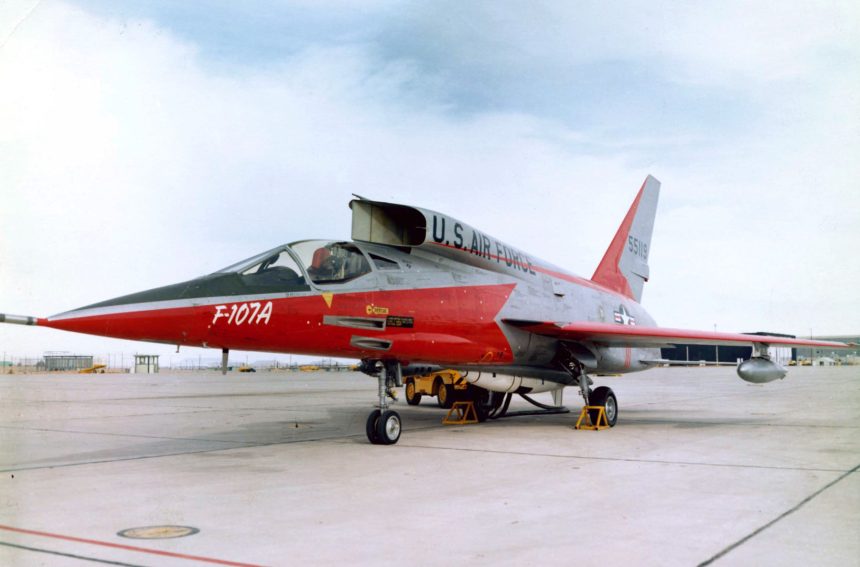

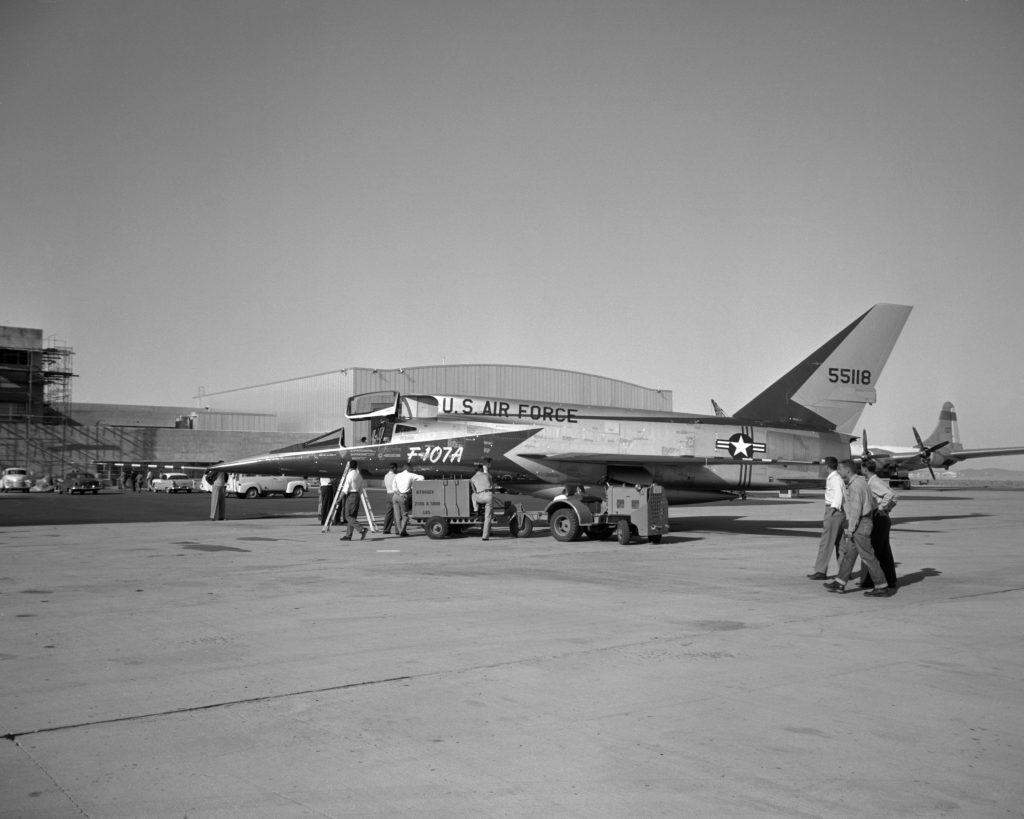
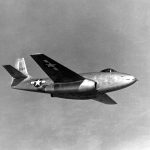
In the 1950s, the US Air Force initiated a competition to design a new tactical fighter-bomber. In June 1953, to take part in the competition, North American began an in-house study to improve the design of the F-100 Super Sabre. The improved aircraft became the North American F-107, which had an air intake above the cockpit, a movable vertical fin, and a Variable Area Inlet Duct that automatically controlled the amount of air reaching the jet engine. The F-107 did not have an official name, but some people called it the “Super Super Sabre” informally. Some also call the aircraft the “Ultra Sabre.” In August 1954, a contract was signed for three prototype aircraft, and six more planes were ordered for pre-production. The single-seat North American F-107 was 61.10 feet long, 19.8 feet high, with a wingspan of 36.7 feet and a wing area of 376 square feet. Its empty weight was 22,696 pounds, the gross weight was 39,755 pounds, and the maximum takeoff weight was 41,537 pounds. The aircraft was powered by a Pratt & Whitney YJ75-P-9 turbojet engine, producing 24,500 lbf of thrust. The range of the aircraft was envisioned at 2,428 miles, with a service ceiling of 53,200 feet and a rate of climb of 39,900 feet per minute.
Design of North American F-107
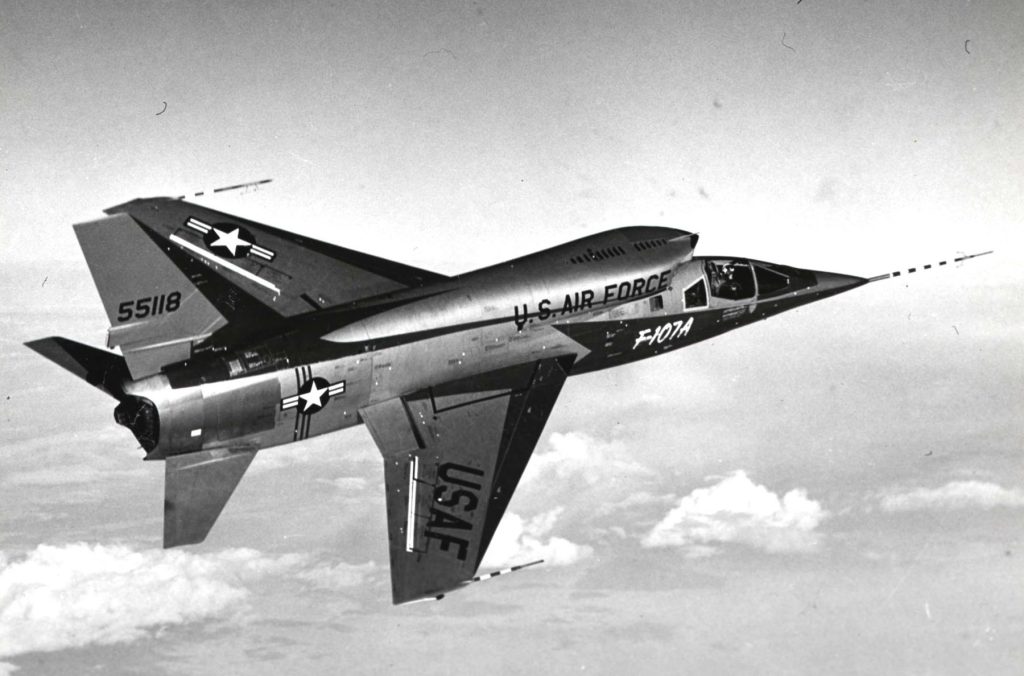
The North American F-107 could be armed with four 20 mm Pontiac M39 cannons or a 20 mm, 6-barreled M61 Vulcan autocannon. It also had provisions to carry 10,000 pounds of bombs, including tactical nuclear weapons, on 5 hardpoints. The first F-107 prototype flew for the first time on September 10, 1956, with North American’s chief test pilot, Bob Baker, at the controls. It reached a speed of Mach 1.03. After this successful flight, the brake parachute failed to deploy, causing a rough landing that broke the nose gear strut. The aircraft then achieved Mach 2 in tests on November 3, 1956. The second North American F-107 flew for the first time on November 28, 1956. It was used to test weapons with both conventional and atomic bombs. The last prototype had its first flight on December 10, 1956. After the successful test program for the F-107A, the Tactical Air Command decided to compare it with the Republic F-105, which had the same mission requirements and used the same engine. The competition was close, but the command chose the F-105 as the new standard tactical fighter. As a result, the three F-107A prototypes became test aircraft, and the pre-production order was canceled.
The Cancellation
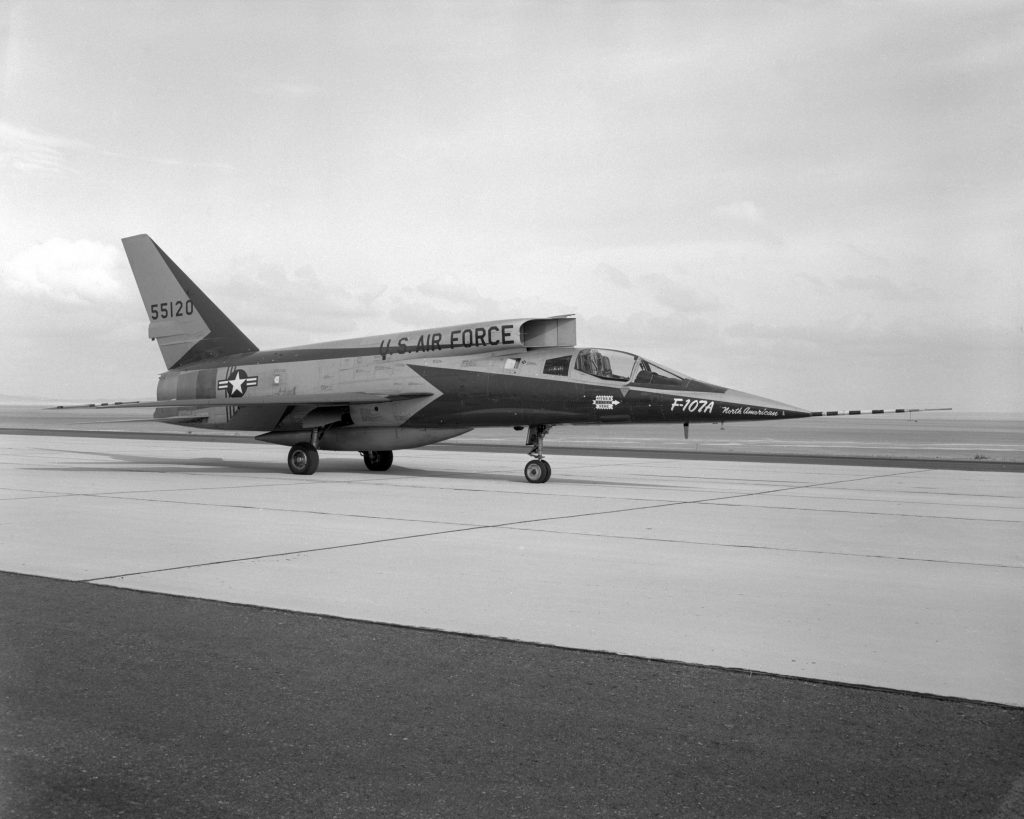
In late 1957, the first and third North American F-107 prototypes were loaned to the National Advisory Committee for Aeronautics (NACA), the predecessor to NASA (National Aeronautics and Space Administration), for high-speed flight research. The first is now part of the Pima Air & Space Museum collection. In September 1959, while American naval officer and test pilot Scott Crossfield was flying it, the third aircraft was damaged during a failed takeoff. This aircraft was not fixed and was eventually used for fire-fighting training before being destroyed in the early 1960s. The second North American F-107 prototype, which NACA did not use, was flown to the National Museum of the US Air Force at Wright-Patterson Air Force Base near Dayton, Ohio, on November 25, 1957. North American also proposed a two-seat version of the North American F-107, which would have placed both crew members under a single canopy in a longer forward fuselage. However, none of these planes were built. In the Grounded Dreams series, there are not many aircraft that reached Mach 2 and were still canceled. It shows the kind of competition companies faced even in the early years of aviation, and how that competition helped shape the world as we know it today. Read more Grounded Dreams articles HERE.




I saw one in 1971 fly at NAS Moffett Field in Mountain View CA also home to NASA’s Ames Research. For years wondered what Aircraft it was. Now i know. Saw it recently at the Pima Air Museum in Tuscon AZ.Had to go see the Martin MARS Aircraft.