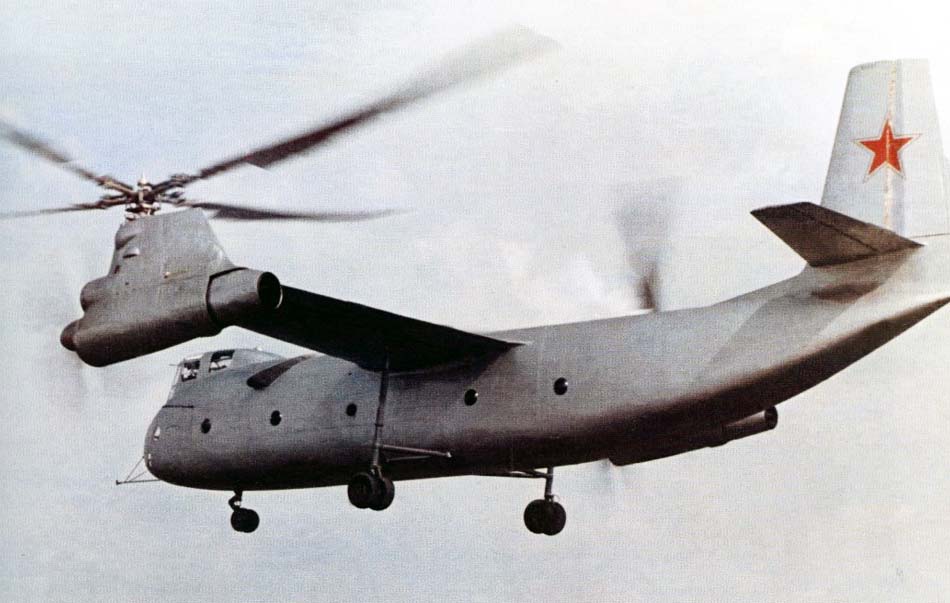
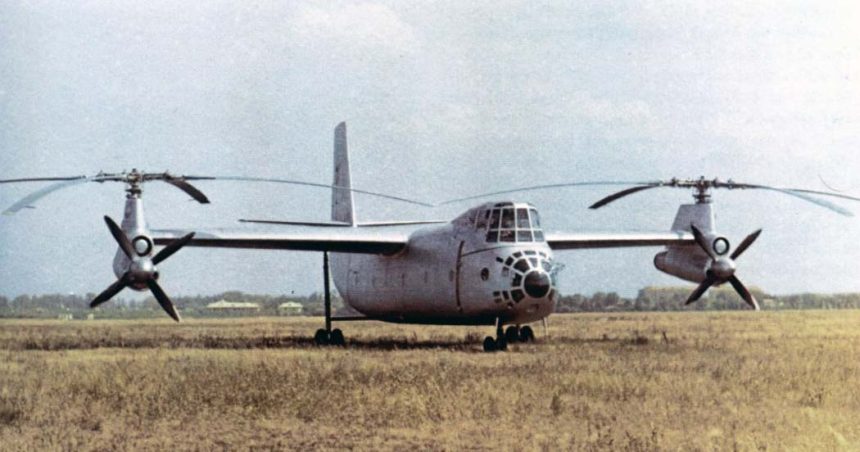

In the 1950s, the Soviets built an unorthodox machine that combined the capabilities of a helicopter and a fixed-wing aircraft. The Kamov Ka-22 was an experimental transport aircraft that combined the features of a helicopter for vertical takeoff and landing with the capabilities of a fixed-wing aircraft for sustained cruise flight. It set eight world records, but was still abandoned. The development of the aircraft began when Kamov’s designer, Vladimir Barshevsky, decided to extend a helicopter’s range by designing a wing-and-propeller configuration. In 1954, a proposal to produce three Ka-22 helicopters was approved. However, due to initial project delays, the second and third prototypes were canceled on March 28, 1956. The Ka-22 had its first flight on June 17, 1959, and completed its first untethered flight on August 15, 1959.
Design of Kamov Ka-22
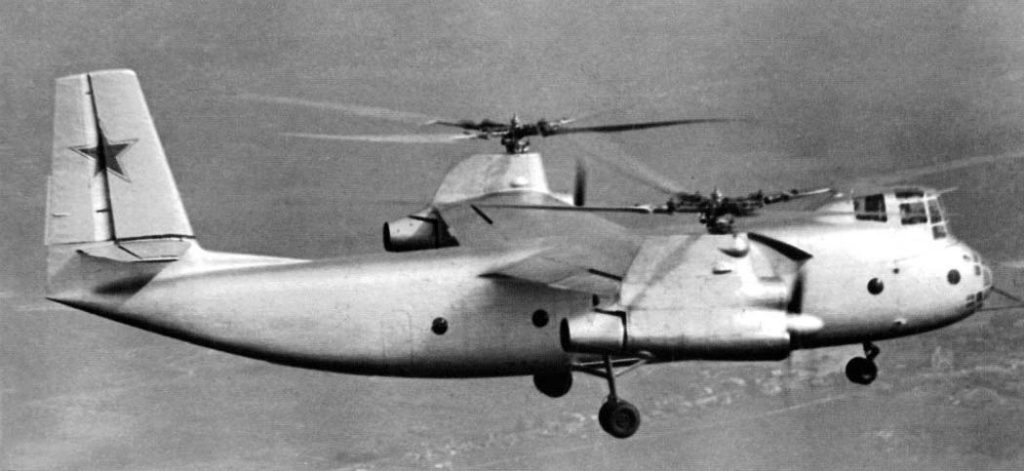
The Kamov Ka-22 was a fixed-wing aircraft with rotors on the tips of its wings. It had an engine on each wing tip that powered both a four-bladed propeller and a four-bladed main rotor. The first version was powered by two Kuznetsov TV-2VK engines, which produced 5,900 horsepower, but were later changed to 5,500 horsepower Soloviev D-25VK engines. The fuselage had a cockpit for three people above the front glass nose and a main cargo area that could accommodate up to 80 passengers or carry 16.5 tonnes of cargo. The entire nose could swing open to the right for loading large items. In helicopter mode, the propeller drive was turned off, and the flaps were set to 90 degrees. In fixed-wing mode, the rotors could spin freely, and the ailerons and tail controlled the aircraft. The landing gear had two wheels and was fixed in place. The aircraft was 88.7 feet long, with a wingspan of 73.10 feet and a wing area of 1,130 square feet. Its empty weight was 62,170 pounds, the gross weight was 78,264 pounds, and the maximum takeoff weight was 93,696 pounds. It had two 65.7-foot main rotors with an area of 8,559 square feet. The aircraft was also equipped with four-bladed variable-pitch propellers. Initially, the aircraft experienced control problems, causing delays in orders until engineers resolved the issues. In July 1960, an order was awarded to develop three more Ka-22s. The Kamov Ka-22 aircraft set eight world records during its short time in operation, with D.K. Yefremov and V.V. Gromov as its pilots. The aircraft made its first public appearance on Soviet Aviation Day in 1961.
The Cancellation
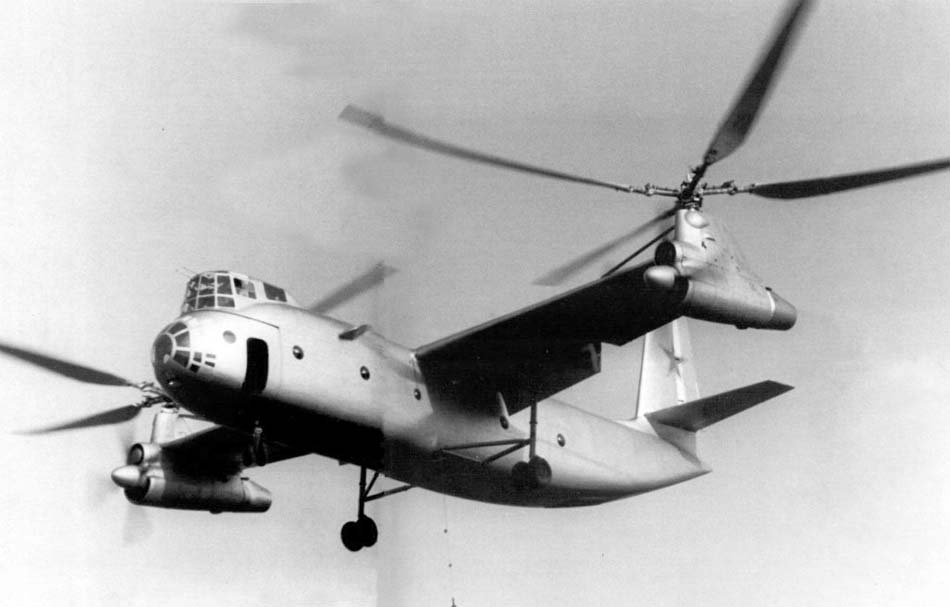
On October 7, 1961, Kamov Ka-22 achieved a speed record of 221 mph while equipped with wheel spats and a fairing behind the cockpit. The additions were later removed, and on November 24, 1961, it lifted a payload of 36,343 pounds to a height of 8,390 feet. On August 28, 1962, the first prototype of Kamov Ka-22 crashed during a stop on its way to Moscow for testing. The helicopter rolled to the left and crashed upside down, killing the entire crew. Investigators found that the crash happened due to a problem with the starboard rotor’s pitch control system. They also discovered that two of the other three Ka-22 helicopters had similar issues. To make the helicopters more stable and easier to control, engineers installed a complex autopilot system. The system sensed the helicopter’s position and movements and used that information to help control the flight. On August 12, 1964, during a Soviet Air Force test, another prototype was destroyed. It made an uncontrolled right turn, and while trying to fix this, the Ka-22 went into a steep dive. The crew was ordered to abandon the aircraft. Three crew members survived, but Col S.G. Brovtsev, the pilot, and technician A.F. Rogov were killed. As a result, the Kamov Ka-22 program was abandoned because the Mil Mi-6 took over its role as a heavy helicopter. The two remaining Kamov Ka-22 helicopters were later scrapped. Western observers only saw the Ka-22 once during the Cold War, at an Aviation Day display in Moscow on July 9, 1961. In the Grounded Dreams series, the Ka-22 was an excellent aircraft, merging both helicopter and aircraft, and had a hold that is about the same size as the one on the Antonov An-12. But handling such a heavy machine proved difficult. Read more Grounded Dreams articles HERE.