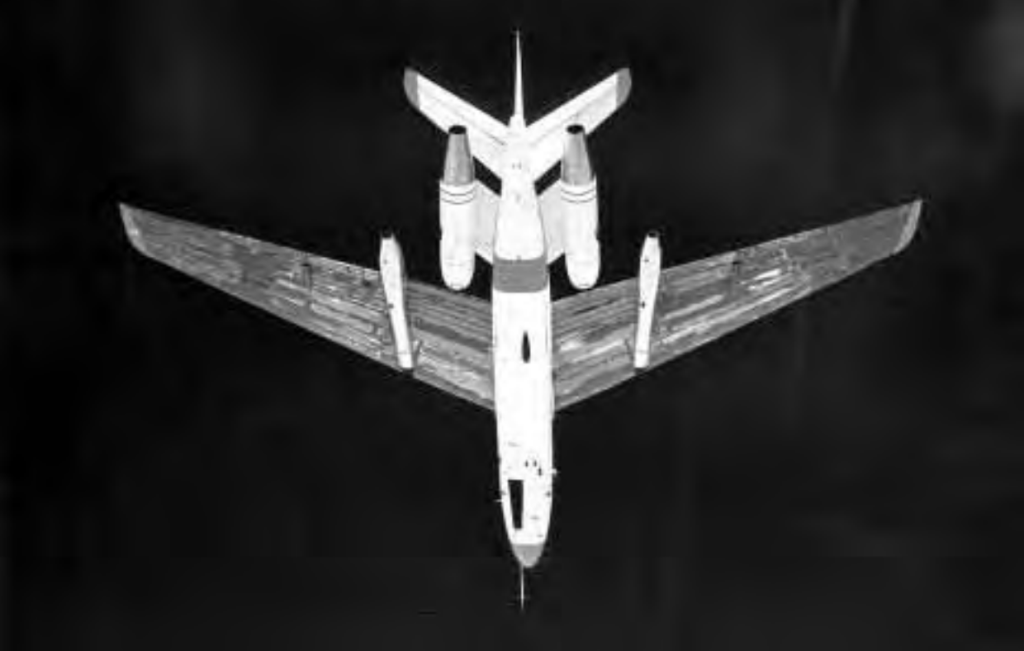
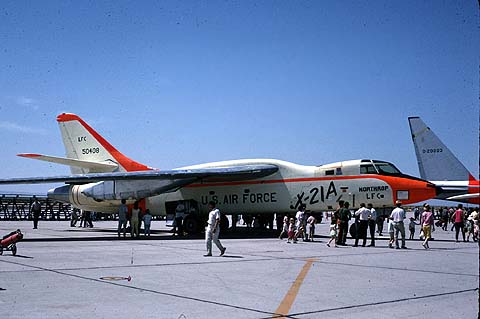


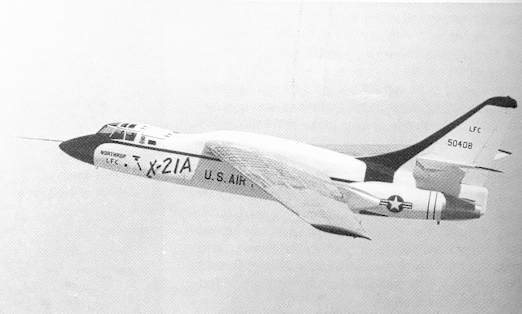
In the early 1960s, the US wanted to test wings with laminar flow control. At the time, Laminar-flow control was an emerging aerodynamic technology and could improve aircraft efficiency by reducing drag, resulting in decreased fuel burn and higher range and endurance. In theory, if 80% of a wing operated in a laminar flow, overall drag could decrease by 25%. The friction between the airflow and the aircraft surface, called viscous drag, is much higher in a turbulent flow than in a laminar flow. As a result, Northrop built an experimental aircraft to test wings with laminar flow control. The aircraft, called the Northrop X-21A, was based on the Douglas WB-66D airframe. It had the engines moved from the wings to the back of the fuselage, creating space for air compressors. To develop the Northrop X-21A, the standard underwing Allison J71 engines in the Douglas WB-66D were replaced with two General Electric XJ79-GE-13 turbojets, each producing 9,490 pounds of static thrust, mounted in pods on the rear fuselage sides.
Design of Northrop X-21A
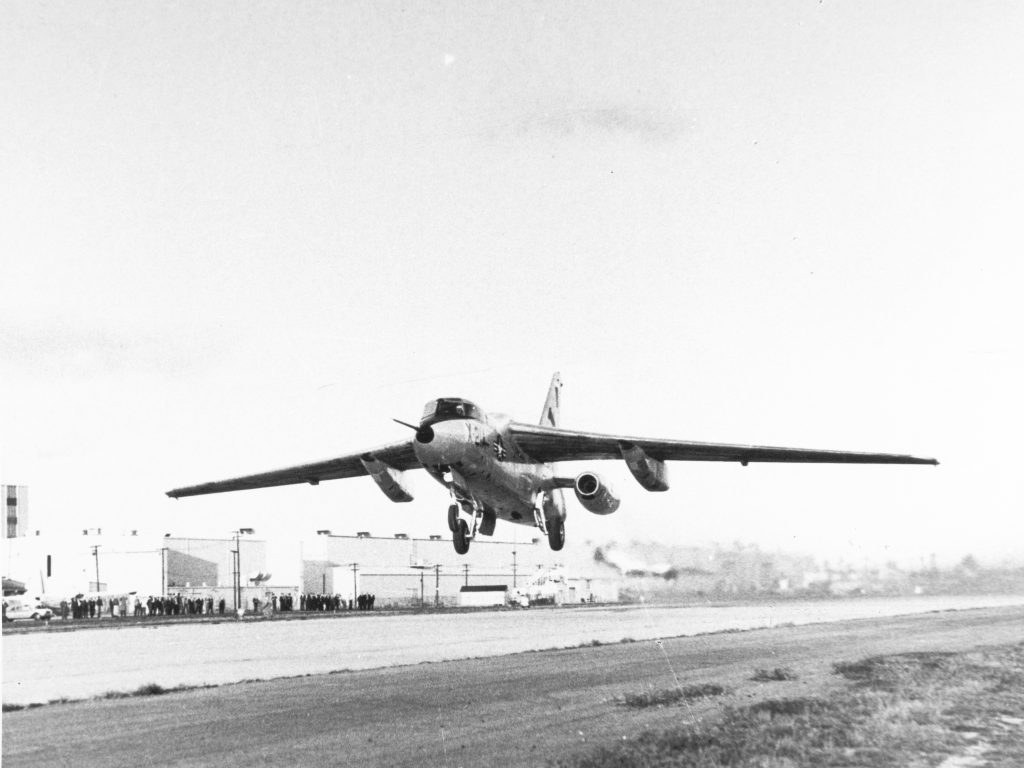
Northrop built two X-21A test vehicles with advanced systems to control airflow over the wings. The vehicles featured redesigned wings that were larger and had a lower angle of sweep, changed from 35° to 30°. The Northrop X-21A wings also had 800,000 small slots to achieve smoother laminar flow. The Northrop X-21A had a crew of five, including a pilot, two flight engineers, and two additional flight test engineers, who sat in a central area below the wing. The aircraft was 75.3 feet long, 25.7 feet high, with a wingspan of 93.6 feet and a wing area of 1,250 square feet. The empty weight of the aircraft was 45,828 pounds, and the gross weight was 83,000 pounds. The maximum speed of Northrop X-21A was 560 mph with a range of 4,780 miles and a service ceiling of 42,500 feet. The aircraft first flew on April 18, 1963, and was intended to test how weather conditions such as rain, sleet, and snow affected the system. During the initial testing, the researchers found many issues with the Northrop X-21A’s porous materials and surface slots, which became clogged with debris, bugs, and even rain. During the X-21A flight tests, researchers found another problem with ice crystals in the atmosphere. They observed that when the X-21A flew in or near visible cirrus clouds, it lost its laminar airflow and reverted to turbulent flow. However, once it moved away from the ice crystals, the laminar airflow returned immediately.
The Cancellation
At the end of the program, 38 flights successfully achieved laminar flow over more than 95 percent of the area meant for this improvement on a large airplane. Despite its good performance, the program was canceled because the government and industry focused on challenges rather than the success the researchers had achieved with the Northrop X-21A. The Northrop X-21A flight program provided important data. It proved that surface irregularities, such as dust, bugs, debris, or water, could affect the wing’s performance. In addition, it showed that three-dimensional airflow effects, known as spanwise contamination, could cause boundary-layer turbulence, and environmental conditions, such as atmospheric ice crystals, could also have negative effects. After retirement, both X-21As were stored at Edwards Air Force Base in California, where they were mostly used as photo targets. In the Grounded Dreams series, the Northrop X-21A was built to test full-scale laminar flow control on a large aircraft and proved it could maintain smooth airflow. During testing, the Northrop X-21As demonstrated that laminar flow control worked well. Even though useful testing had been conducted, the program ended because the complex laminar-flow system required costly maintenance that neither the government nor industry was willing to continue. Read more Grounded Dreams articles HERE.