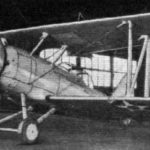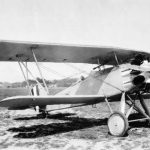
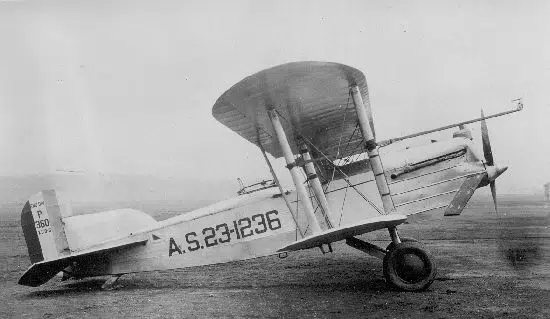


The last fighter plane built by the US Army Engineering Division was the TP-1, designed by engineers Alfred Verville and Virginius E. Clark. The TP-1 was a two-seat biplane powered by a 423-horsepower Liberty 12 engine. The lower wing was smaller than the upper one. It had two fixed Browning machine guns in the nose, one Lewis gun in the rear cockpit, and another Lewis gun that could fire downward through a hatch. The aircraft was assembled at McCook Field in 1922. After it was built, the performance of the TP-1 was found to be too weak for a fighter. It could only reach a top speed of 130 mph. The first prototype, numbered 68578, was tested at Wright Field and given the tail number P-263. After its accident, the second aircraft (68579) was converted into an observation plane and designated XCO-5. It flew at Wright Field and had the tail number P-305.
Design of Engineering Division XCO-6

On October 10, 1928, Captains Clair Streett and Albert William Stevens flew an XCO-5 with a turbosupercharger and broke the unofficial altitude record for planes with more than one person on board, reaching 36,500 feet. At this altitude, the air temperature dropped to minus 108 degrees Fahrenheit, causing ice to accumulate on the aircraft’s control surfaces. The pilots could only glide the plane down safely after they ran out of fuel. As a continuation of this development, the Engineering Division XCO-6 was developed, a two-seat observation biplane used to test new engine designs. It specifically featured an inverted engine setup with either an air-cooled or a liquid-cooled engine. It was different from earlier models like the XCO-5, which used traditional upright engine configurations. It was 29.8 feet long, 9.7 feet high, with a wingspan of 48 feet and a wing area of 481 square feet. Its loaded weight was 2,600 pounds, with a maximum speed of 65 mph and a stall speed of 62 mph. It was powered by a Liberty V-1410 V-12 water-cooled piston engine, producing 420 hp. Two prototypes of the Engineering Division XCO-6 were built.
The Cancellation

One was tested at McCook Field and later modified. The first version, XCO-6A, was planned to move the main fuel tanks into the upper wing, but it was never built. The second version, XCO-6B, used a new 435 hp Liberty 12A engine. Finally, XCO-6C was an improved version of XCO-6B, featuring a larger propeller and updated landing gear. The tests showed that the performance and flight characteristics were excellent. However, the wire-braced, twin-bay wing made maintenance difficult. Still, none of the versions of the Engineering Division XCO-6 entered mass production because they were built strictly as a limited research and testbed project rather than as finalized combat aircraft. Read more Grounded Dreams articles HERE.