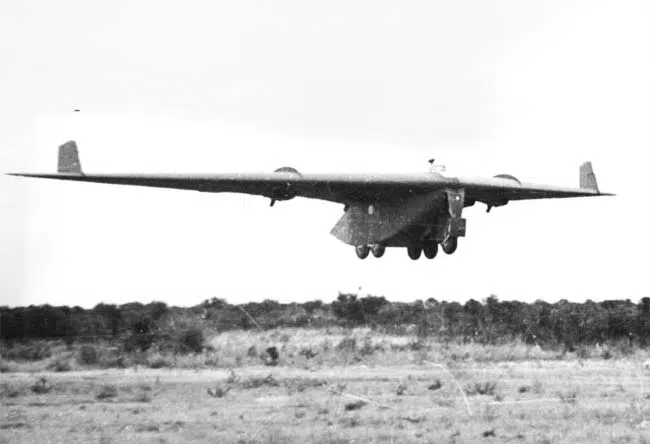


In the 1950s, Argentina needed a way to transport citrus fruits, especially oranges, from the west of the country to Buenos Aires. There were no rail links, except to San Luis, Mendoza, and a few other cities, and the roads were not good enough for heavy trucks. As a result, the four-engine experimental tailless transport aircraft DINFIA IA 38 was developed under the direction of Reimar Horten. It was based on the German Horten Ho VIII project and was built by DINFIA. The DINFIA IA 38 was an all-metal design without a tail, featuring swept-back shoulder wings. It had vertical control surfaces near the tips of the wings. The fuselage was short and stubby, and it used a tricycle landing gear with a retractable nose wheel and fixed main wheels.
Design of DINFIA IA 38

The two-seat DINFIA IA 38 was 44.3 feet long, 15.1 feet high, with a wingspan of 105 feet and a wing area of 1,430 square feet. Its empty weight was 18,739 pounds, and the gross weight was 35,274 pounds. The aircraft was powered by four IA 16 El Gaucho radial engines mounted in the wings. These engines drove pusher propellers that were clear of the wing’s trailing edges. The aircraft was intended to use 750 hp I.Ae. 19R El Indio engines, but since they were unavailable, the prototype had to use 450 hp I.Ae. 16 El Gaucho engines instead. The DINFIA IA 38 was envisioned to reach a maximum speed of 157 mph, a cruise speed of 134 mph, a range of 780 miles, and a service ceiling of 14,800 feet. Two crew members sat in an enclosed cockpit above the wing’s leading edge. The fuselage included a cargo compartment with a capacity of 30 m³ (1,100 cu ft), designed to hold a planned load of 6 long tons (13,000 pounds).
The Cancellation

A clamshell rear cargo door provided access to the cargo compartment and could be opened in flight to air-drop loads. The development and construction of the prototype were slow. DINFIA IA 38 faced further delays due to the 1955 Revolución Libertadora, which overthrew Juan Perón’s government. Work resumed in 1958, but the prototype did not make its first flight until December 9, 1960. The DINFIA IA 38 was difficult to control and lacked power, resulting in poor performance. Additionally, the engines had overheating problems. The prototype had three more test flights before the project was canceled in 1962. After the project was canceled, the DINFIA IA 38 was displayed at the Aeronautical School. It remained there until a fire, possibly started intentionally, damaged the aircraft’s outer covering. Eventually, the remains of the plane were scrapped. In the Grounded Dreams series, the DINFIA IA 38 proved a failure due to the unavailability of suitable high-power engines. Read more Grounded Dreams articles HERE.