






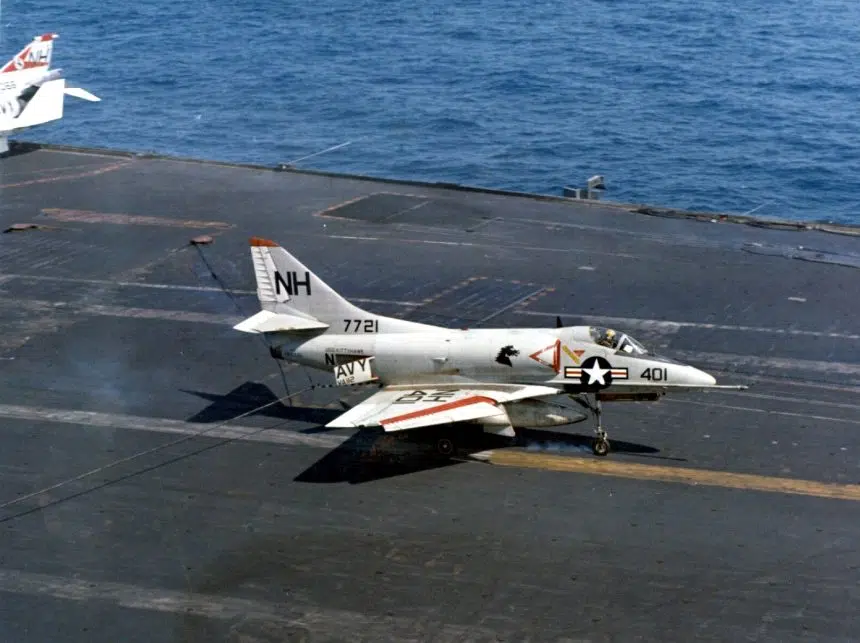

Attack Squadron 112 (VA-112), nicknamed the “Broncos,” was a US Navy attack squadron that began with piston-engine fighters shortly after WWII and continued to serve through the Korean and Vietnam Wars as aviation transitioned to jets. The squadron was first formed as Bomber-Fighter Squadron VBF-11 on April 9, 1945. It was renamed Fighter Squadron VF-12A on November 15, 1946, and then became VF-112 on July 15, 1948. Finally, it became Attack Squadron 112 on February 15, 1959. The squadron initially flew the Grumman F6F Hellcat and later the F8F Bearcat. One of its early missions involved an unusual event in naval aviation. On March 25, 1948, the USS Valley Forge, with the squadron on board, operated in the Persian Gulf with Saudi Arabian Prince Ibn Saud present to watch American carrier aviation. However, the planned demonstration could not happen because a sandstorm made flying impossible. A month later, on April 29, the carrier reached Bergen, Norway. The squadron’s Bearcats participated in an unusual maneuver called Operation Pinwheel. They used the engines of the aircraft on the carrier’s deck to help move the Valley Forge next to the dock without the need for tugboats.

Attack Squadron 112 entered combat during the Korean War. On August 5, 1950, the squadron began its first combat missions against targets near Mokpo and Kwangju in South Korea. The squadron played an important role in the campaign around the Inchon landings. From September 12 to 19, their planes attacked roads, railways, and airfields near Inchon and also provided air patrols. After the landings, the squadron continued to strike at various targets and North Korean supply routes each day. During the Korean War, Attack Squadron 112 also faced the MiG-15 fighter jets. On November 10, 1950, Attack Squadron 112 encountered MiG-15s over Sinuiju, North Korea, during a mission. It managed to damage one MiG-15 in the encounter. Later, the squadron replaced its F8F Bearcats with the F9F Panther. On June 23 and 24, 1952, it took part in major strikes against North Korean hydroelectric power plants. These attacks involved multiple aircraft from different carrier air groups and targeted nine facilities, making it one of the largest attacks of its kind in the war. After the war, the squadron continued its operations in East Asia. From February 6 to 13, 1955, it provided air support during the evacuation of over 26,000 people from the Tachen Islands during the First Taiwan Strait Crisis. Attack Squadron 112 then transitioned to more advanced jet aircraft, first operating the F9F Cougar and later the McDonnell F3H Demon. In April 1959, it received the Douglas A-4 Skyhawk.

By the 1960s, Attack Squadron 112 was part of the Navy’s growing attack force in the Pacific. Its most intense combat operations occurred during the Vietnam War. On April 24, 1967, Attack Squadron 112 aircraft joined a coordinated strike against Kép Air Base in North Vietnam, northeast of Hanoi. The attack was important because it was the first strike on a North Vietnamese airfield used by MiG fighters. The squadron continued to attack targets across North Vietnam. On May 10, 1967, Commander M. L. Minnis Sr. from VA-112 received the Silver Star for his actions during a strike on the thermal power plant in Haiphong. In April 1969, Attack Squadron 112 faced a crisis when North Korean forces shot down a US Navy EC-121 reconnaissance aircraft. The USS Ticonderoga, which carried VA-112, was ordered to the Sea of Japan along with other American carriers in response to the incident. By 1969, VA-112 had changed a lot over more than 20 years of naval warfare. It started with the F6F Hellcat and F8F Bearcat, fought in Korea with early jet fighters, and then moved on to the Panther, Cougar, and Demon. Eventually, it operated the A-4 Skyhawk during the Vietnam War. After 24 years of service, Attack Squadron 112 was disestablished on October 10, 1969.









In the mid 60’s I was on the Shangri La CVA 38 and the A4 was a big weapon along with the F8. Looking like dinosaurs now but we’re killing machines back then.
I’m sorry,but the F8F Bearcat was already out of active duty Navy squadrons by the time the Korean War erupted in June of 1950. Also, when you said that VF/VA112 started flying combat sorties with first generation jets, then changed to F9F Pnthers, that made absolutely zero sense, because, after VF/VA-112 I’d goodbye to the Bearcat,they started flying the Panther, which is the plane that they used during the Korean War. This squadron never flew the early carrier based jet fighters, at all.