






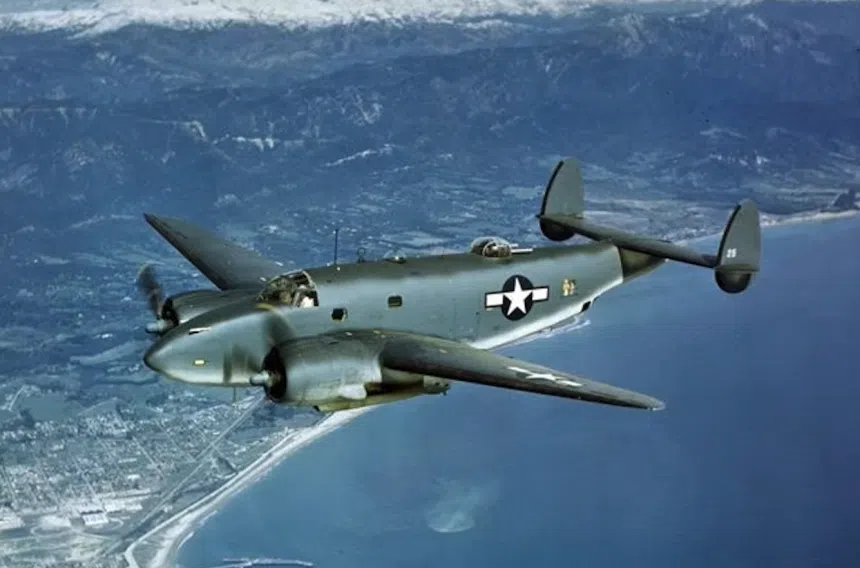

The Lockheed PV-1 Venturas of Lts. “Butch” Mason and William Sparks had the rising sun at their backs as they closed in on the dockyards at Kakumabetsu in the Kurile Islands. They had been airborne for over four hours when they spotted their target on the morning of September 7, 1944. U.S. Navy Venturas had been flying missions to the Kuriles in the far north of the Japanese home islands regularly for nearly a year, but no trip to Japan was ever routine. Sparks spotted a small vessel in the harbor, and Mason dropped down to make three mast-top-level strafing runs on the ship, leaving it smoldering. Sparks dumped his load of three 500-pound bombs on the docks, scoring a direct hit, but the element of surprise was lost—20mm antiaircraft positions opened fire and hit Mason’s PV-1. Whirling shrapnel wounded two of his crew. A fire broke out in the nose, where the radar set was housed; the navigator fought through the smoke and extinguished the blaze as Mason and Sparks wheeled around and headed for home, 750 miles away. They wouldn’t touch down on their home strip at Attu for another four hours.
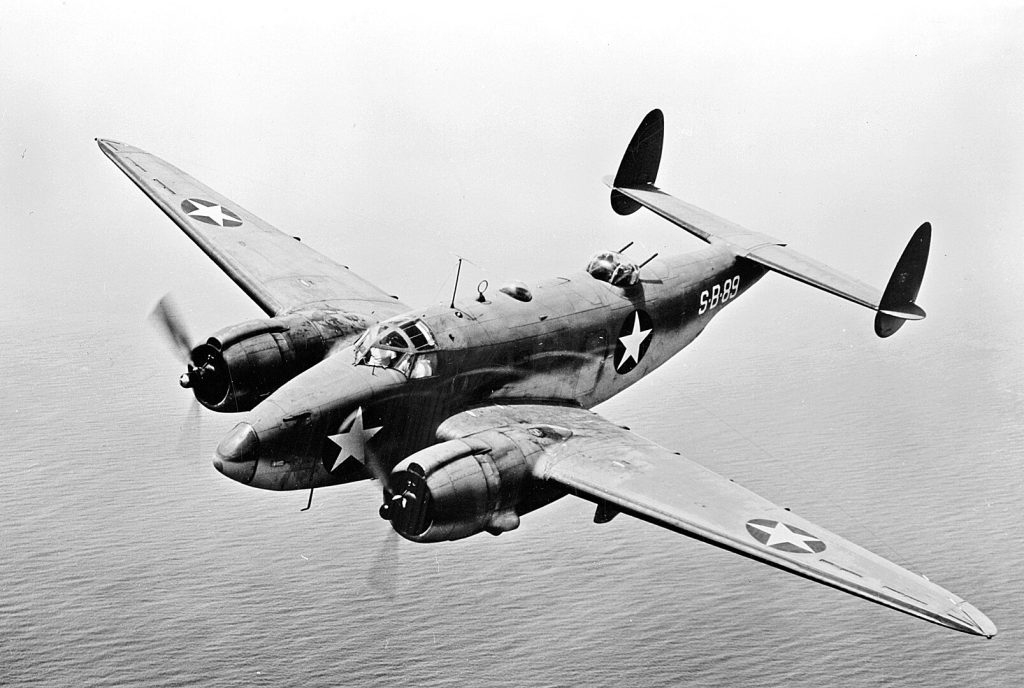
A common misperception about the Pacific Air War is that the Japanese home islands weren’t attacked from the air after the Doolittle Raid in April 1942 until B-29s made their initial raid on June 15, 1944. But Aleutian-based PV-1 Venturas had been bombing the Kuriles since March 25, 1944, usually at low altitude and against healthy fighter and anti-aircraft defenses. It was an unforgiving mission across 750 miles of frigid open ocean each way, where bailing out meant almost certain death. The best option if a PV-1 was damaged over the target was a diversion to the Soviet Union, where the plane and crew would be interned for the duration, since the USSR and the Empire of Japan were not officially at war.

Lockheed’s series of twin-engine aircraft was state-of-the-art in the late 1930s. The Lockheed Model 10 Electra became the choice of pioneers like Amelia Earhart; the Model 12 Electra Junior became a favorite of corporate users and was used for espionage over the prewar Third Reich. The Model 14 Super Electra is perhaps best known as the plane that brought Neville Chamberlain to and from the signing of the Munich Agreement in September 1938, but it was also the choice of Howard Hughes for his flight around the world earlier that year.
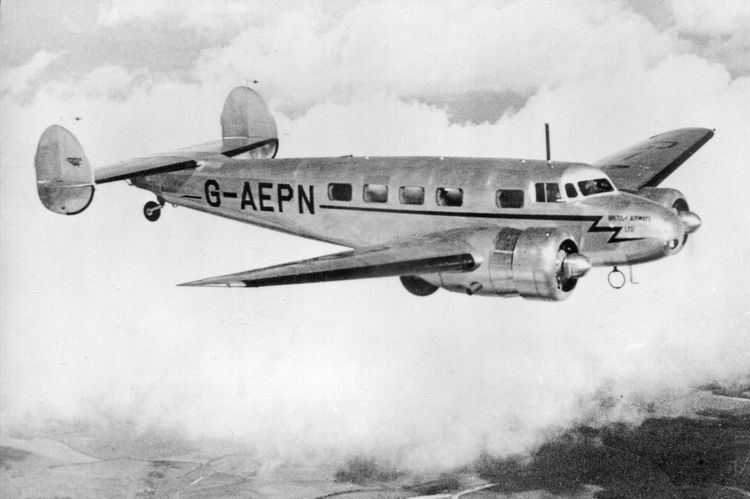
The British Purchasing Commission took notice of the Model 14 after Lockheed circulated drawings of a conversion of the Super Electra into a light bomber. In 1938, the commission ordered 200 aircraft, which were dubbed the Hudson. Nearly 3,000 Hudsons of various marks were built; although they suffered badly in the bomber role, they filled an important niche as patrol planes with Commonwealth nations. The Model 14 begat the Model 18, also known as the Lodestar. Developed as a competitor to the DC-3, only 115 were built as airliners, and many American Lodestars were impressed at the start of World War II as the C-56. New-build aircraft were purchased by the USAAF as the C-60 and by the Navy as the R5O. Based on its success with the Hudson, Lockheed proposed further development of the Model 18. The new aircraft would be slightly larger and heavier, but it would also boast new engines. Instead of the Hudson’s 1,100-hp Wright R-1820 engines, the new aircraft would boast two Pratt & Whitney R-2800 engines, each providing 2,000 hp. It could carry twice the bomb load of the Hudson and was 50 mph faster. In recognition of its construction in Southern California at Lockheed’s Vega subsidiary, it was named the Ventura.

The RAF initially tried to use the Ventura in the same role in which the Hudson had failed. As a low-level medium bomber, the Ventura entered combat on November 3, 1942, flying in the same role as Boston and Mosquito bombers. Vulnerable to German fighters and flak at low altitude, the Ventura’s RAF reputation was poor. One disastrous mission, on May 3, 1943, saw the Venturas miss their rendezvous with their fighter escort, resulting in 11 of the 12-aircraft force being shot down by German fighters. The Ventura flew its last RAF bombing mission on Sept. 9, 1943, less than a year after its introduction. Many were passed on to Coastal Command, and the type saw patrol service in the Mediterranean.

In the U.S. Navy, the Ventura had a very different war. Officially named the PV-1 (for Patrol, Lockheed), its long range—1,660 miles with a normal fuel load—was an advantage, allowing it to patrol vast stretches of ocean. It provided an effective weapon against German U-boats in the Mediterranean, South Atlantic, and Caribbean, and it was employed by the Marine Corps as a night fighter with limited success in the central Pacific. Navy and Marine crews found it a potent weapon against Japanese shipping starting in August 1943. Its two nose-mounted .50-caliber machine guns were augmented in 1944 by a chin package of three more .50s, making it a dangerous strafer, and it could carry 3,000 pounds of bombs internally. Late in 1944, rocket rails were added to the wings for five-inch high-velocity aircraft rockets (HVARs), giving it an even more lethal punch. PV-1 units hopscotched across the Pacific from Guadalcanal to Iwo Jima. In August 1945, a VPB-152 Ventura was the first to report survivors in the water from the cruiser USS Indianapolis, triggering the rescue that saved 316. One theater in particular was suited to the Ventura’s long range: the Aleutians. This barren chain of islands contained Attu and Kiska, which were captured by the Japanese in 1942. Army Air Force and Navy units were used to keep the pressure on the Japanese and cut their supply lines, and the Ventura seemed like a natural for the job. The first U.S. Navy squadron in action with the Ventura was VB-135, which began flying missions from Adak, Alaska, on April 12, 1943. They were soon joined by VB-136, and the two squadrons moved to Amchitka, where they flew anti-submarine and photo-reconnaissance missions over Japanese-held Kiska. The radar-equipped PV-1s were at times used to direct USAAF B-24s on raids on Attu and Kiska as a means of coping with the frequently terrible weather.
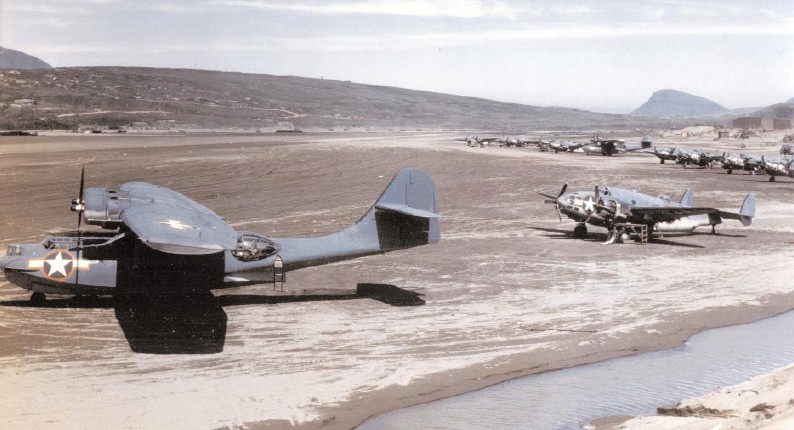
In May 1943, the Japanese were expelled from Attu in a quick but bloody battle, and the Japanese evacuated Kiska. VB-135 moved to Attu in August, followed by VB-136 in October, putting them within 1,500 miles of the Japanese homeland. This proximity raised a question for Allied planners: Would an invasion of Japan from the north through Japan’s Kurile Islands be less costly and quicker than an invasion from the heavily defended and populated south of the country? The first step toward determining that was to learn how well fortified the Kuriles were. The two squadrons began flying night missions over the Kuriles in November 1943, something the airmen called the “Empire Express.” “Our results were only so-so,” said Lewis “Pat” Patteson, a pilot with VB-135. “On these ‘photoflash’ missions, we’d dash in and the crew would hand-drop 30-pound magnesium flash bombs—one man would hold the bomb and the other man would set the timer and pull the safety pin—all while we might be dodging anti-aircraft fire. These one-million-candlepower bombs would go off, and a sensor would trip the cameras. The results were rarely helpful; clouds could obscure the targets, and Japanese searchlights could trip the cameras as easily as the flash bombs.”
Even after VB-136 was relieved by VB-139 in December 1943, night raids and reconnaissance continued, often in the face of weather that would have grounded aircraft in other theaters of war. Flying to the Kuriles meant stripping some of the armor and fitting 280-gallon tanks in the rear of the bomb bay. The added weight made the Ventura, already a difficult single-engine plane, a genuine handful to fly. On March 24, VB-139 launched a five-plane attack against the island of Paramushiro. One plane crashed on takeoff, killing four of the seven on board. Near the target, another plane’s crew became disoriented in the weather and crashed into the Mutnovsky volcano on Kamchatka. The wreck and its six-man crew remained undiscovered until 1962. The night work continued for the Venturas through April and May, and so did the losses. VB-135 lost the Ventura flown by Lt. A. A. Wheat over the Kuriles on May 6 during a raid on the airfield at Kashiwabara, and two other PV-1s and their crews vanished during the month.
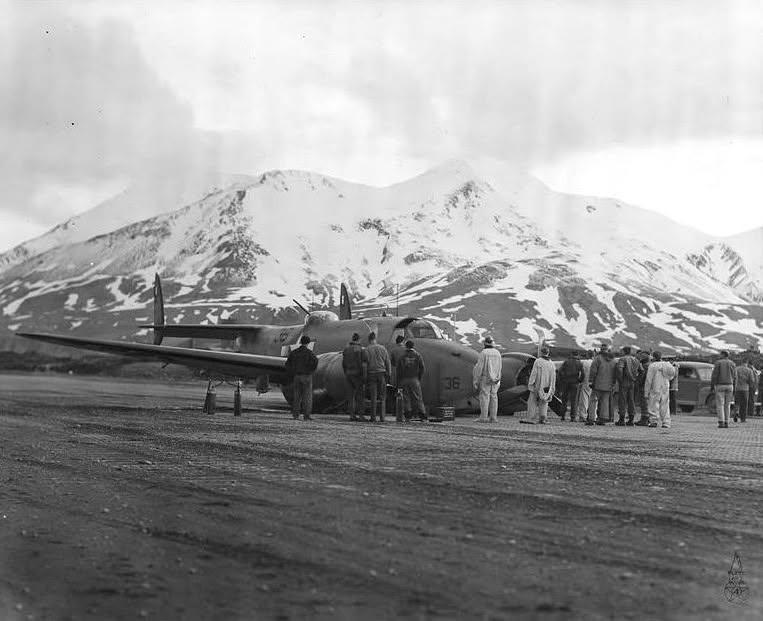
In the early morning of June 10, 1944, Lt. John Vivian of VB-135 was flying a weather mission near the Kuriles—an important task that helped all Allied forces in the Aleutian Theater predict conditions for the next few days. He had an impulse to sneak in and photograph a new airstrip on Shimushu Island with the benefit of daylight. Vivian radioed for permission, and before he heard back, he zoomed in, photographed the strip from 7,000 feet, and dashed out. “Only then did he get the OK over the radio!” said Patteson. “The results were fantastic—you could see 22 twin-engine G4M ‘Betty’ bombers on the field, loaded with torpedoes, and other details of the installation.” The squadron followed up with a six-plane attack that night that started secondary fires among the G4Ms. This success prompted VB-135 to plan a mission to photograph the entirety of Shimushu and Paramushiro in the early morning daylight. Six of the Venturas would carry bombs and act as a diversionary force. “My Ventura was equipped with five fixed cameras and a couple of hand-held K20 cameras, and our job was to photograph as much of the islands of Shimushu and Paramashiro as we could,” said Patteson. Patteson was the last of the seven planes to take off and was wheels-up at 0100 on June 14, 1944. “The flight to the target took over four hours,” Patteson said. “The trip was dull, dark, cold and noisy. No one relaxed.” Lt. Vivian dumped his 500-pound bombs on Miyoshino Airfield before heading north and dropping his incendiaries on Kataoka Airfield. Lt. James Mabus was headed for Kataoka Airfield but spotted six Japanese fighters—probably A6M3s—and made a 90-degree turn to the south to attack Miyoshino Airfield instead. He salvoed his entire load while the flak probed for him. Two fighters chased him for 100 miles before giving up on the Ventura, which had been hit by 12.7mm and 20mm fire and flak fragments.

Flying with Mabus was Lt. Howard Schuette, who was not so lucky. His Ventura developed an oil leak, and one of his fuel tanks was punctured by fire from the Zeros and drained of fuel. Schuette had no way to get back to Attu, so he instead landed in Petropavlovsk, where his crew was interned by the Soviets. Lt. William Sparks and Lt. Ray Clapham bombed Miyoshino, where they spotted at least 13 A6M3s, three of which cut in behind Sparks’ Ventura. One made a high-side approach from above and ahead, and Sparks turned to port to throw off his aim and put distance between himself and the three other fighters. Clapham dropped all his bombs on the airfield, turned the Ventura west, put it into a shallow dive, and hightailed it out of the area at 280 knots and 800 feet. The PV-1 flown by Lt. Russell Bone was seen to be in trouble over the Paramushiro Strait, flying erratically under heavy anti-aircraft fire. A direct hit knocked out one of his engines. Bone nursed his plane to Yelizovo Airfield in the Soviet Union and landed safely.

Last to come was Patteson’s photo plane. As the sun was rising, “the weather was perfect, and at 11,000 feet I could see the activity below,” said Patteson. “We began our photo run from Shimushu, headed south from Point Lopatka, and headed for Miyoshino. Everyone was on the lookout for bogies. Sure enough, about that time six of them appeared behind us at our level. Three of them broke off; not having bombs gave us even more of a speed advantage.” Patteson sped south across the islands. The crew turned the cameras off after each target to save film, then flipped them back on at the next. “Over Kashiwabara airfield, the crew shouted they saw planes taking off below us,” said Patteson. “Our next target, Kakumbetsu Airfield, was 40 miles south, and on the way there the Zeros started to catch us.” When the Zeros got too close, “I yelled for AO2c Floyd Jacobsen (the turret gunner) to open fire, and the sound of the .50s banging away drowned out the engine noise for a moment. The Japanese had a healthy respect for the twin .50s and quickly veered out of the way, instead climbing to make high-side attacks from 4 o’clock and 8 o’clock.” Navigator Lt. Dick Rice had his head in the astrodome, watching the fighters’ approach. “When a Zero started his run, Dick would warn me and I would cut into the direction of the fighter’s pass, shortening his angle,” said Patteson. “All their fire went behind us. I started to think we had an edge on them.” The PV-1 was traveling flat-out now as they approached another target, Kurabu Zaki. “I saw several more fighters coming up at us from the front and sides,” Patteson said. “One of them tried a high-side approach from 10 o’clock; there was much shouting and shooting as Jacobsen gave him a long burst and hit him, though I couldn’t see any damage. Another one of these fellows tried the same approach but passed beneath us, then pulled up in front of our nose, and I gave him a squirt with the nose-mounted .50s—I didn’t notice any damage, but I think I got his attention.”

The control wheel jerked slightly as a Zero’s fire hit the PV-1’s right aileron, but then the fighters pulled away as the batteries at Kurabu Zaki opened fire. “Their first bursts were at our altitude but well behind us, but they started correcting quickly,” said Patteson. “I began jinking and realized we were getting low on film. We managed to get an oblique shot of Kurabu Zaki, our last target, and headed out over the ocean at 8,000 feet, with the Zeros back on our tail.” With Jacobsen squeezing off short bursts to discourage the Zeros, Patteson put the Ventura into a shallow dive through some patches of fog. “When I reached the deck, I firewalled the engines, leaving them behind,” he said. “On the way back, we were jubilant—we sent a coded message of ‘mission successful,’ and then the crew threatened the photographer’s mate with bodily harm if the cameras had jammed! They did not—we brought home 318 photos of seven airfields, while the rest of the squadron added 54 more images that would help us plan future operations.” The crew was happy with the outcome, but the ground crews were less so—running the R-2800s flat-out for so long meant the PV-1’s engines both had to be replaced after the mission.

On June 17, VB-136 returned to the theater with upgraded PV-1s equipped with Long-Range Navigation (LORAN) and a chin package with three additional .50-caliber guns. Raids continued with increased aggressiveness; on July 23, Lt. Vivian of VB-135 strafed and sank an armed picket boat off the coast but suffered damage in the attack that forced him to seek an emergency landing in the USSR. A week later, VB-135 was back over the Kuriles, with Patteson again at the controls of the photo plane. The Japanese had continued to reinforce the islands’ defenses, and this time Patteson was jumped by 11 fighters. Turret gunner Jacobsen shot down one of the intercepting fighters and damaged a second. “I was kind of scared at first,” Jacobsen said. “This Jap was flying right along beside us, maybe 1,000 or 1,500 feet away. I was on the turret gun, and I could see my tracers spraying all over him. He was shooting at us, but he only got us once—the bullet is still in the tail. Finally, he rolled over, trailing smoke, and went through the overcast. We were so low that it’s a cinch he never pulled out.”

On July 23, Patteson flew the weather hop, “but he was so anxious for action that he usually turned the weather hop into a mission,” said Lt. Marion Mason, VB-135’s executive officer. “When the target area was fog-bound, Patteson spotted a field that hadn’t shown up in previous pictures and went down for photographs. When he finished with these, he bombed and strafed the field from low altitude, then turned back for another run. He brought in some really low-level photography.” Six Japanese fighters attempted to catch Patteson, but he again outran them. Lt. John W. Pool’s PV-1 was also jumped by fighters, and a 20mm round cut a hydraulic line. The Ventura brought the crew back to Attu with enough fluid to lower the landing gear, but not enough to get the flaps down. Machinist’s Mate Charles Scott suggested pouring any of the crew’s remaining coffee and orange juice into the hydraulic reservoir, and sure enough, the flaps lowered sufficiently for a safe landing.

Missions to harass the Kuriles continued through September, when a VB-136 Ventura shot down a Ki-44. But on Sept. 17, the commanding officer of VB-136, LCDR Charles Wayne, was hit over Paramushiro and had to force-land in the USSR. Fleet Air Wing 4 commander Commodore Leslie Gerhes put the missions on pause for several weeks while awaiting the arrival of VPB-131 with an even punchier PV-1. VPB-131 brought north new Venturas equipped with ASD radar and rails for five-inch HVAR rockets, giving the plane even more destructive potential. The new squadron’s first mission was as a diversionary force ahead of a strike on Karabu Zaki by 11th Air Force B-24s. The diversion worked, perhaps a little too well—while the Liberators were free to plaster their target, the PV-1s were swarmed by six fighters. In a running battle, one PV-1 was lost with its crew, while another Ventura crew claimed a fighter destroyed.

After two months of anti-shipping and night-reconnaissance missions, the squadron flew to Adak for the installation of rocket rails in early January 1945. On Jan. 25, VPB-131 CO LCDR Rolland Hastreiter led four PV-1s on an attack against a lighthouse and radio facility at Kututon Zaki, bringing the Venturas in at low level. Hastreiter loosed his eight rockets at 1,000 feet and pulverized the base of the lighthouse, while the other Venturas hit the radio towers and the station itself. The rockets were such effective weapons that VPB-131 never carried bombs during its tour; this lightened the Venturas and made them safer on takeoff. On Jan. 27, Hastreiter led another four-plane flight to Kurabu Zaki, where his planes hit a radar station. On the way out, the CO spotted a column of Japanese troops and strafed them with the five .50-caliber machine guns in the nose. The plane following Hastreiter finished off the radar station but clipped the top of the hill behind it with its wing; miraculously, the damaged Ventura was able to complete the flight home. Further missions attacked fisheries, canneries, and other installations as it became clear that Japanese military activities in the Kuriles were dwindling in preparation for the coming invasion of Kyushu in the south.

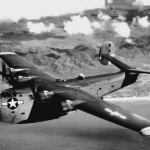
Missions continued to harass the Japanese, and so did losses. On Feb. 20, one plane was damaged by its own rockets, and the crew bailed out over Kamchatka, safe but in Soviet captivity. Another PV-1 was lost on April 24 during landing when a 60 mph gust of wind from behind caused the aircraft to stall while turning for final approach. All six men aboard were lost when the plane crashed into Casco Bay. In March, VPB-139 returned to the theater to relieve VP-136, this time in the improved PV-2 Harpoon. The Harpoon had a larger fuselage, a larger tail, and greater fuel capacity, and its bomb load was increased by 50 percent. The Harpoon’s entry into combat was delayed until April by extended training. The Harpoons made a rocket attack against Kotukan Zaki on April 6 but were grounded later that month because of issues with the planes’ wing spars, which led to a limitation on maneuvers that meant the Harpoon could only be used in areas where fighter opposition was not expected and weather conditions were favorable.

Japanese opposition was significantly less than during the summer of 1944, but it could still be ferocious. On May 10, eight VPB-139 PV-2s attacked a radar station at Minami Zaki, and three of the planes were damaged by anti-aircraft fire. A month later, two PV-2s were attacked by a Ki-43 during a mission against a fishing facility on Masugawa, but after a single halfhearted pass, the Ki-43 pulled into the clouds and was not seen again. Missions against radar installations, fishing assets, and canneries continued through July; in August, VPB-135 returned with its own PV-2s and relieved VPB-139. But by now, there were few worthwhile targets, and VPB-135 flew only a single mission to the Kuriles before V-J Day. Navy PV-1 and PV-2 units lost 34 aircraft during their war in the Aleutians, as many to accidents as to enemy action. Eleven of them wound up in the Soviet Union, which repaired a few and used them locally in Soviet markings. After the war, the Harpoon was provided to many Allied air forces, including those of Brazil, the Netherlands, and, ironically, Japan, while its role with the U.S. Navy was largely taken over by the four-engine PB4Y-2 Privateer. It soldiered on in the reserves, but its time was drawing to a close—as was the lineage of Lockheed’s remarkable twin-engine series.









New Zealand used Lockheed Venturas during WW2, both down here, (in initial training,) and in the South West Pacific. Also with the RAF in the middle stages of the War. In fact, RAF 487 (NZ) Sqn. was the Squadron mentioned that suffered that heavy loss, it’s leader Sqn.Ldr. Trigg being awarded the Victoria Cross. (The Squadron went on to use De Havilland Mosquitoes to greater success afterwards. Their code letters “EG” are often seen on Mosquito model kits. Two other NZ Sqns also used Mosquitoes, RAF 488 (Night fighers) and RAF 489 (Coastal Command Strike Squadrons.) ~The Venturas patrol & mission activities in the South Pacific were busy, they went on to use Grumman Avengers until the end of the War ~