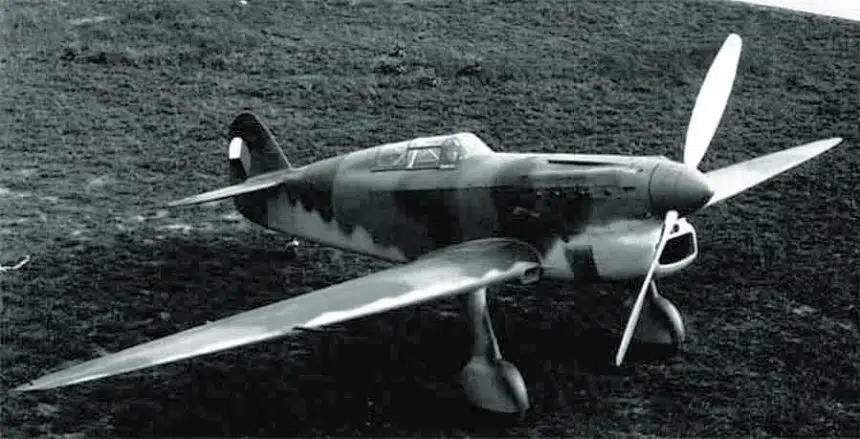

On this day in aviation history, 88 years ago (September 28, 1938), the Avia B.35 took flight for the first time. Designed by František Novotný, the Czechoslovak fighter represented an effort to replace the country’s aging Avia B-534 biplane fighters with a faster and more modern monoplane. Development of the B.35 began in response to a 1935 Czechoslovak Air Force requirement. The resulting aircraft was a streamlined low-wing monoplane featuring an elliptical wing. Its fuselage consisted of welded steel tubing, with metal covering around the forward fuselage and fabric aft of the cockpit, while the wing was constructed primarily from wood. To simplify development, the B.35/1 prototype retained fixed landing gear.

The first prototype demonstrated good handling and performance but had a brief career. On November 22, 1938, it was destroyed in a crash that killed test pilot Arnošt Kavalec. Two additional prototypes followed, with the B.35/3 receiving a redesigned wing and retractable landing gear. German occupation of Czechoslovakia interrupted plans for a ten-aircraft preproduction batch, although development eventually continued into the improved Avia B.135. The B.35/1 measured 27 feet 11 inches in length with a wingspan of 35 feet 7 inches and was powered by an 860-horsepower Hispano-Suiza 12Y-series V-12 engine. It could reach approximately 308 mph, had a range of 311 miles, and climbed at approximately 2,560 feet per minute. The prototype was intended to receive an engine-mounted cannon firing through the propeller hub, although the B.35/1 did not carry its intended armament during testing.