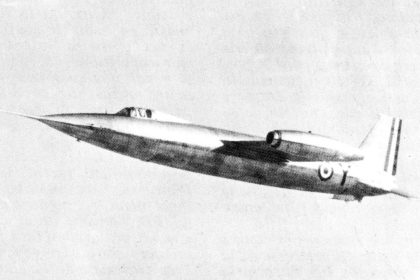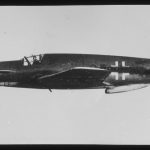
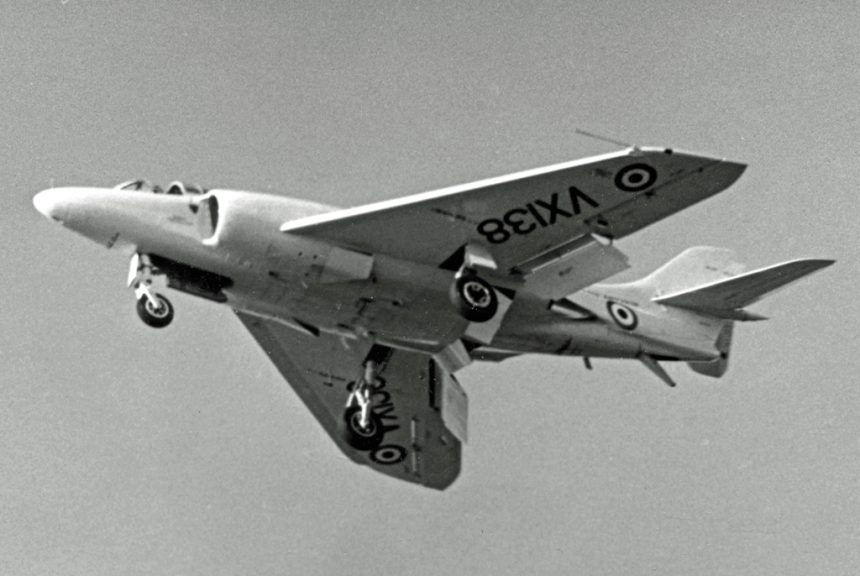


On this day in aviation history, 72 years ago (April 27, 1954), the Supermarine Type 525 took flight for the first time. The Type 525 was a British naval jet fighter prototype developed during the 1950s. Supermarine designed and built the 525 as a furtherance of the Type 508, which had been developed in response to Air Ministry specification N.9/47 in November 1947. This spec called for a carrier-borne interceptor that could handle recon and low-level nuclear strike duties. The Type 508 that was developed to satisfy N.9/47 would later be built to specification N.113D as the Type 544, which ultimately entered service as the Scimitar. The third Type 508 built, VX138, was modified by Supermarine while still on the assembly line. The aircraft was reworked to Scimitar standards and was redesignated as the Type 525. VX138 was transported by road to the Aeroplane and Armament Experimental Establishment (A&AEE) at Boscombe Down, Wiltshire. On April 27, 1954, Supermarine’s test pilot M.J. Lithgow took the Type 525 aloft for its first flight. The aircraft would make its first public appearance at the September 1954 Farnborough Airshow.
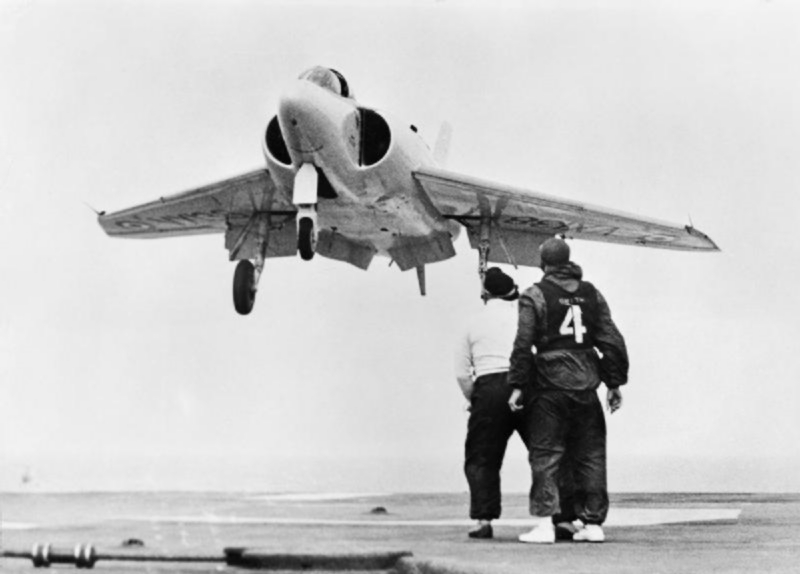
The Supermarine Type 525 was powered by two Rolls-Royce Avon R.A.3 turbojet engines, each with 6,500 pounds of thrust. The maximum attainable airspeed for the 525 was Mach 0.954, which is 647 mph. The aircraft had a service ceiling of 42,600 feet. Supermarine designed the 525 with conventional tail and rudder surfaces and swept wings. In early 1955, the aircraft had a flap blowing system installed to reduce the safe landing approach speed for carrier operations. This feature also lowered the catapult launch speed. These “super-circulation” flaps benefited from the Coandă effect, which took air from the wing’s trailing edge slot and bent the jet of air over the flaps. On July 5, 1955, the Type 525 was test flown for low-speed handling trials. At an altitude of 10,000 feet, the 525 entered an unrecoverable flat spin. Both the aircraft and the pilot were lost as a result. Supermarine took what was learned from the Type 525 and improved upon it, the first Type 544 Scimitar prototype flying on January 19, 1956.