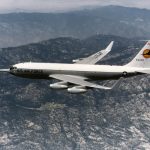
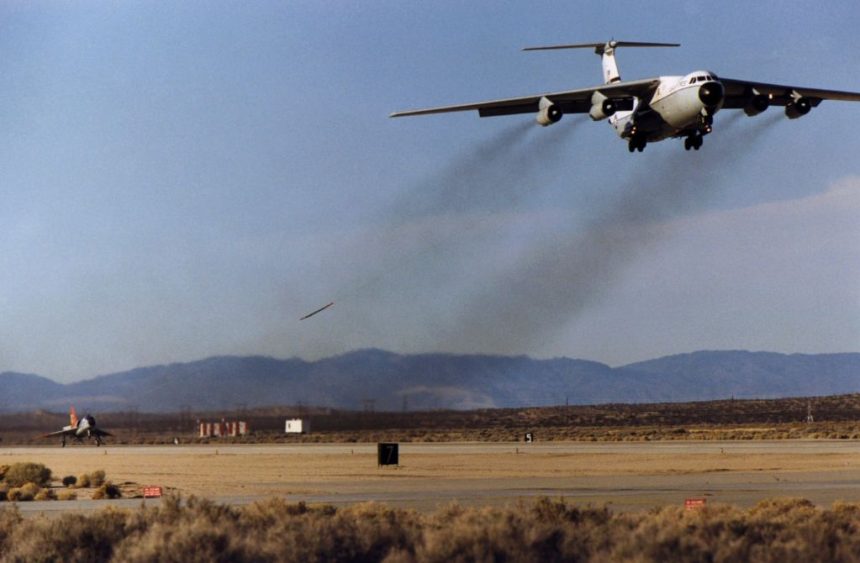

In the late 1950s, the US wanted to replace piston-engined cargo planes such as the C-124 Globemaster II because of their slow speed. As a result, the C-141 Starlifter was designed in 1960, with its first flight taking place in 1963. The aircraft deliveries, of a total order of 285, 284 for the US Air Force, and one for NASA, began in 1965. NASA used its C-141 as the Kuiper Airborne Observatory (KAO) from 1974 to 1995. It carried a 36-inch telescope at nearly 50,000 feet altitude to study the solar system, observe galaxies, and even examine the space shuttle’s heat shield in infrared light during its re-entry into Earth’s atmosphere. The KAO helped NASA engineers discover Pluto’s atmosphere, rings around Uranus, and complex organic molecules in space. In addition, it discovered a ring of star formation around the center of the Milky Way, and water in comets and in Jupiter’s atmosphere. In 1995, the KAO was decommissioned to develop a larger flying observatory with a more powerful infrared telescope.
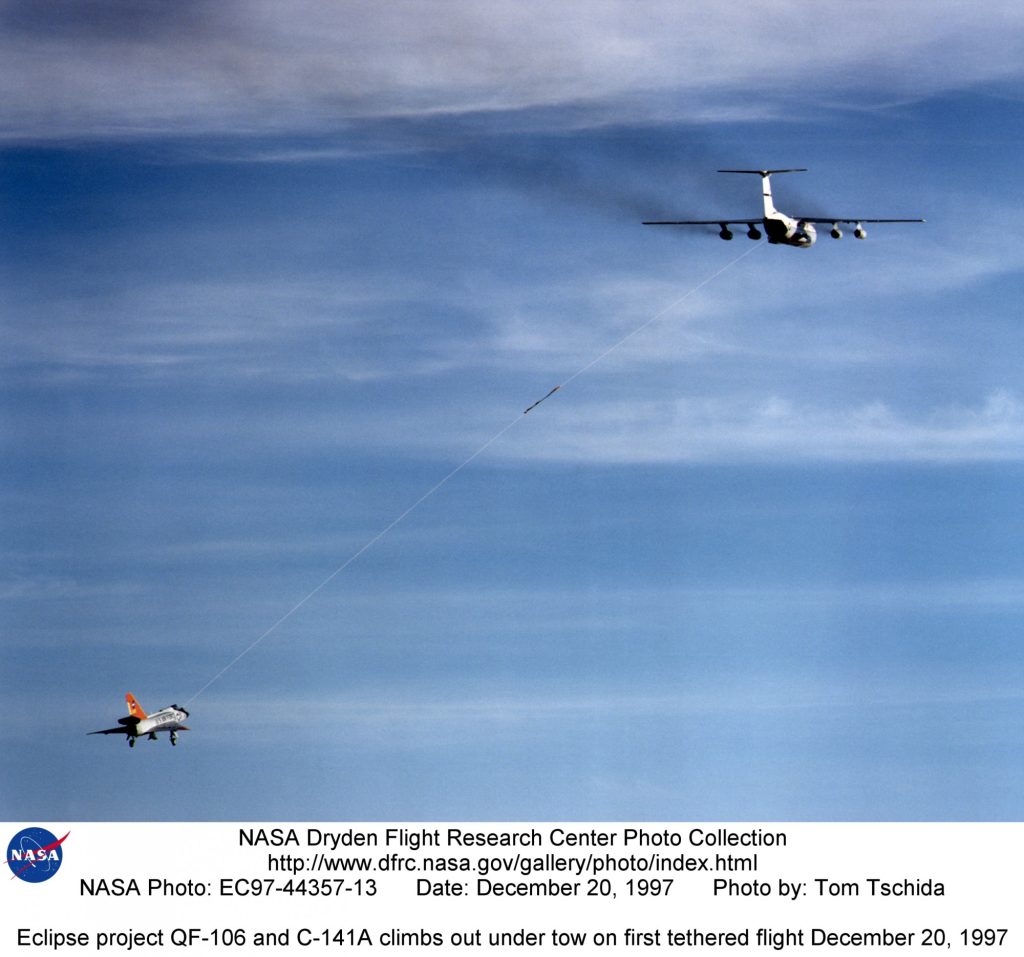
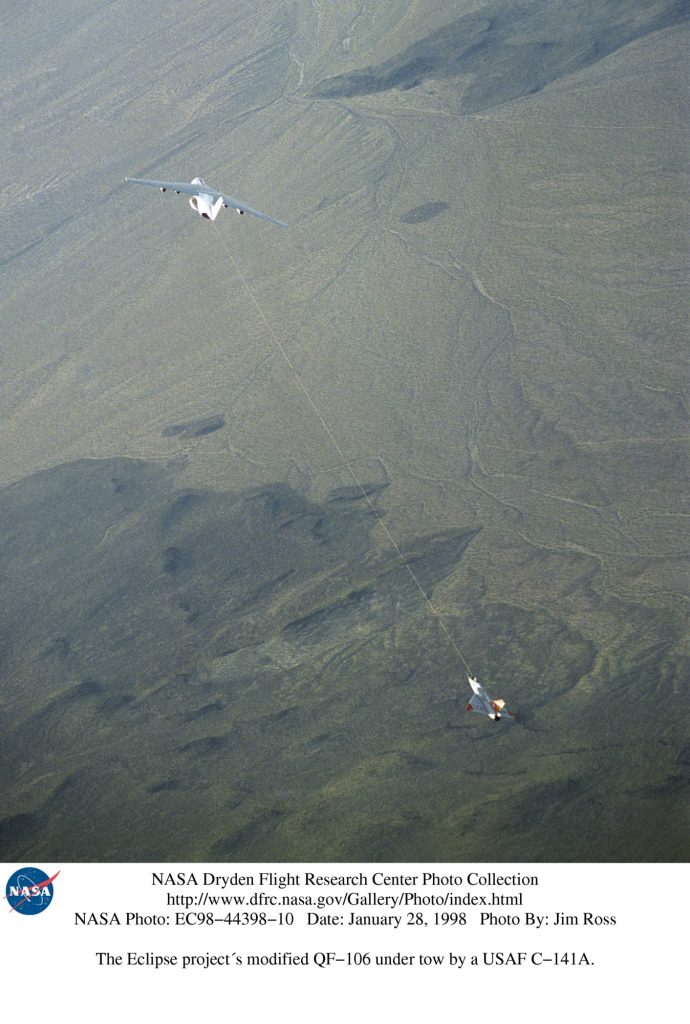
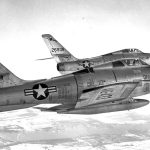
NASA’s Dryden Flight Research Center in Edwards, California, also used an updated C-141 model, known as the C-141A Starlifter, for Project Eclipse. In 1997 and 1998, NASA helped Kelly Space and Technology (KST) and the US Air Force explore the idea of a reusable tow-launch vehicle. The goal was to show that this tow-launch concept, invented and patented by KST, could work. KST received a contract from the US Air Force Research Laboratory for the tow launch demonstration project as part of the Small Business Innovation Research (SBIR) program. The US Air Force SBIR contract included the modification of a QF-106 into the Eclipse eXperimental Demonstrator-01 (EXD-01) and adding tow provisions into the C-141A Starlifter aircraft to connect the two planes. Both aircraft needed testing on the ground as well as in the air, and the main goal of the program was to successfully tow a modified QF-106 delta-wing aircraft in flight using a C-141A Starlifter transport aircraft from the Air Force.
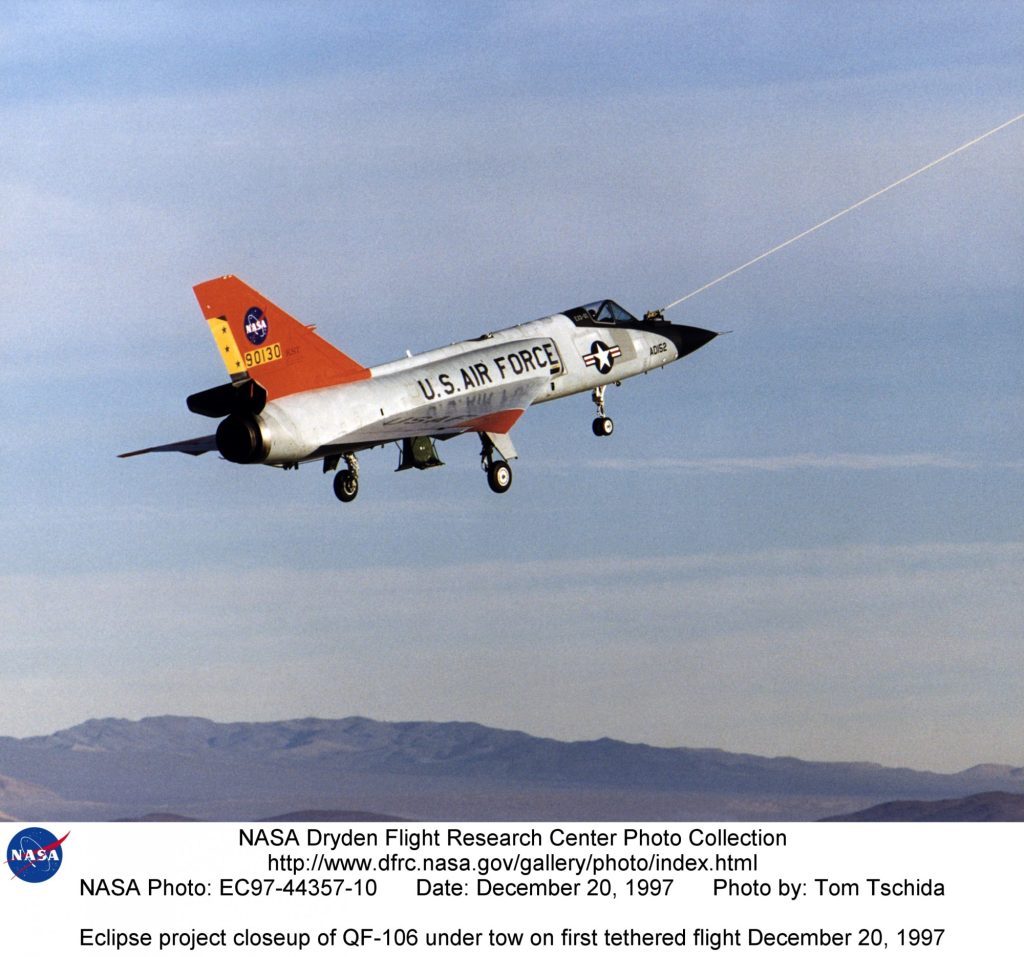
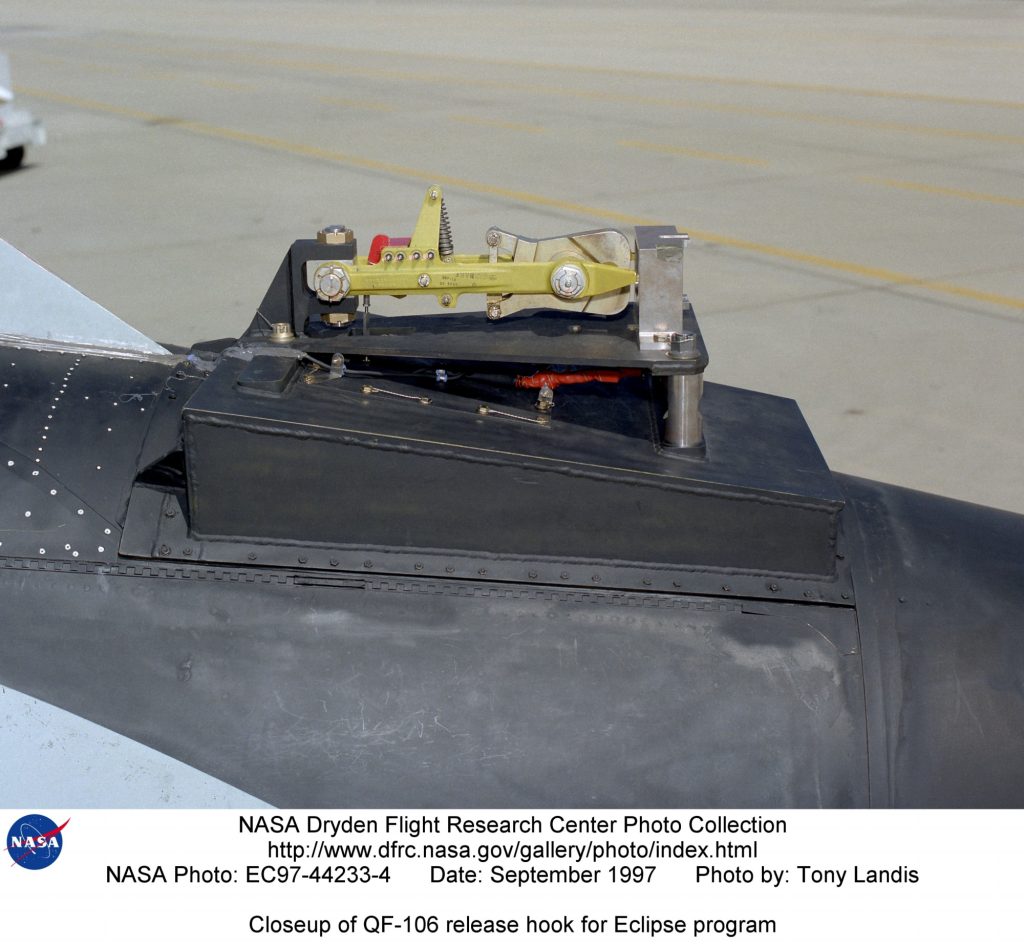
The program aimed to show that it is possible to tow and launch a real launch vehicle from behind a tow plane. Dryden managed the tests and ensured flight safety for the Eclipse project. The engineers provided engineering support, instruments, simulations, modifications, maintenance, range support, and research pilots for the testing program. The Air Force Flight Test Center (AFFTC) in Edwards, California, provided the C-141A Starlifter transport aircraft, its crew, and the necessary setup for the tests. The service also developed the design and analysis for the tow system and fabricated the hardware to modify the QF-106. Dryden completed the changes to turn the QF-106 drone into the piloted EXD-01 experimental aircraft. KST intended to use the data from the tests to develop a series of low-cost, reusable launch vehicles.
On February 6, 1998, the Eclipse project completed its sixth and final towed flight. Preliminary flight results indicated that the handling qualities of the QF-106 during towing were very stable. The actual measurements of tow rope tension matched the simulation predictions, and the tow rope’s aerodynamic features and flexibility were important to the towing system. Dryden’s high-fidelity simulation provided a representative model of the performance of the QF-106 and C-141A Starlifter airplanes in tow configuration. Overall, the project’s total time on tow was 5 hours, 34 minutes, and 29 seconds. All six flights were productive, and the project achieved all its goals. In the Flight Test Files series, the tests on C-141A Starlifter demonstrated the validity of towing a delta-wing aircraft having high wing loading. In addition, according to NASA, the tests validated “the tow simulation model, and demonstrated various operational procedures, such as ground processing of in-flight maneuvers and emergency abort scenarios.” Read more Flight Test Flights articles HERE.