






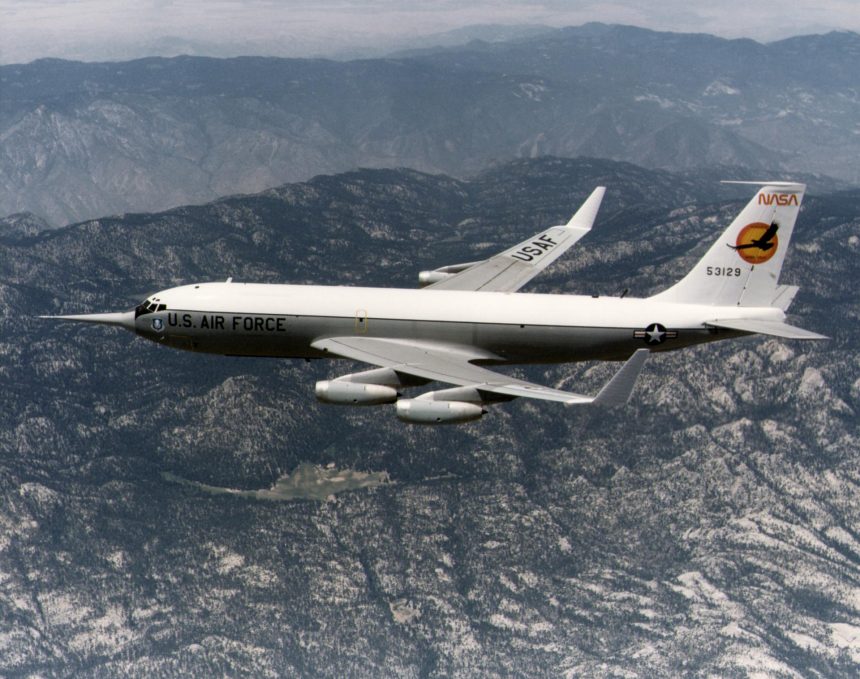

There are not many aircraft designed in the 1950s that are still in operation today. One such aircraft is the KC-135 Stratotanker, the US Air Force’s premier refueling tanker. First flew on August 31, 1956, the aircraft is currently a part of a joint US-Israeli military campaign launched on February 28, 2026, against Iran, called Operation Epic Fury. The KC-135 derives from the Boeing Model 367-80, which served as a prototype. The aircraft were initially powered by four CFM International CFM-56 turbofan engines, each producing 21,634 pounds of thrust, and are now powered by CFM International F108-CF-100 turbofan engines. The KC-135 Stratotanker is 136.3 feet long, 41.8 feet high, with a wingspan of 130.10 feet. It can fly at 50,000 feet with a range of 1,500 miles while carrying 150,000 pounds of fuel. Its maximum takeoff weight is 322,500 pounds, and it can carry 200,000 pounds of fuel. The US Air Force inducted 732 KC-135 Stratotankers till 1965, which served as tankers, reconnaissance aircraft, electronic surveillance aircraft, and airborne command posts. At the start of 2026, the Air Force had about 376 to 396 KC-135 Stratotankers. Since its first flight, the aircraft saw nearly every combat the US was involved in, including the Cold War, Vietnam War, Gulf Wars, supported operations in Kosovo, Iraq, and Afghanistan, and is a part of Operation Inherent Resolve against ISIS. Over its six decades of service, the KC-135 Stratotanker has refueled aircraft such as the B-52, F-16, F-22, F/A-18, F-4, F-8, and A-3, as well as AWACS and reconnaissance planes, among others. In addition to its primary military role as an in-flight refueling aircraft, the KC-135 Stratotanker was used by NASA Dryden Flight Research Center to conduct several research projects.
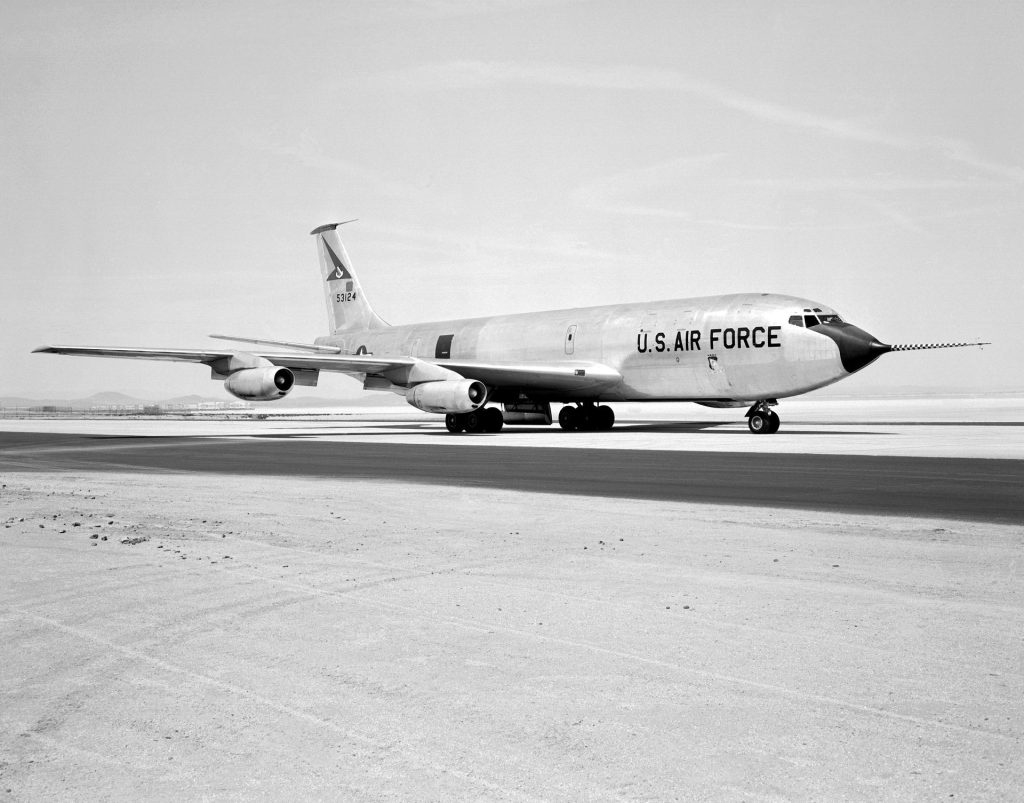
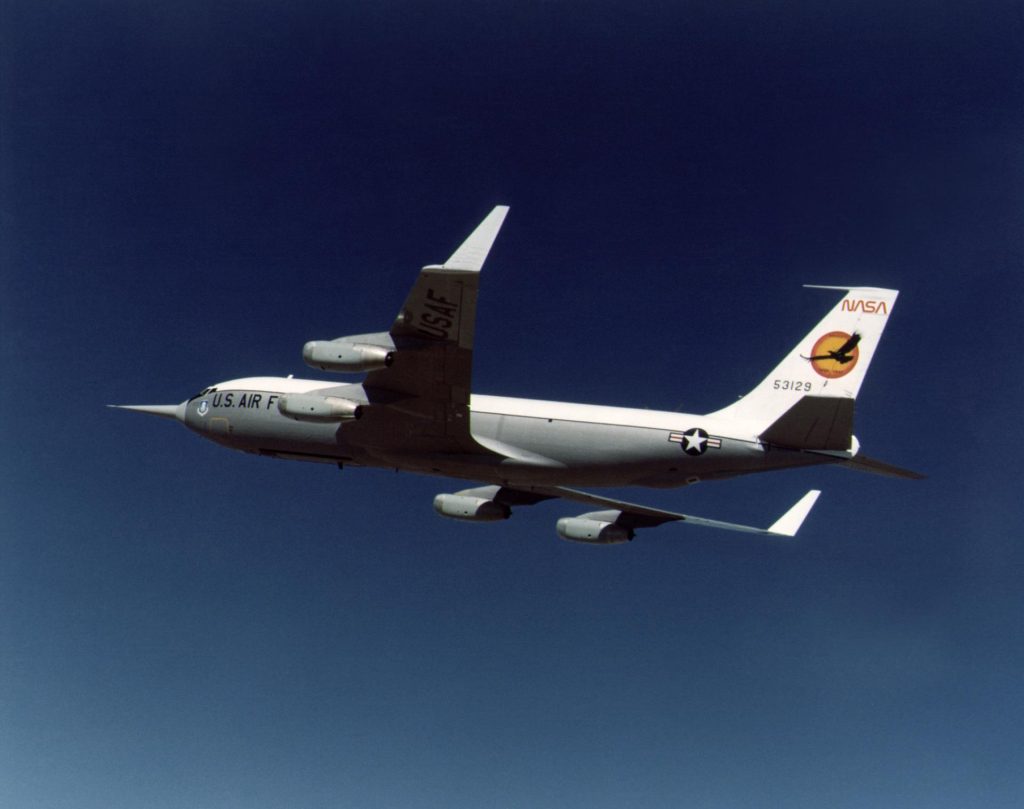
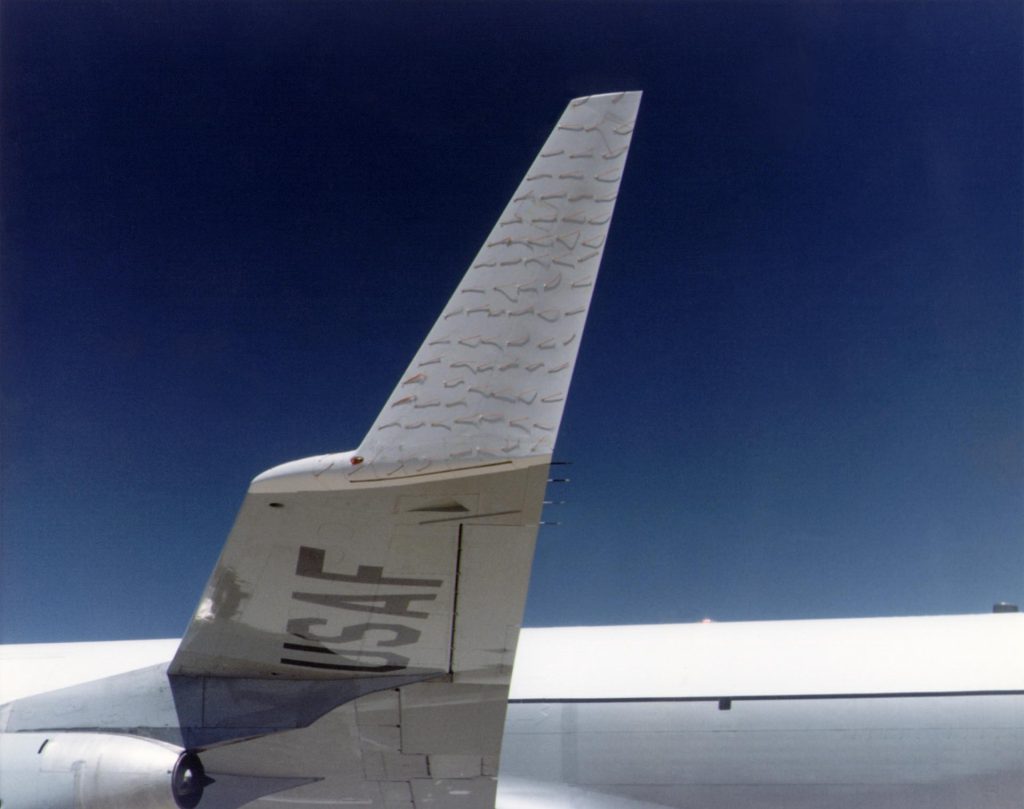
In 1957 and 1958, the Civil Aeronautics Administration (CAA), which later became part of the Federal Aviation Administration (FAA), asked Dryden to help establish new approach procedure guidelines on cloud-ceiling and visibility minimums for Boeing B-707. Dryden used a KC-135 Stratotanker to help CAA in these tests. In 1979 and 1980, Dryden was again involved with general aviation research with the KC-135. The researchers tested a special wingtip feature called a “winglet,” designed by Dr. Richard Whitcomb from Langley Research Center. Winglets are small, vertical fins added to the ends of airplane wings, and they help reduce drag by creating forward thrust from the swirling air at the wing tips. Dryden tested this winglet idea on a KC-135A tanker that the Air Force loaned to NASA. The research showed that the winglets could increase an aircraft’s range by as much as 7 percent at cruise speeds. The first use of NASA’s winglet technology in the industry was in business jets. Now, winglets are standard on most new commercial and military transport jets, including the Gulfstream III and IV, the Boeing 747-400 and MD-11 airliners, and the C-17 military transport. In the 1980s, a KC-135 helped with the Space Shuttle program. Since the Shuttle launched from Florida, researchers wanted to test how rain would affect its sensitive thermal tiles. The researchers mounted the tiles on special fixtures on an F-104 aircraft and a P-3 Orion. The F-104 flew in real rain conditions and also behind the KC-135 spray tanker as it released water. However, the KC-135 Stratotanker could not create enough rain impact damage, so it was removed from the tests. The KC-135 also worked as a reduced gravity aircraft for NASA for around three decades.
A Reduced-Gravity Aircraft allowed scientists to conduct experiments in microgravity. The plane flew in a curved path (parabolic, roller-coaster-like pattern) that created 2-g (twice the force of gravity) during the pullout and 0-g (weightlessness) for about 25 to 30 seconds at the peak. Researchers used the KC-135 Stratotanker to simulate microgravity to train astronauts and test equipment for spaceflight. Between 1973 and 2004, NASA’s KC-135 made 40 to 60 parabolic flights each day, four days a week. People who have experienced the sensation of floating often refer to the Reduced-Gravity Aircraft as the “Vomit Comet.” One of the KC-135As that served in this role reportedly completed more than 58,000 parabolas before retiring in 2004 and passing the duty to the C-9. In the Flight Test Files series, the KC-135 Stratotanker stands out not only as a refuelling legend but also as an aircraft that helped NASA to shape aviation as it is today by participating in several research programs. Read more Flight Test Files series articles HERE.
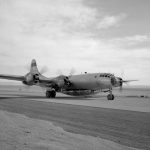









The first KC-135s were powered by Pratt & Whitney J57 jet engines. A few were re-engined with TF33 low-bypass turbofans as KC-135E models, but most of the fleet was re-engined starting in the 1980s with CFM56 engines (F108 in USAF service).