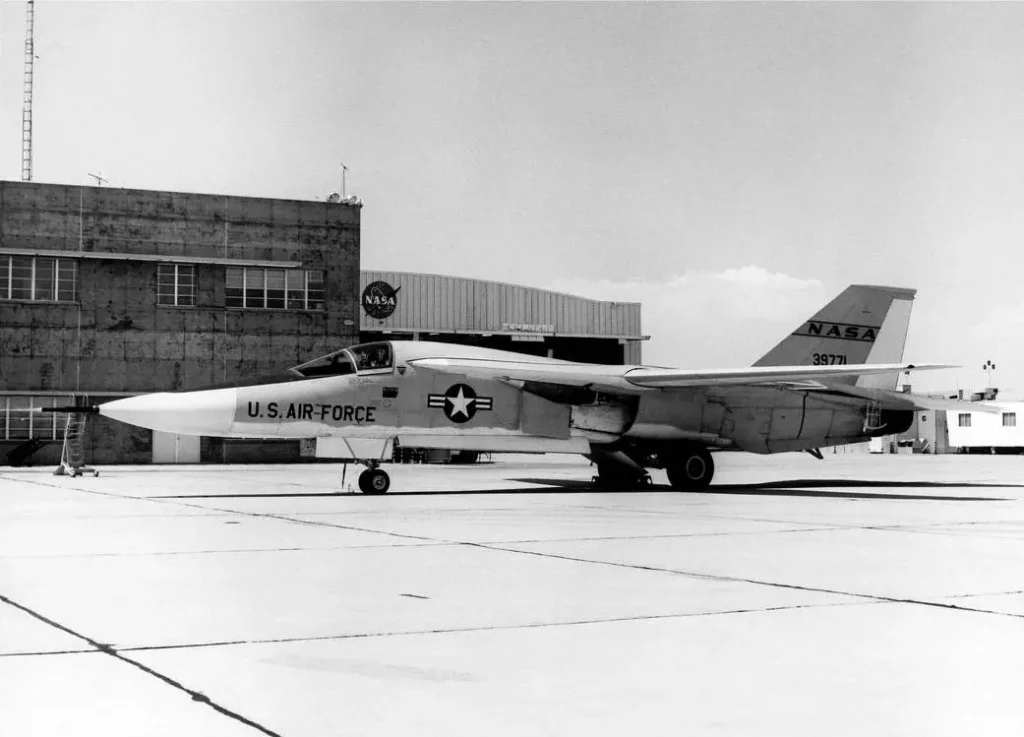
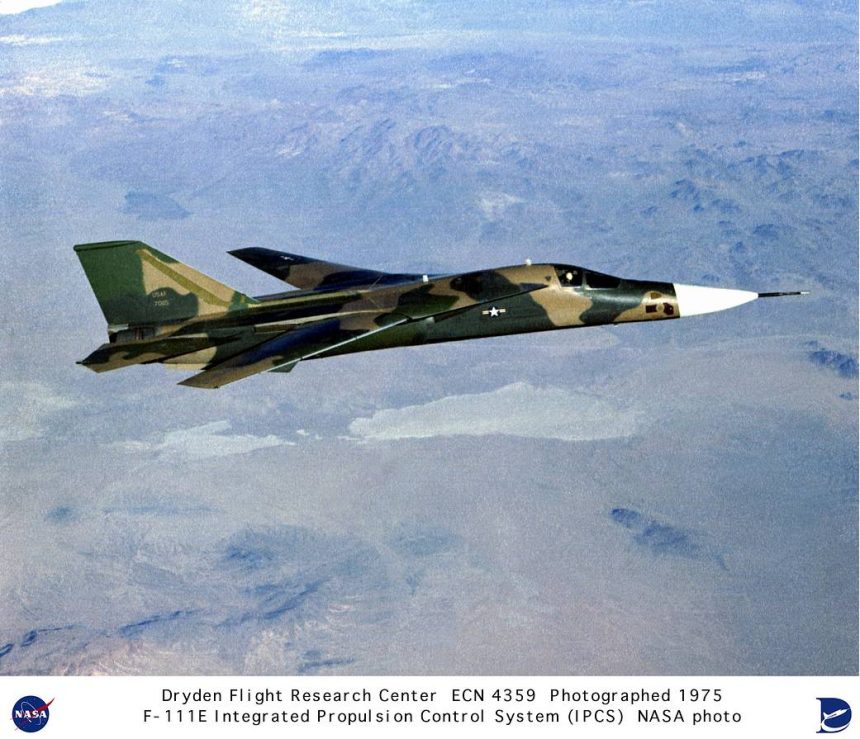

Between 1967 and 1990, NASA’s Flight Research Center, now known as the Armstrong Flight Research Center at Edwards Air Force Base, used six General Dynamics F-111 Aardvark aircraft for four research projects. The first tests began in the late 1960s, during which NASA worked on evaluating problems with the early F-111A model for the Air Force and Navy. From the early 1970s to the late 1980s, NASA conducted the second and third phases of testing with the F-111A. The second phase of testing, known as transonic aircraft technology, introduced a new supercritical wing that increased efficiency. The third phase, called Advanced Fighter Technology Integration, focused on advanced flight control technologies, using a technology called the Mission Adaptive Wing. The fourth effort involved an F-111E from 1973 to 1976, which tested an electronic control system, or fly-by-wire, instead of the traditional hydraulic-mechanical system. This program, named the integrated propulsion control system, helped confirm the concept of Digital Electronic Engine Control.
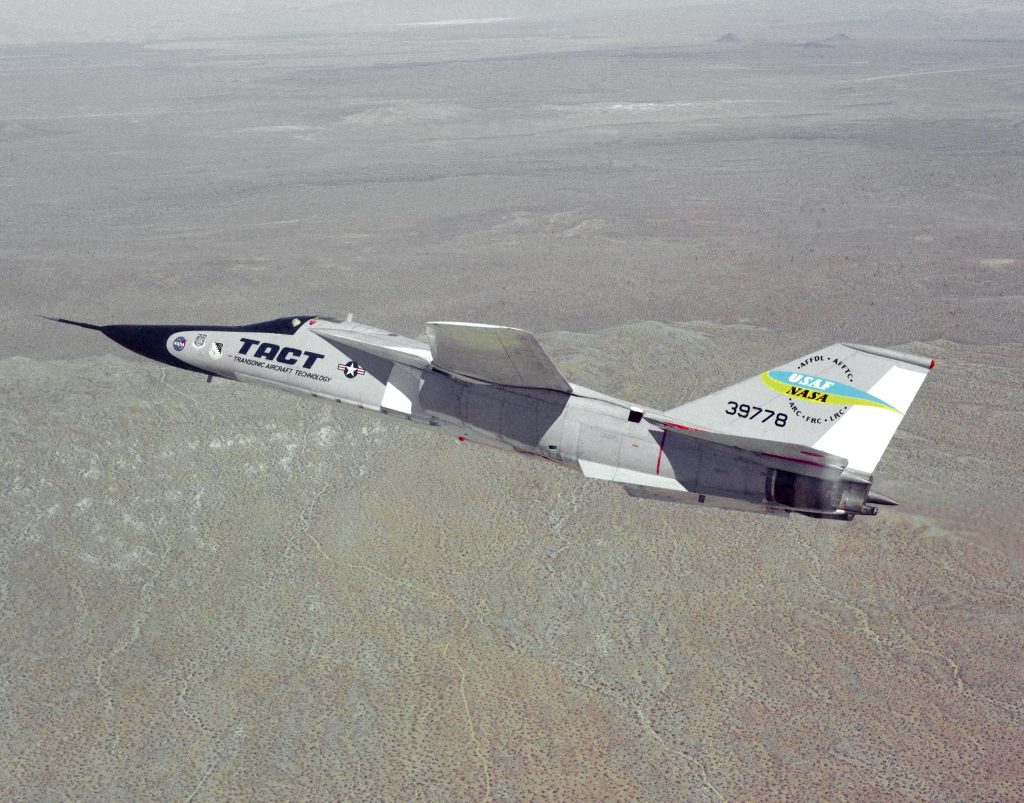
NASA received its first F-111 Aardvark in 1967 to evaluate early operational issues with the aircraft. The aircraft faced engine problems, such as compressor surges and stalls. NASA worked with the US Air Force and General Dynamics to study these issues. Through flight tests, the researchers redesigned the engine inlet system, improving airflow and reducing stalls. A second F-111A was received in 1969 and used for studies of the aircraft’s flight response. In 1971, the NASA Flight Research Center and the Air Force began a lengthy program that lasted nearly 20 years to research and test the F-111A aircraft. Interest in the NASA F-8 supercritical wing program led NASA and the Air Force to modify the F-111A to look at how supercritical wing technology could be used in military aircraft. By 1971, NASA and General Dynamics had spent over 1600 hours in wind tunnels on perfecting a suitable wing. Dr. Richard Whitcomb from NASA’s Langley Research Center designed the wing’s shape, twist, and airfoil coordinates. General Dynamics built the wing, and the Air Force Flight Dynamics Laboratory funded the program. Thus, NASA and the Air Force started the Transonic Aircraft Technology (TACT) program. Over the next few years, the TACT aircraft flew frequently on research flights. The supercritical wing improved the F-111A’s performance by delaying drag increases at transonic speeds and providing substantially more lift than a standard wing.
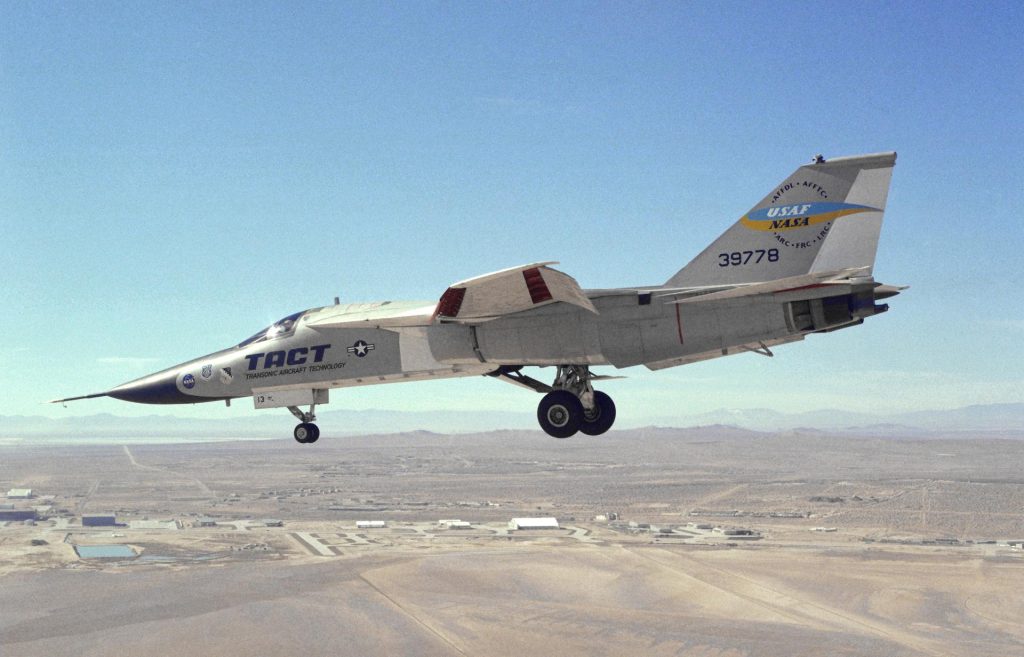
In parallel with the TACT program, NASA conducted a series of aerodynamic experiments to gather data. A base-drag experiment was conducted in which the researchers used different shapes in two base-pressure areas, including the fuselage closure between the engines and the aft end of the body-of-revolution above the vertical fin. During the F-111 Aardvark TACT program, NASA also tested an F-111E Aardvark aircraft at the NASA Flight Research Center to compare an electronically controlled hydro-mechanical engine with a conventional one. The program, called the integrated propulsion control system (IPCS), was a joint effort by NASA’s Lewis Research Center and Flight Research Center, the Air Force’s Flight Propulsion Laboratory, and the Boeing, Honeywell, and Pratt & Whitney companies. For this program, the left engine on the F-111E was modified to use an entirely electronic control system. A Pratt & Whitney TF30-P-9 engine was modified and ground-tested before installation into the F-111E. Under the IPCS program, 14 F-111E flights were conducted from 1975 to 1976, demonstrating that an engine could be controlled electronically, which led to the more efficient Digital Electronic Engine Control System used in the F-15.
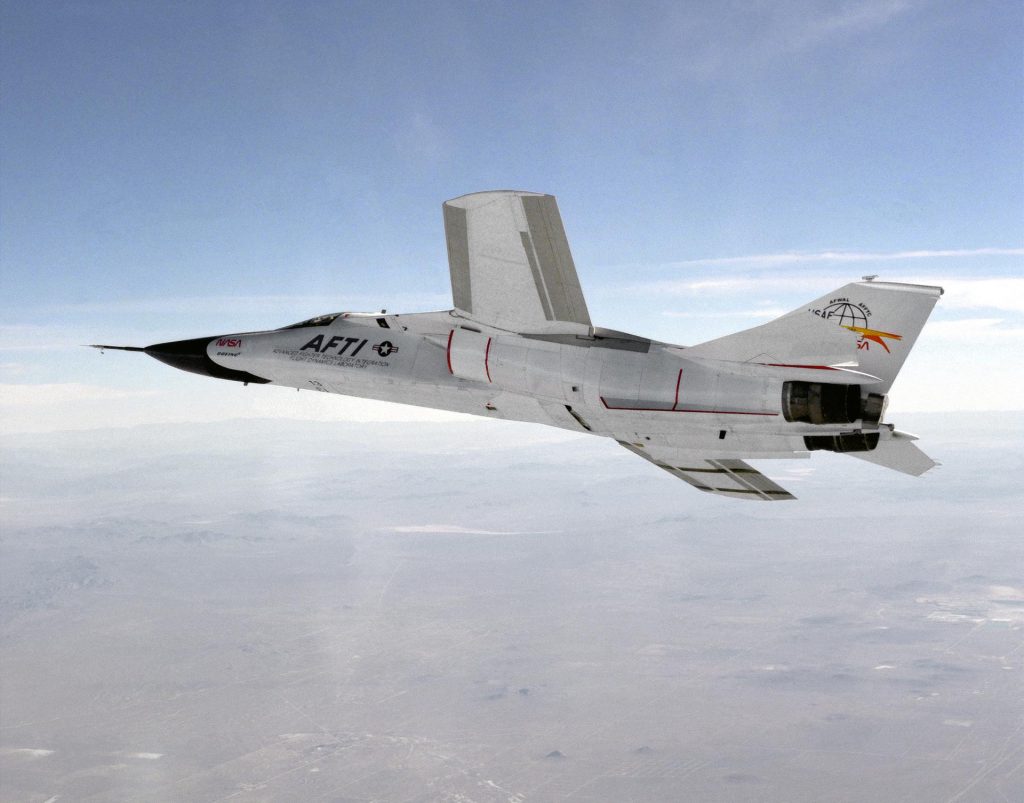
After the TACT program, NASA and the Air Force worked on a couple of programs using the F-111 Aardvark to improve wing performance. A joint experiment by NASA’s Dryden Flight Research Center and Langley Research Center examined natural laminar flow on the F-111A. NASA added two partial wing gloves to each wing, featuring pressure ports and boundary rakes on the right glove. A series of flights indicated that the airfoil installed on the partial glove improved natural laminar flow. In the early 1980s, NASA and the Air Force modified the F-111A under the Advanced Fighter Technology Integration (AFTI) program. The supercritical wing on the F-111A aircraft was replaced with a wing built by Boeing Aircraft Company, called a “mission adaptive wing” (MAW). This wing could change its shape to improve performance at different speeds. At subsonic speeds, it had an internal mechanism to flex the outer wing skin and produce a high camber section. The wing used a supercritical section at transonic speeds and a symmetrical section at supersonic speeds. The wing design had been improved by removing bumps from the leading edge and reducing the effects of the trailing edge flap. Using flexible wing skins created a smoother upper surface, making it more like a bird’s wing.
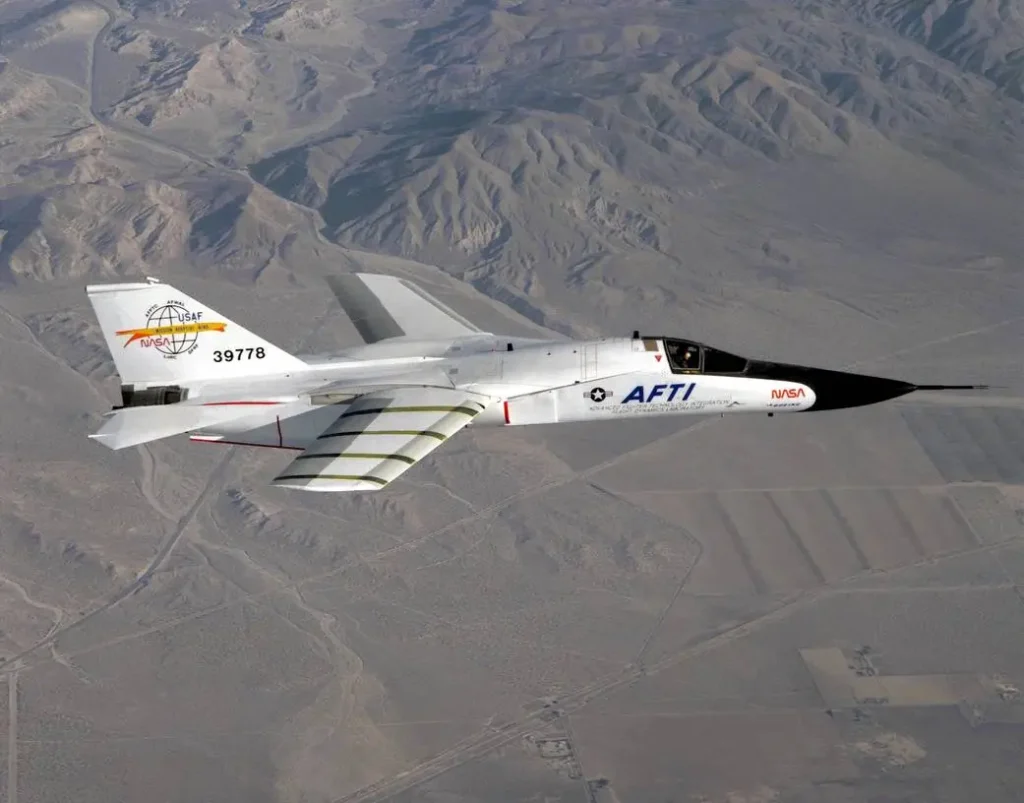
A digital flight control system, with four modes, automatically adjusted the wing geometry. One mode adjusted the wing shape to maximize aerodynamic efficiency during maneuvers. Another focused on maximizing speed at any altitude and power setting during cruising. The third helped the aircraft to handle higher loads safely. The system’s last mode worked to reduce the impact of gusts on the airplane’s ride quality. NASA flew the F-111 Aardvark with an MAW under the AFTI program 59 times between 1985 and 1988. The flight tests showed a drag reduction of about 7 percent at the design cruise condition and more than 20 percent at other conditions. The four automatic modes also showed satisfactory results. In the Flight Test Files series, the F-111 Aardvark was used to test various technologies over more than 2 decades, including improvements in inlet design, supercritical wings, studies on laminar flow, electronic engine controls, and adaptive wing structures. The results from these programs helped shape future aircraft designs and control systems, particularly in aerodynamics and propulsion. Read more Flight Test Files stories HERE.