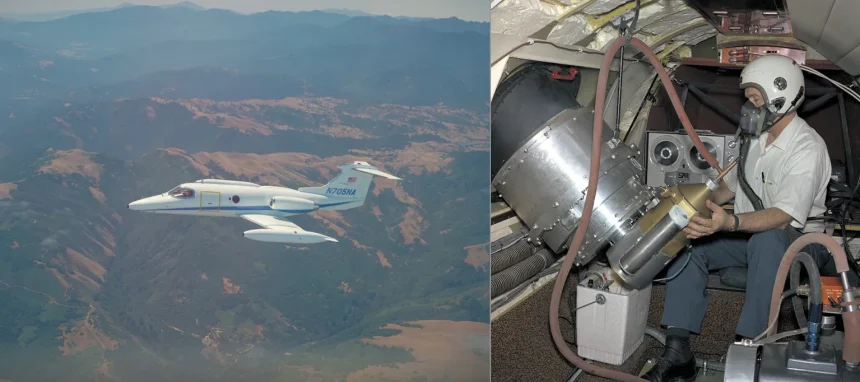

In the 1960s, NASA, which had a history of using airplanes to study space, wanted to learn more about the universe. At the time, ground-based telescopes were not powerful enough to provide an unobstructed view of space because water vapor in Earth’s atmosphere blocked certain wavelengths of light, such as infrared, from reaching them. As a result, NASA researchers planned to fly at high altitude with telescopes to avoid these hindrances. Such airborne labs could conduct observations from anywhere and allow NASA engineers to learn more about outer space, planets, objects, or events, such as eclipses. The research was also intended to help with the upgrading of telescopes. NASA began airborne astronomy in 1965 by flying a modified Convair 990 aircraft to observe a solar eclipse from the path of totality. In 1968, astronomers used 12-inch telescopes aboard Learjet planes, called the Learjet Observatory, to study objects such as Venus using infrared light. NASA used to fly these observatories using the Learjet 23 and Learjet 24 models at about 50,000 feet. The Learjet 24 helped NASA to develop the Kuiper Airborne Observatory (KAO), a modified C-141 cargo plane that carried a 36-inch telescope. Named after astronomer Gerard Kuiper, the KAO operated from NASA’s Ames Research Center in California from 1975 to 1995. Scientists used the KAO to study the solar system, observe galaxies, and even examine the space shuttle’s heat shield in infrared light during its re-entry into Earth’s atmosphere.
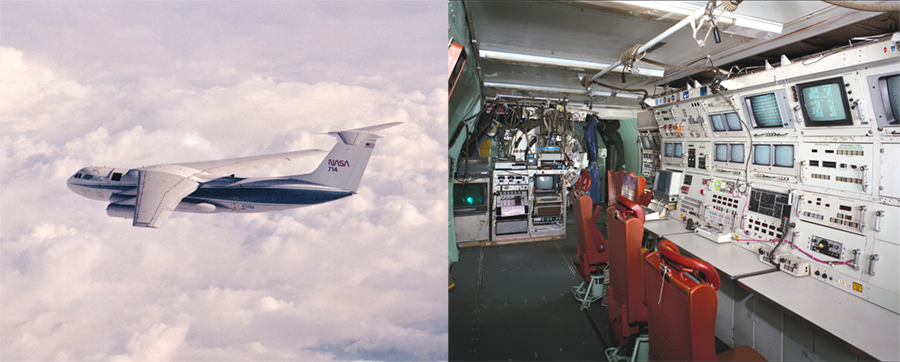
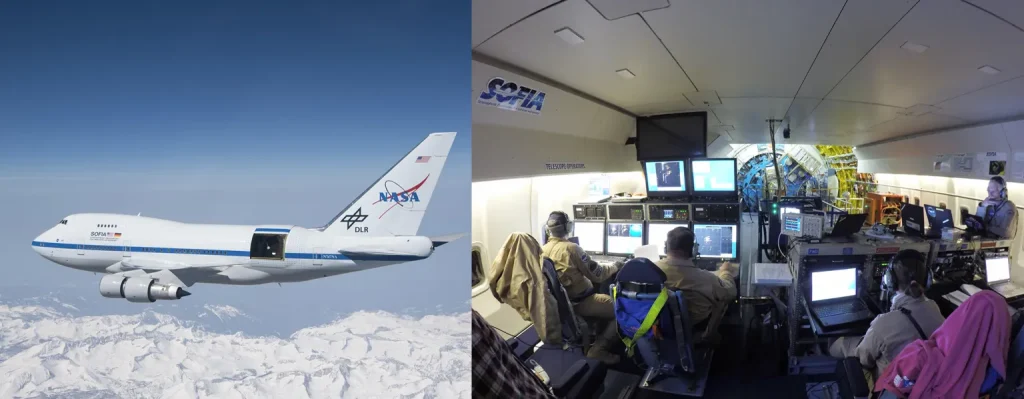
The KAO helped NASA engineers to discover rings around Uranus, Pluto’s atmosphere, complex organic molecules in space, a ring of star formation around the center of the Milky Way, and water in comets and in Jupiter’s atmosphere. In 1995, the KAO was decommissioned to develop the Stratospheric Observatory for Infrared Astronomy (SOFIA), a larger flying observatory with a more powerful infrared telescope. NASA, in partnership with the German Aerospace Center, chose a Boeing 747SP as the aircraft for SOFIA to carry the largest airborne telescope, which was 106 inches (2.7 meters) in diameter. The Boeing 747 that was used to develop SOFIA earlier flew for Pan American World Airways and United Airlines. However, NASA researchers modified it to carry the crew, telescope, and its support systems. The German Aerospace Center designed and built the telescope, which operated at altitudes of up to 45,000 feet and speeds of over 650 mph. NASA was tasked with maintaining the aircraft, while the German Aerospace Center maintained the telescope. The aircraft’s modifications included a hole for the telescope cavity, adding a new pressure bulkhead to keep the pressurized cabin separate from the cavity, and airflow ramps that helped the plane to fly normally with the telescope door open. Inside the cabin, mission control systems replaced the seats that had been in the passenger plane. The modifications and test flights occurred in Waco, Texas, and at NASA’s Armstrong Flight Research Center Hangar 703. Each flight carried about 20 people to operate the aircraft and the telescope, and to collect astronomical data.
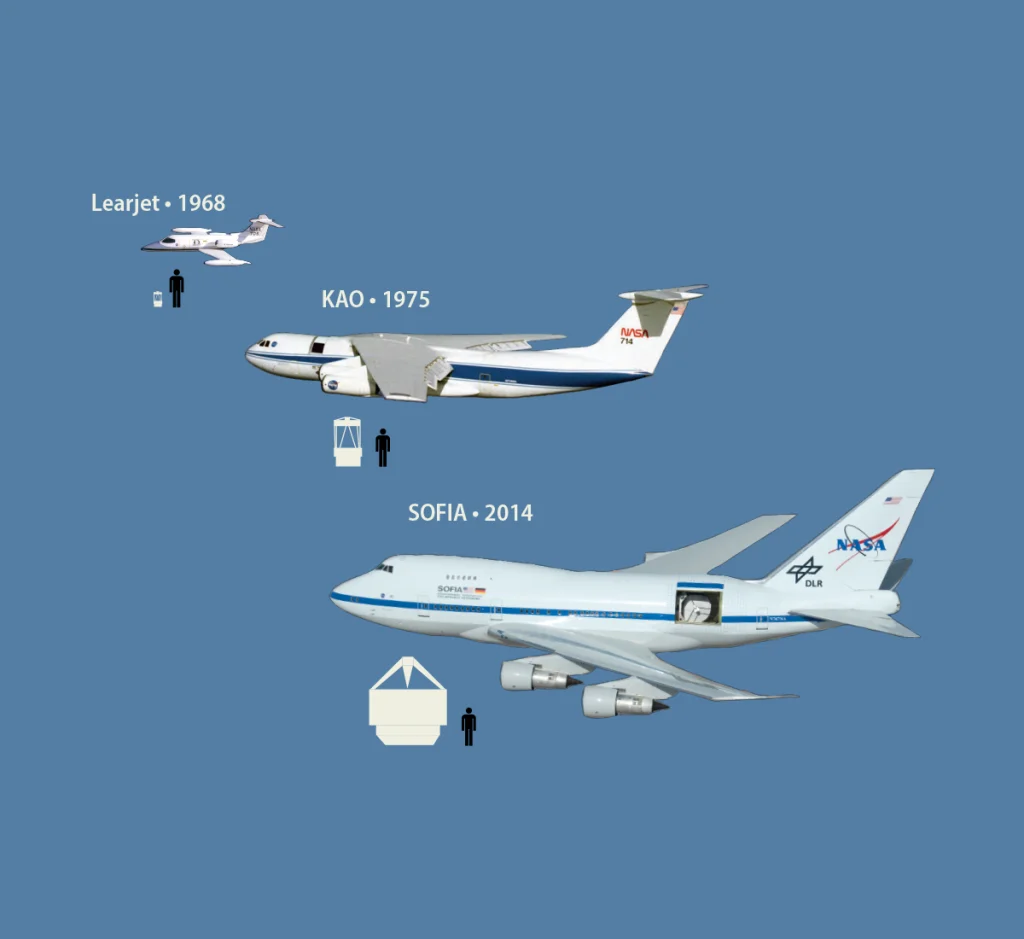
The telescope, developed by the German Aerospace Center, was made from a unique glass material with almost zero thermal expansion to keep the mirror unaffected by temperature differences between ground-level warm air and the stratosphere’s cold air. The back of the telescope had a honeycomb design, making it about 80 percent lighter than most telescopes of this size. It featured a complex stabilization system that kept the telescope steady and focused on its target during night flights. SOFIA became fully operational in 2014 and typically flew 3 or more times a week, each time for 10 hours. The researchers understood new concepts using SOFIA, including star birth and death, the formation of new solar systems, the identification of complex molecules in space, and the study of planets, comets, and asteroids in our solar system. The flights with SOFIA also helped in understanding nebulae, the ecosystems of galaxies, celestial magnetic fields, and black holes at the centers of galaxies, before its final science flight in September 2022 and its final flight overall in December 2022. The retired SOFIA is now on display at the Pima Air & Space Museum in Arizona. The airborne astronomy concept, which began with the Learjet 24 and ended with the Boeing 747, helped NASA scientists develop many concepts. The Learjet 24 was a foundation for the project, which later informed the world about important space phenomena. In 2001, NASA Dryden Flight Research Center also modified a Learjet 24 into an airborne test aircraft for high-altitude testing capabilities. However, on June 7, 2001, the aircraft crashed at Victorville during touch-and-go training and was damaged beyond economic repair. In the Flight Test Files series, the Learjet 24 stands as a high-altitude aircraft that proved its worth through atmospheric research. Read more Flight Test Files articles HERE.