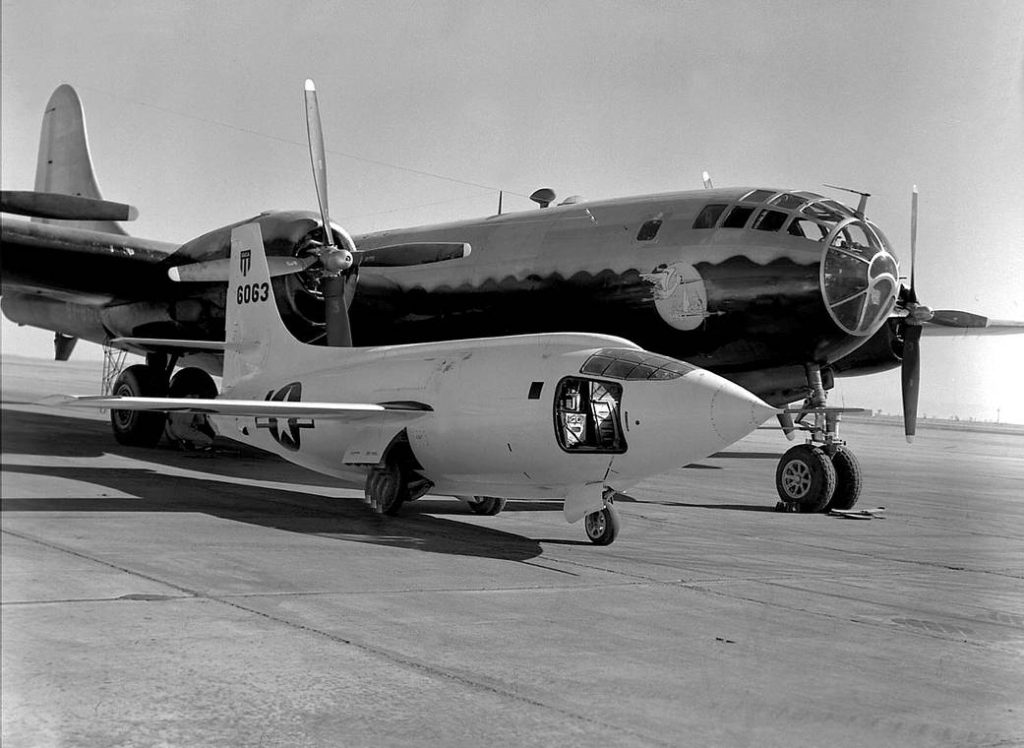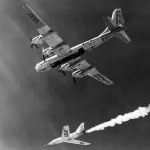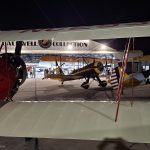
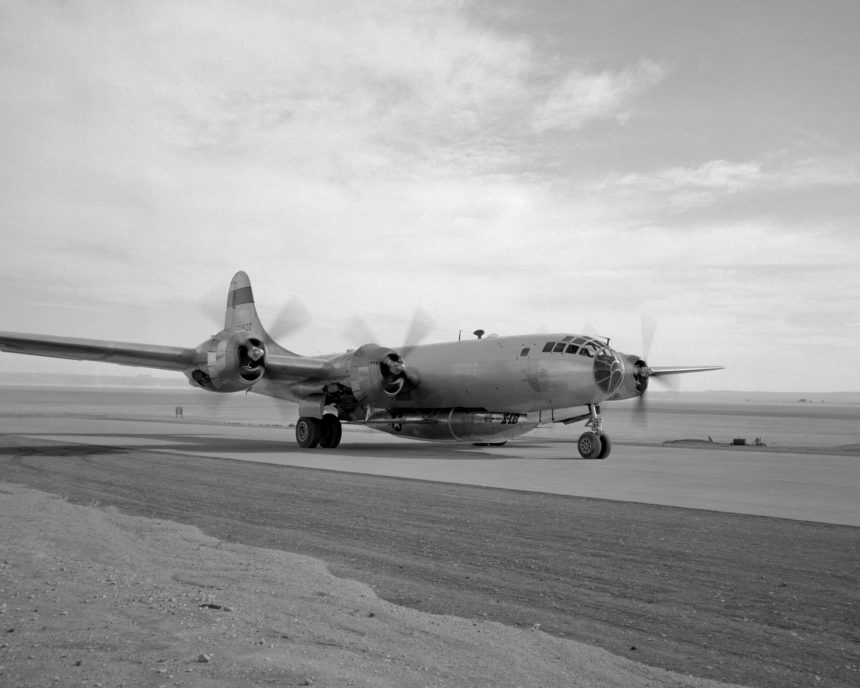

The Boeing B-29 Superfortress was the first U.S. aircraft to be modified for use as an airborne launch vehicle. At the NACA (now NASA) High-Speed Flight Research Station in Edwards Air Force Base, California, the researchers modified the B-29 to carry and release rocket-powered research aircraft, including the Bell X-1 series. The aircraft was originally accepted into service by the US Army Air Force on August 2, 1945. It was later transferred to Bell Aircraft and modified to carry the X-1 in its bomb bay, turning the B-29 into a “mothership,” capable of launching research aircraft at altitude.
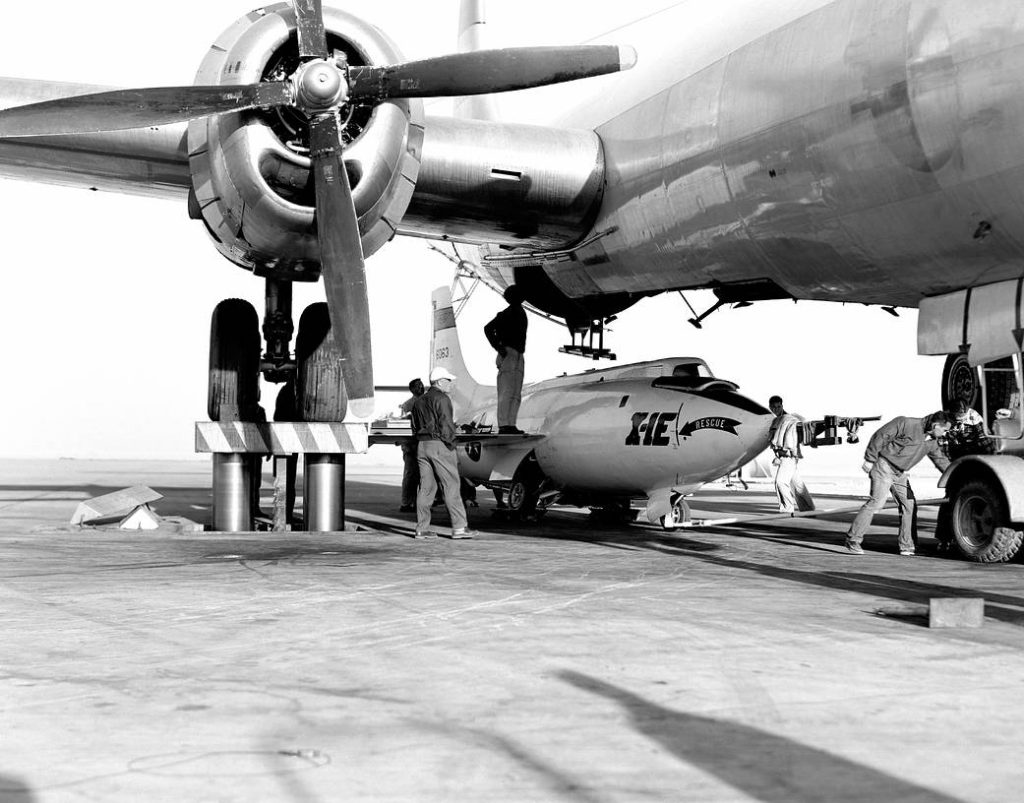
The first air launch of the X-1 from a B-29 Mothership took place on January 25, 1946, at Pinecastle Army Air Base, Florida. The aircraft completed 10 drops of the X-1 at Pinecastle before moving to Edwards Air Force Base, California, in September 1946. On December 9, 1946, the B-29 dropped the X-1 for its first powered flight. On October 14, 1947, the B-29 Mothership played a major role in one of the most important events in aviation. It carried the X-1 to altitude and released it for a flight that exceeded the speed of sound. The aircraft, piloted by Capt. Charles “Chuck” Yeager reached Mach 1.06 at about 43,000 feet. The B-29 Mothership remained the primary launch platform for subsequent X-1 flights, including the X-1-2, later modified into the X-1E, as well as the X-1A and X-1B.
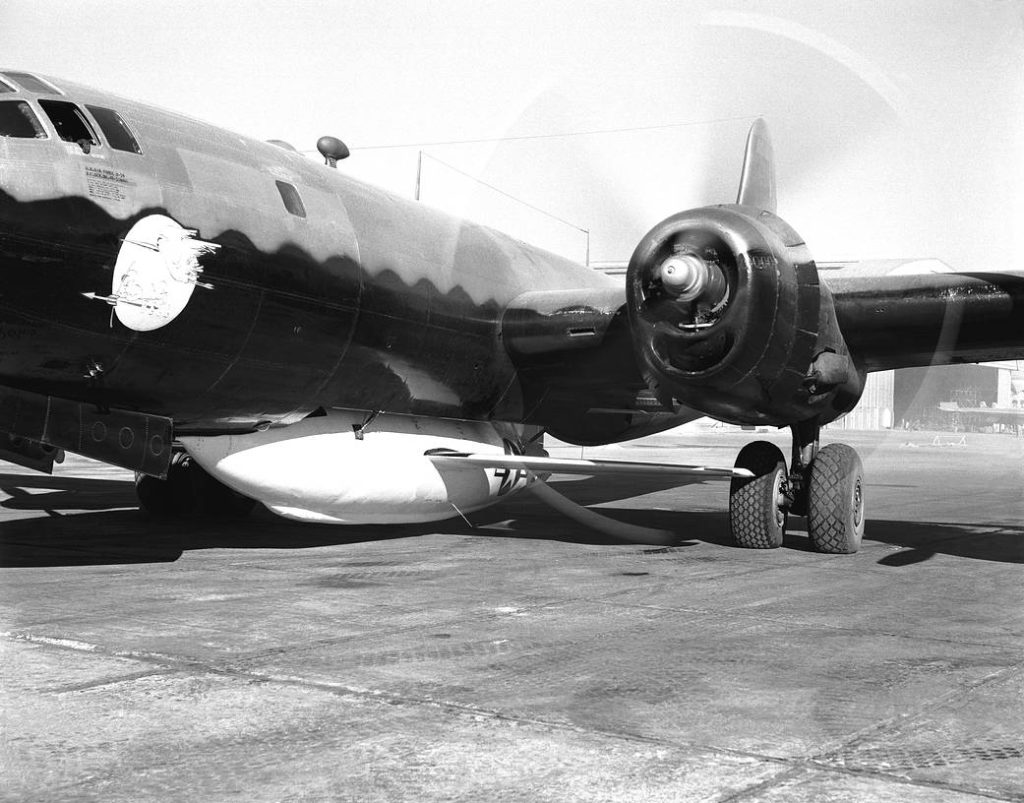
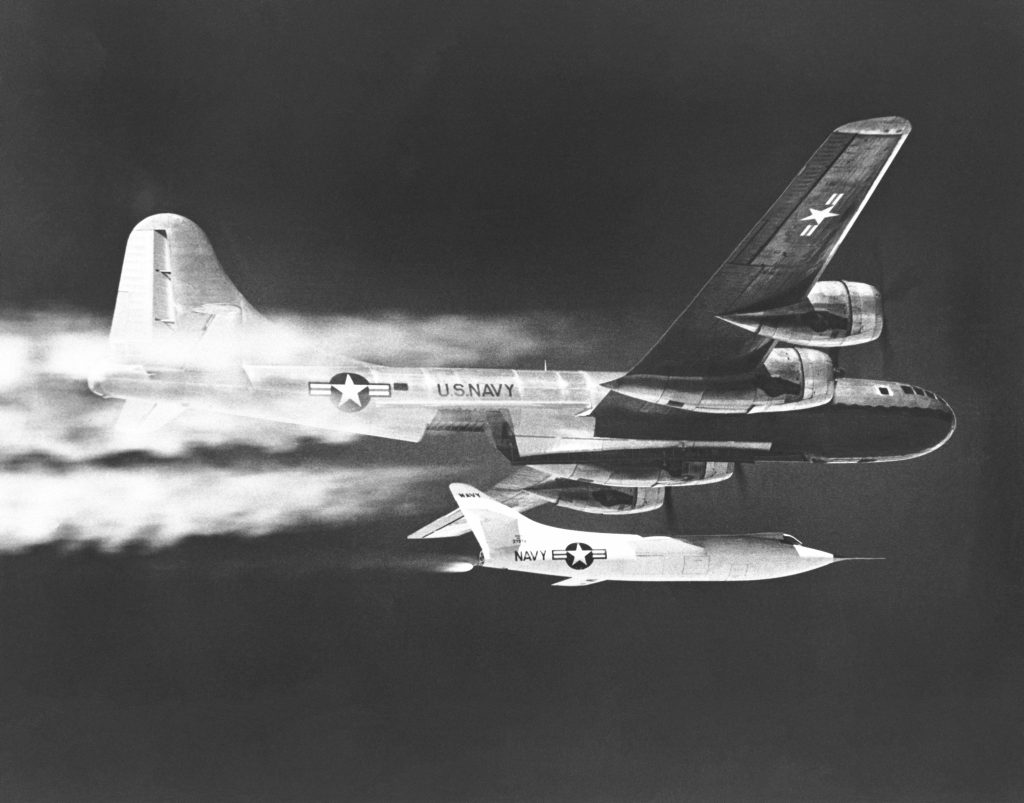
In addition to the X-1 research, the B-29 Mothership supported a range of test missions through the late 1940s and 1950s, which helped engineers study the transonic region, aircraft stability, control behavior, structural loads, and high-speed aerodynamics. From 1950 to 1956, the NACA used a P2B, a Navy version of the B-29 Mothership, to launch the rocket-powered versions of the D-558-2 Skyrocket research aircraft from altitudes around 30,000 feet. During Skyrocket testing, pilots encountered a violent rolling motion known as lateral instability at high speed and low angle of attack. The NACA engineers studied the aircraft’s behavior, and over the next couple of years, NACA pilot A. Scott Crossfield flew the plane 20 times to collect information on its lateral stability and control, as well as the loads on the wings and tail. He also examined how the plane behaved in terms of lift, drag, and shaking at speeds up to Mach 1.878.
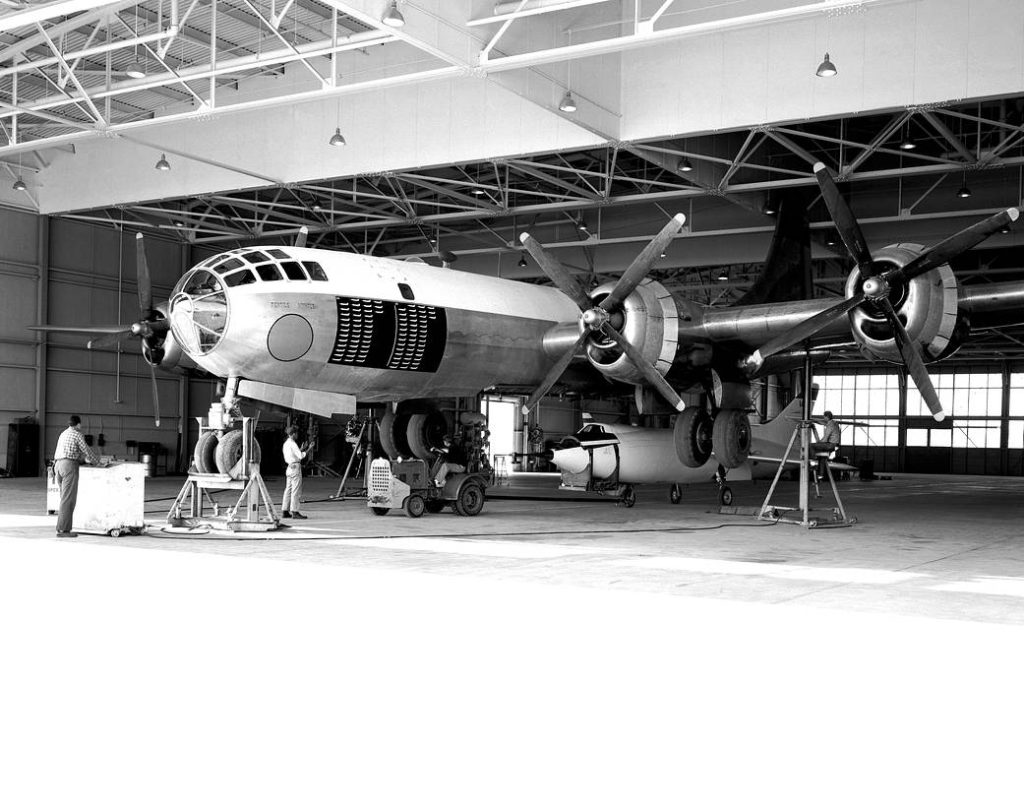
On November 20, 1953, the Skyrocket, launched from a B-29 Mothership, became the first aircraft to reach Mach 2 in level flight as it reached Mach 2.005 at about 72,000 feet. The flight provided data on structural loads and heating, dynamic stability, pressure distribution, and sound-pressure levels at transonic speeds and above. The B-29 Mothership also supported continued research into swept-wing in transonic and supersonic flight, including studies of pitch-up and boundary-layer effects. The study helped engineers improve the design of future swept-wing fighters for the armed forces and enabled better correlation between wind-tunnel test results and actual flight values. Additionally, information about stability and control contributed to the design of the Century Series of fighter planes. All of these planes featured movable horizontal stabilizers, first used on the X-1 and D-558 series.
On August 8, 1955, the aircraft was involved in a serious incident when an X-1A experienced an explosion while still attached to the carrier aircraft. The X-1A pilot returned to the B-29 Mothership, and the damaged aircraft was released before it could affect the carrier aircraft. The B-29 continued operations until July 1, 1959, when it was flown to Davis-Monthan Air Force Base, Arizona, for retirement. By that time, newer programs required larger and faster carrier aircraft. The role of the airborne launch platform was taken over by the B-52, which supported the X-15 program. In the Flight Test Files series, the B-29 Mothership helped modern aviation reach where it is today. The aircraft, which not only witnessed the first Mach 1 and Mach 2 flights but also helped make them possible, perfectly showcases its legacy. After the B-29 Mothership’s 14-year service to NASA, it was transferred to Davis-Monthan Air Force Base in Arizona, also known as “The Boneyard,” for retirement. Read more Flight Test Files articles HERE.