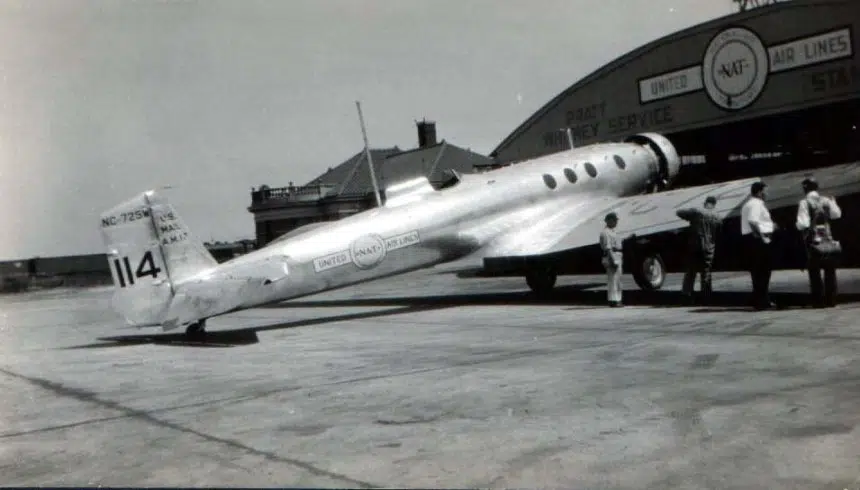

In the early 1930s, Boeing developed a mail plane, designated Boeing Model 200 Monomail. The aircraft introduced a new design for transport planes by using a single, low-set, all-metal wing instead of the usual biplane style. It also had retractable landing gear and a streamlined body, increasing its aerodynamics. Boeing built only one test prototype, called the Y1C-18. Because it was never mass-produced, the aircraft later joined Boeing’s fleet on the San Francisco-Chicago airmail route starting in July 1931. A second version of the aircraft, called the Boeing Model 221 Monomail, was created. It had a fuselage that was stretched by 8 inches, which reduced its cargo capacity but allowed it to carry six passengers in an enclosed cabin. The pilot still sat in an open cockpit. This version first flew on August 18, 1930. Both the Model 200 and the Boeing Model 221 Monomail were later updated for long-distance travel as the Model 221A. The update included slight fuselage stretches, giving both models room for eight passengers. United Air Lines used these aircraft on its Cheyenne-Chicago route.
Design and Cancellation of Boeing Model 221 Monomail

The Boeing Model 221 Monomail was 42 feet long, with a wingspan of 59 feet, and a gross weight of 8,000 pounds. It was powered by a Pratt & Whitney R-1860 Hornet B radial engine, which produced 575 horsepower. The maximum speed of the aircraft was estimated at 158 mph, with a cruise speed of 135 mph and a service ceiling of 14,700 feet. However, the Monomail’s design couldn’t succeed due to limited engine and propeller technology. By the time better engines and variable-pitch propellers became available, the design was already outdated, as multi-engine planes such as Boeing’s 247 were already in development. However, many Monomail features carried over into advanced bomber and fighter aircraft of the early 1930s, including the Boeing B-9 and the Model 248, which later became the P-26 Peashooter for the US Army Air Corps. Thus, the Boeing Model 221 Monomail couldn’t succeed on its own, but it showed a way for others to succeed. Read more Grounded Dreams articles HERE.