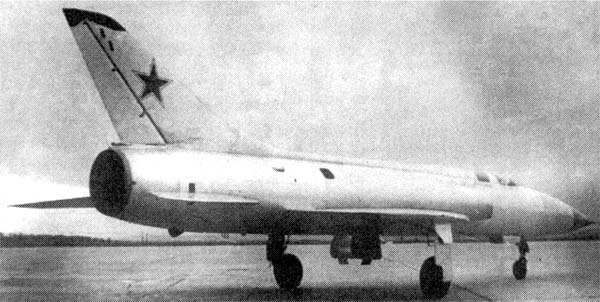
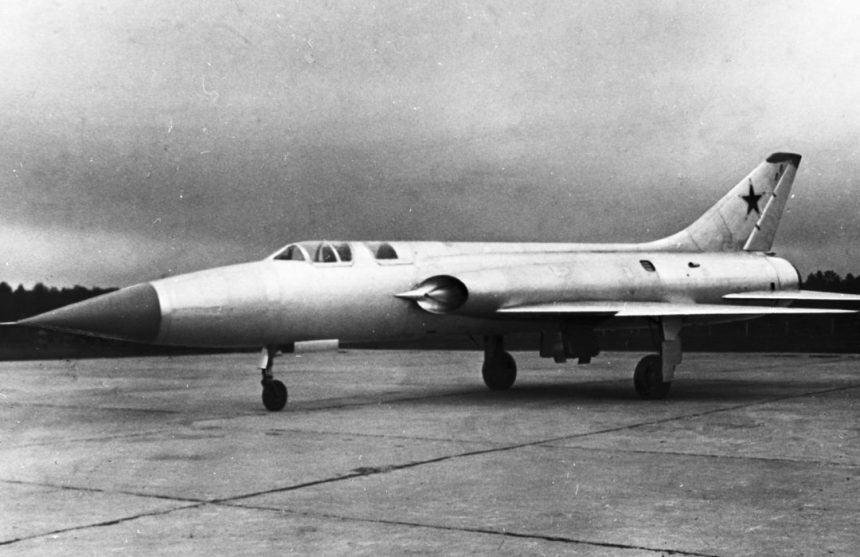


After designing the S-1 and T-3 frontline fighters, the Sukhoi Design Bureau’s General Design Department began preliminary design work on a new aircraft intended to work with the Uragan-1 collision-course intercept radar. The aircraft was developed following a decree from the Council of Ministers in January 1955. The main design was a two-seat version, but a single-seat version called the Sukhoi P-1 was also explored. Earlier, OKB-155, led by Anastas Ivanovich Mikoyan, created single-seat interceptors I-3U and I-7U for the Uragan-1 system, as well as the later Uragan-5 and I-75 interceptors. However, all of these remained prototypes. The P-1 was meant to have an Almaz-7 radar and carry a strong weaponry load, including two K-7 missiles that could be guided by radar, unguided rockets with fins (two ARS-212 and 50 ARS-57), or 32 TRS-85 turbojet missiles that were spin-stabilized. The K-7 missiles were mounted under the wings, while the unguided rockets were stored in launchers with protective flaps under the body of the aircraft. However, choosing a power plant was challenging. Initially, the team considered the promising AL-11 and R15-300 engines, or two AL-9 engines. However, except for the AL-9, which was delayed, the others did not materialize. Eventually, the team selected the R15-300, but they had to install the AL-7F engine temporarily.
Design of Sukhoi P-1
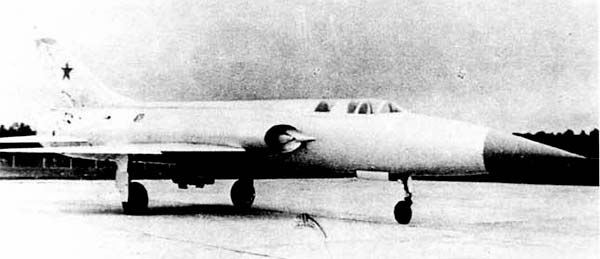
The first sketches of the Sukhoi P-1 aircraft featured a front air intake with one of two radar antennas mounted above it, similar to the T-3 prototype. However, the size of the targeting station required a design change, leading to the use of untested side intakes that could be adjusted. The delta wing had a unique aerodynamic “tooth,” as recommended by the Russian Central Institute of Aerodynamics. It was 69.1 feet long, with a wingspan of 32.2 feet and a wing area of 470 square feet. Its gross weight was 23,700 pounds. The maximum speed of the Sukhoi P-1 was envisioned as Mach 1.93, with a range of 1,200 miles and a service ceiling of 64,000 feet. The aircraft’s control system had the AP-28 autopilot, which was uncommon for similar aircraft at that time. The aim was to automate the interceptor guidance. In June 1957, a prototype was built and moved to the Flight Research Institute airfield in September. The first flight of the P-1 took place in early October, conducted by test pilot N.I. Korovushkin from the Air Force Research Institute. Another pilot, E.V. Elyan from the Flight Research Institute, later joined the flight tests, and by November 26, there had been four flights. The experimental Sukhoi P-1, which had a lower-thrust engine and did not have radar, guidance equipment, or weapons, was used mainly to test takeoff and landing characteristics, stability, and controllability in different flight modes.
The Cancellation
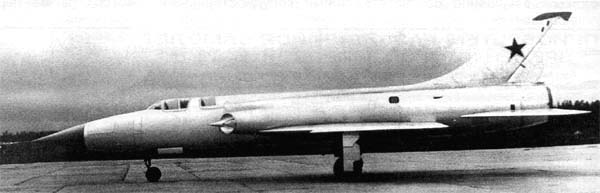
However, the interest in the new aircraft later faded for both the industry and customers. First, the Uragan automated guidance system was dropped, then work on the K-7 guided missile stopped, and finally, the lack of necessary engines grounded the aircraft, leaving it as just a platform for equipment and weapons. In 1958, Sukhoi and Andrey Borisovich Slepushkin tried to save the aircraft by proposing a two-seat version of the Sukhoi P-1. The version would include a Panther radar and two K-9 guided missiles to target low-flying threats. However, to guide the low-altitude fighter, they needed a relay aircraft for the Vozdukh-1 system, which was still being developed. This requirement, together with the work on another aircraft, caused the plans to stall. In the Grounded Dreams series, the Sukhoi P-1 did not get the attention it deserved, and the frequent changes made it unworkable. Read more Grounded Dreams articles HERE.