


In the mid-1970s, the US Air Force was thinking about distance in a different way. The Vietnam War had ended, and overseas basing rights could not always be assumed. At the same time, Soviet air defenses were improving, and regional crises could emerge far from established American airfields. The Air Force was trying to figure out how to place fighter aircraft over a distant battlefield quickly, without waiting for diplomatic clearance or building new bases. Boeing proposed an answer, at least on paper, which was to carry the fighters with you in an airliner, and the Model 985 microfighter study grew from that idea. Under an Air Force feasibility contract, the company examined whether a modified Boeing 747 could serve as an airborne aircraft carrier, carrying and launching a group of small, high-performance microfighters. These aircraft would separate from the carrier, conduct short combat missions at supersonic speed, and then return to be recovered in flight. It was an ambitious concept, but it never advanced beyond study drawings and wind-tunnel work.
A Return of the Parasite Fighter
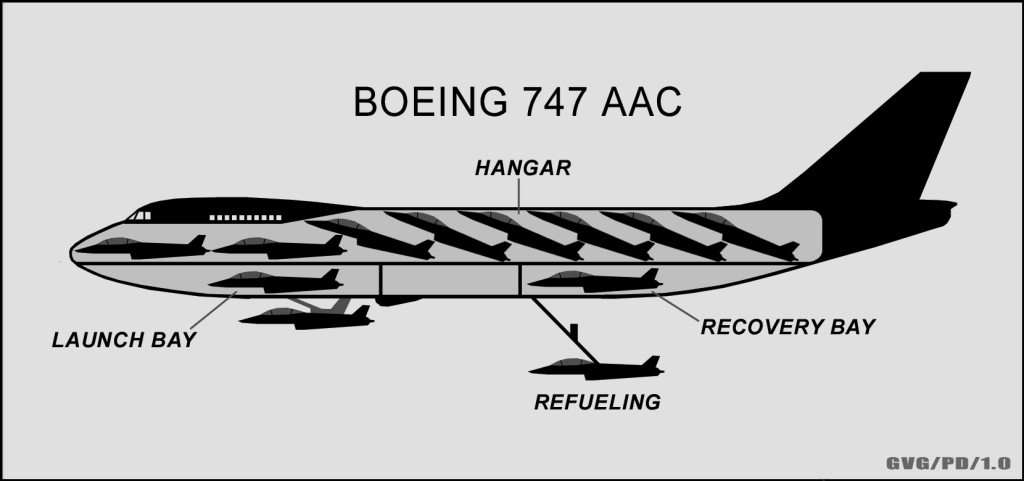
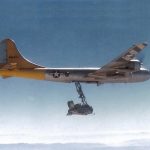
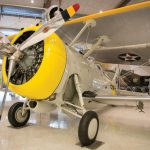
The idea was not entirely new. In the 1930s, the US Navy designed USS Akron (ZRS-4) and USS Macon (ZRS-5) as flying aircraft carriers. These carriers used to launch Curtiss F9C-2 Sparrowhawk parasite fighters to extend the service’s reconnaissance capabilities. The Sparrowhawk was a small biplane equipped with a skyhook to attach to a trapeze system on the airship for in-flight launch and recovery. During the Cold War, the Air Force experimented with parasite aircraft carried by the Convair B-36, including the tiny XF-85 Goblin and modified RF-84 fighters. Those programs were limited by launch and recovery difficulties and by rapid changes in aircraft technology. However, by the 1970s, transport aircraft were larger, and the Boeing 747 had entered service with a maximum takeoff weight approaching 883,000 pounds. Boeing’s study proposed converting a freighter 747 variant into an Airborne Aircraft Carrier (AAC). The modified 747 was envisioned to carry up to 10 Model 985 microfighters inside a dorsal hangar structure. Launch and recovery bays would be installed along the fuselage, supported by internal rails and handling systems. The carrier would also include pressurized space for flight crews, pilots, and maintenance specialists. In theory, the entire formation could deploy across oceans without depending on forward airfields.
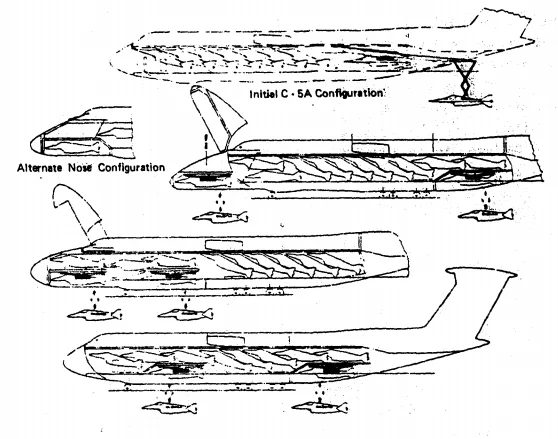
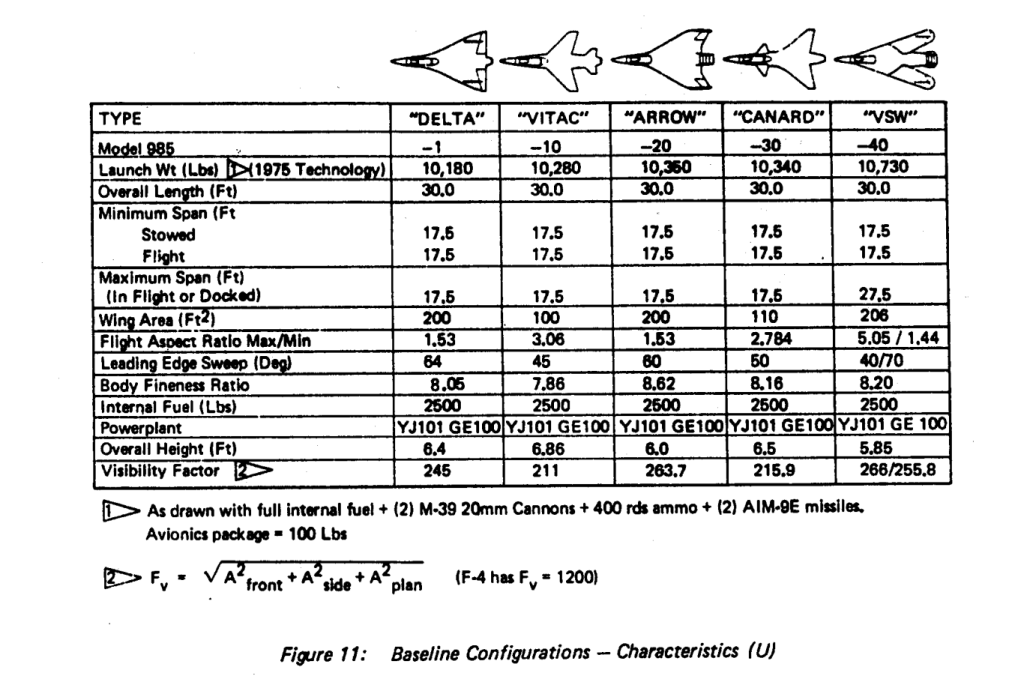
On paper, the concept promised fast response, as a single AAC could launch as many fighters as a small fighter would have, and that too to a distant theater. The parasite fighter studied under the project was the compact Model 985. The wingspan was limited to roughly 17.5 feet so that it could fit within the carrier’s handling system. Empty weight was projected at around 8,000 pounds, with a launch weight of around 10,000 pounds. The fighter was envisioned to be equipped with a single advanced turbofan engine, and it was expected to have a thrust-to-weight ratio of 1.4 at lighter configurations. With a top speed estimated at approximately Mach 2.2 and operational ceilings near 50,000 feet, the fighter was designed to achieve supersonic speeds. The fighter would be armed with two 20 mm cannons and short-range air-to-air missiles. The microfighter could carry a few bombs or missiles for attack missions, but because it was small and light, it could not carry much, as it was mainly built for air-to-air combat, not heavy strike missions. A fuel capacity of roughly 2,500 pounds also reflected that the fighter was designed for short-range combat missions measured in hundreds of nautical miles rather than thousands. The microfighter was therefore not conceived as a deep-strike platform. It was meant for interception, combat air patrol, or short interdiction missions conducted near the carrier’s operating area.
The Carrier Problem and End of Model 985
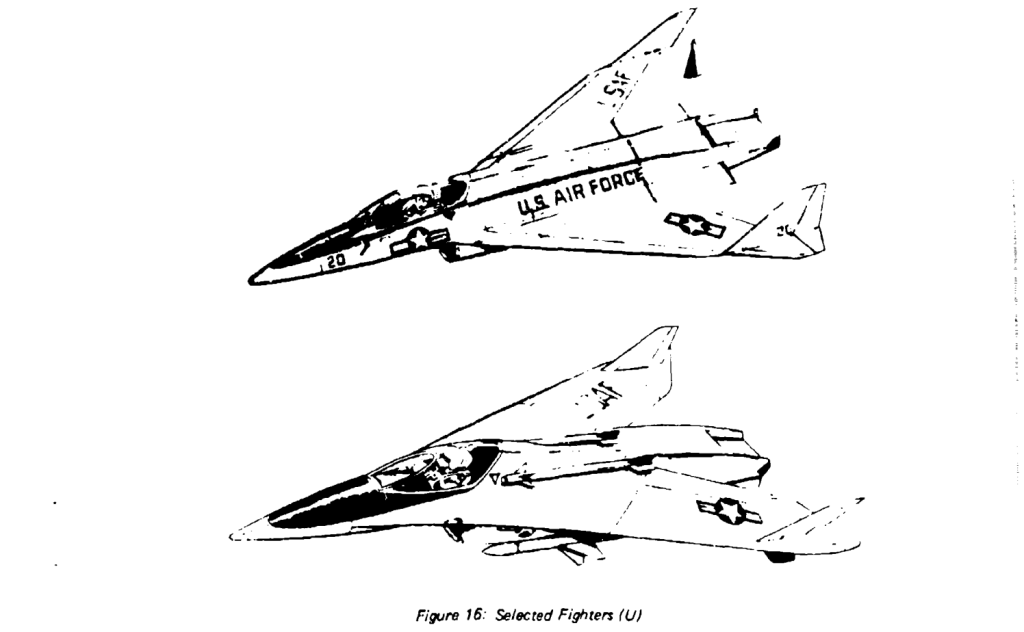
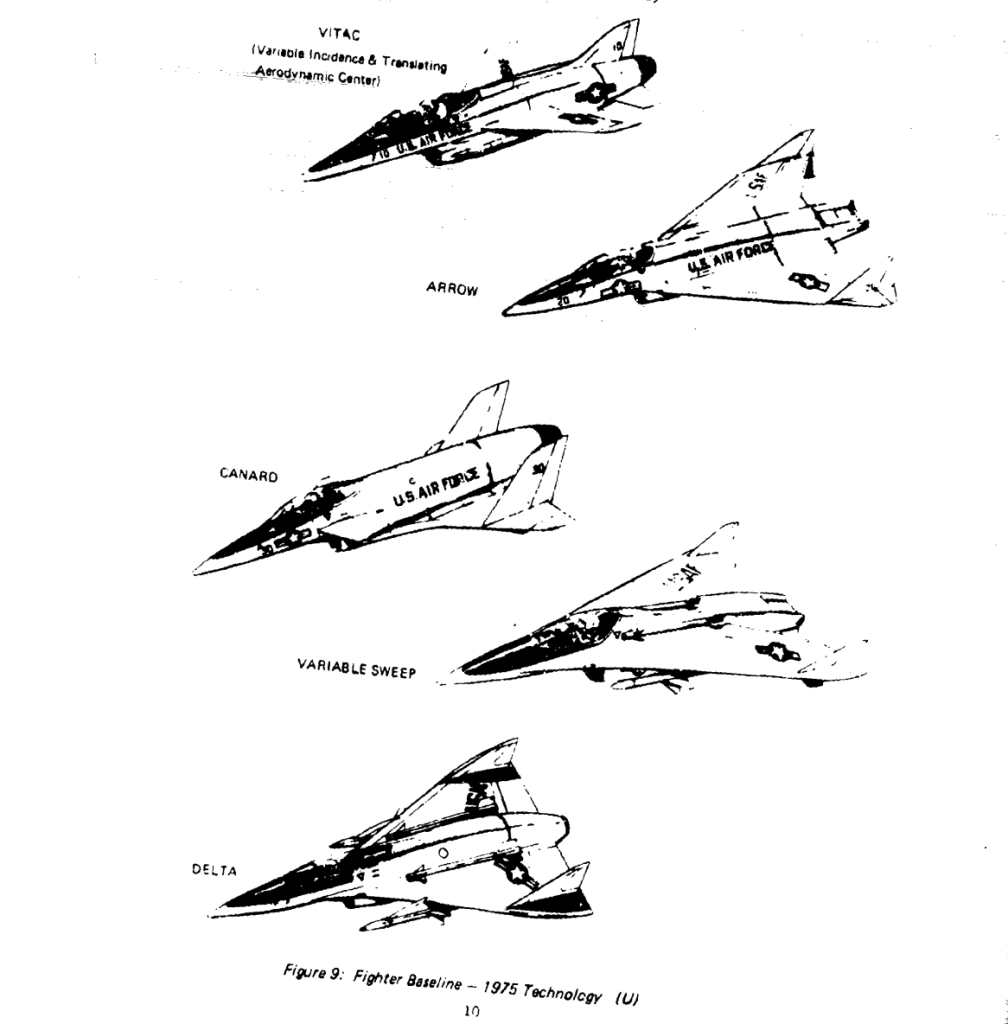
Engineers tested two main shapes of Model 985 in wind tunnels, one with a delta wing and another shaped more like an arrow. They adjusted the air intakes, checked how stable the aircraft would be, and studied how to fit weapons inside the fuselage without hurting performance. They also looked at newer control ideas, including lighter built-in stability and electronic flight controls, to make the aircraft more agile. The aim was to build a very small fighter that could match, and in some situations even outperform, aircraft like the MiG-21 in maneuvering. However, the aircraft carrier, 747, in this concept was not armored, stealthy, or designed for combat maneuvering. It remained a very large transport aircraft. Even with structural modifications and refueling capability, it would operate at subsonic speeds and high altitude. By the mid-1970s, Soviet air defense systems and surface-to-air missile systems such as the SA-6 were constantly proving fatal against high-performance aircraft, radar coverage was expanding, and even interceptor aircraft were improving. Intercepting a large 747 by modern air defense would be easy. While the engineers addressed launch cycles and internal handling times, there was no way to provide stealth to the 747 at the time. If detected and engaged before its microfighters were deployed, the entire concept would fail.
At the same time, conventional fighters such as the F-15s and F-16s were improving and entering service with a greater range and a heavier payload. The introduction of aerial refueling also allowed fighters to reposition globally without needing to be physically carried. New cruise missiles and precision-guided munitions with better range were being developed, and reliance on short-range manned strike platforms was being reduced. The microfighter’s limited fuel and payload made it obsolete in comparison to advanced platforms and weapons. Three short sorties per deployment cycle were considered feasible, but sustained operations would require either multiple carriers or frequent repositioning. In addition, the 1970s were not a time when money flowed easily through the Pentagon. After Vietnam, every new aircraft program had to justify itself, and the idea of modifying a 747 into a flying carrier, while also designing an entirely new class of tiny Mach-2 fighters, was costly. Boeing’s work proved that the concept could be made to function on paper, and engineers showed that it was technically possible, but what they could not prove was that the Air Force truly needed it. There was no urgent doctrine built around parasite fighters, and no budget set aside to build even a single prototype.
As the decade moved on, priorities settled around aircraft already in development, including frontline fighters, strategic bombers, and missile systems that offered more predictable capability. Like many aircraft in the Grounded Dreams series, no Model 985 microfighter was ever built; no 747 was converted, and a proposed Mach 2+ fighter that would live inside another aircraft, launch, and come back was never constructed. Check our previous entries HERE.