






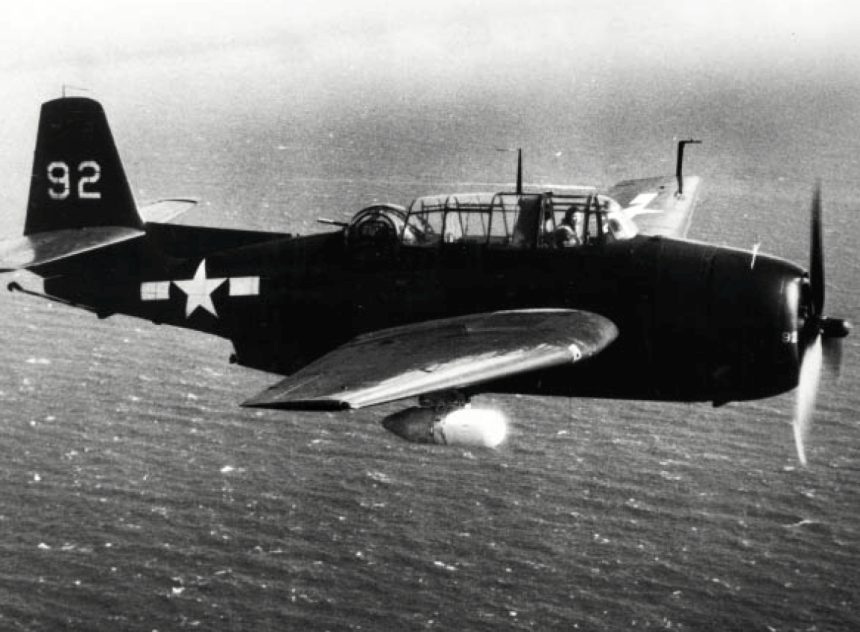

Attack Squadron 135 (VA-135) had one of the most intense combat careers of any attack squadron in the US Navy. During WWII, the squadron, known as the “Uninvited,” was established to attack Japanese targets in the Pacific. It flew the Grumman TBF and TBM Avengers and took part in missions from the Philippines and the South China Sea to the Japanese home islands. After the war, the Navy changed many wartime squadrons, including this one. The squadron started as Torpedo Squadron VT-81 on March 1, 1944. It was renamed Attack Squadron 14A (VA-14A) on November 15, 1946, and finally became Attack Squadron 135 on August 2, 1948. However, its postwar service was short-lived, and it was disbanded on November 30, 1949. Attack Squadron 135 started with the Grumman TBF Avenger, receiving TBF-1, TBF-1C, and TBM-1 models in March 1944.

In 1944, the squadron moved between naval air stations to train for combat. It had short assignments at Naval Auxiliary Air Fields in Martha’s Vineyard, Boca Chica, and Otis, then at Naval Air Station San Diego and Naval Air Station Puʻunene in Hawaii. When Attack Squadron 135 arrived in the Pacific combat zone, its Avengers were ready to operate from carriers. The squadron conducted its first combat strike on November 14, 1944, targeting Japanese positions near Manila Harbor in the Philippines. From January 9 to 20, 1945, Attack Squadron 135 joined a task force in the South China Sea. It carried out strikes against Japanese positions at Cam Ranh Bay, Hong Kong, and Takao Harbor in Formosa. On February 16, 1945, seven aircraft of the squadron attacked Hamamatsu Airfield in Japan. Five days later, on February 21, the squadron flew its first missions to support ground troops during the Battle of Iwo Jima. On March 1, 1945, Attack Squadron 135 carried out its last combat strike of WWII, exactly one year after the squadron was formed. During its four months of combat missions on the USS Wasp, the squadron did not lose any members to enemy fire. However, two members were lost in operational accidents.

The squadron kept flying after its combat tour and got newer Avenger models, including the TBM-3 and TBM-3E, in May 1945. By 1946, it was also using the TBM-3Q, which was modified for special missions. However, the Navy was changing fast after WWII. After WWII, the Navy reorganized, changing VT-81 to VA-14A in November 1946. The squadron operated from US naval bases and, in June 1946, deployed on the USS Princeton as it traveled from Norfolk to San Diego through the Panama Canal. On August 2, 1948, VA-14A changed its name to Attack Squadron 135. The squadron continued to fly Avengers but started transitioning to the newer Douglas AD-4 Skyraider, which it received in September 1949. Attack Squadron 135 did not last long enough to create a new combat history. It was disbanded on November 30, 1949. The squadron, known as the “Uninvited,” underwent several name changes, but its most significant actions occurred during WWII. It began with its first strike on Manila Harbor and continued with attacks across the South China Sea, the Japanese home islands, and Iwo Jima.







The TBM Designation identified Avengers built by Eastern Aircraft, not Grumman.