







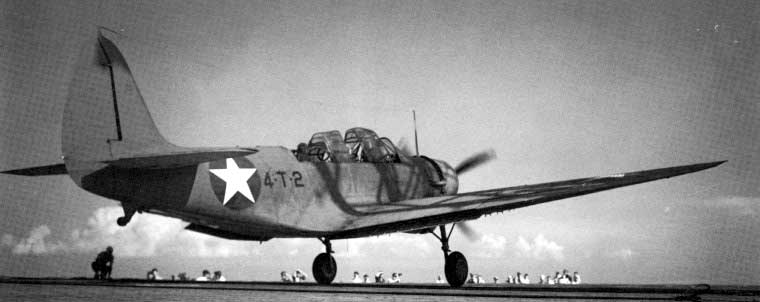
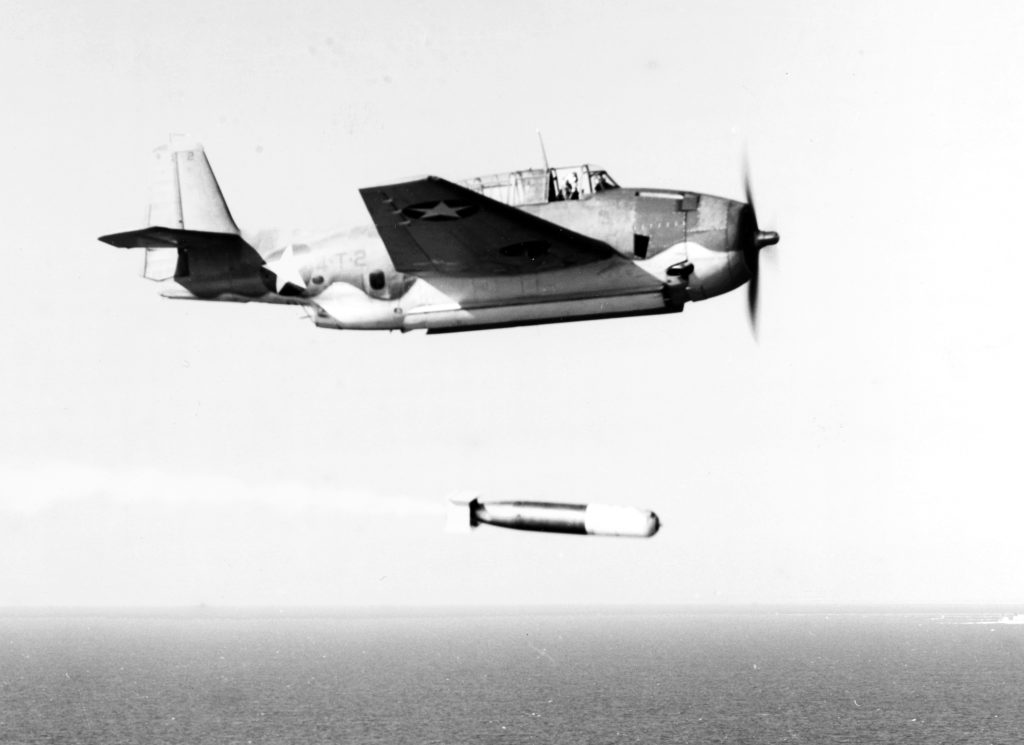
One month after the attack on Pearl Harbor, the US Navy established the new Torpedo Squadron 4 (VT-4), which would later be called Attack Squadron 15 (VA-15), on January 10, 1942, to protect Allied sea routes and fight against German U-boats using torpedo bombers. VT-4 was formed on the USS Ranger while it was docked in Grassy Bay, Bermuda. The squadron initially flew the TBD Devastator and worked to guard the shipping routes between Bermuda and Newfoundland from Naval Air Station Quonset Point in Rhode Island. By August 1942, VT-4 switched from the TBD to the more advanced TBF Avenger. From August to November 1943, VT-4 served with the British Home Fleet on the USS Ranger. The squadron took part in Operation Leader and successfully attacked German shipping. In July 1944, the squadron moved to the Pacific Fleet, and on September 21, 1944, a collision during a practice exercise led to the loss of nine personnel, including the squadron commander. From November 4 to 17, 1944, VT-4 supported landings at Leyte and participated in strikes at Ormoc Bay, Cavite, and Clark Field. In December, the squadron continued operations for landings on Mindoro. In January 1945, while on the USS Essex, VT-4 targeted Japan’s home islands and expanded operations to areas in French Indochina.
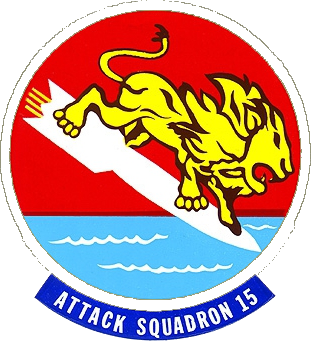
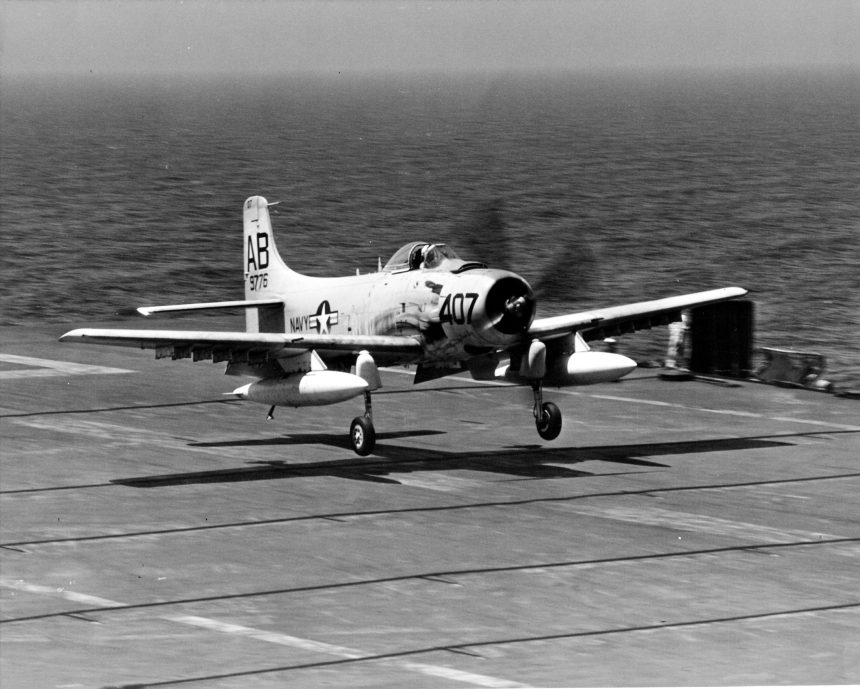
The squadron played an important role in the Battle of Iwo Jima in February 1945. In March, after some strikes on Okinawa, VT-4 left the USS Essex on March 4, ending its combat activities in WWII. The squadron returned to the United States in April 1945. From February 15 to April 15, 1946, VT-4 and other squadrons in Carrier Air Group 4 participated in the shakedown cruise of the USS Tarawa in the Caribbean Sea after the ship was commissioned in December 1945. By November 1946, some aircraft in the squadron had sonobuoy equipment, and personnel received training for antisubmarine missions in addition to their regular torpedo-attack duties. On November 15, 1946, the squadron was renamed VA-2A, which later became Attack Squadron 15 on August 2, 1948. In March 1949, the squadron moved to NAS Cecil Field in Florida and began flying the AD Skyraider. On May 22, 1950, Attack Squadron 15 became a training squadron, and its main job was to train fleet pilots in attack aircraft on glide bombing, dive-bombing, rocket firing, day-and-night tactics, and carrier qualifications using the AD Skyraider. By September 19, 1951, the Chief of Naval Operations approved a new squadron insignia, a design that changed an earlier image of a lion riding a torpedo with a missile.
From September 13 to September 23, 1952, Attack Squadron 15 was on the USS Wasp for Operation Mainbrace, the first NATO naval operation in the North Atlantic. In February 1955, while on the USS Midway, the squadron helped evacuate Chinese Nationalist civilians and military from the Tachen Islands during attacks by the People’s Republic of China. Later, during the Suez Crisis in November and December 1956, Attack Squadron 15 operated near the Azores aboard the USS Forrestal. On September 12, 1958, the squadron received an additional mission for aerial refueling. From November 14 to 28, 1960, the VA-15 squadron served on the USS Shangri-La in the Caribbean Sea. Its mission was to stop possible insurgent attacks in Guatemala and Nicaragua that were believed to be connected to Cuba. The next year, from November 21 to 27, 1961, Attack Squadron 15 operated off the coast of the Dominican Republic on the USS Franklin D. Roosevelt to support the new democratic government there. In March and April 1962, Attack Squadron 15 deployed on the USS Enterprise to the Caribbean. It took part in the test voyage of the first nuclear-powered aircraft carrier.
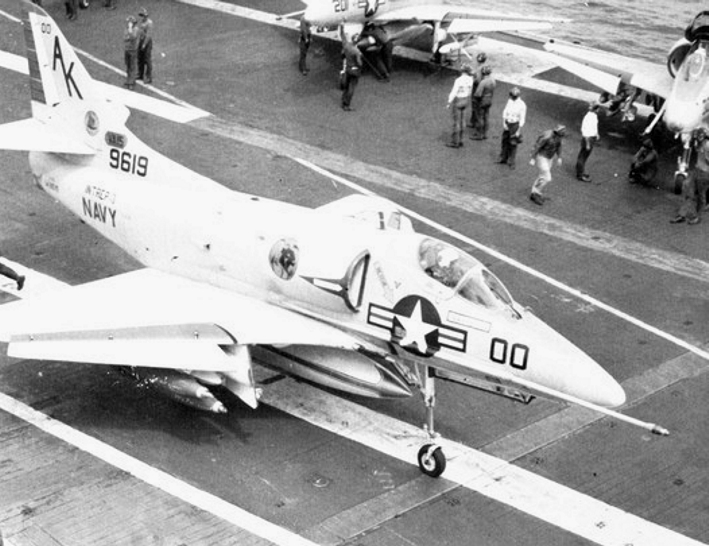
By August 1965, although it was set to switch to the A-6 Intruder, the squadron started training with VA-44 to transition to the Douglas A-4 Skyhawk. From April 4 to November 21, 1966, Attack Squadron 15 served in Vietnam as part of Carrier Air Wing 10 (CVW-10) on the USS Intrepid. CVW-10 was undertaking attack missions and included four squadrons, in which two used A-4 Skyhawks and two used A-1 Skyraiders. On May 15, 1966, the squadron completed its first combat mission since March 1945, when it was known as VT-4 and was part of Carrier Air Group 4. In 1967, Attack Squadron 15 was deployed to Southeast Asia on the USS Intrepid. After that, from 1968 to 1969, the squadron served in the Mediterranean on the USS Forrestal, which had recently been repaired after a major fire. Finally, the squadron was disestablished on June 1, 1969, after 27 years of service. It had been using a Douglas A-4E Skyhawk since 1967 when it was disestablished.





I was Ships Company in Navigation aboard the USS Shangri-La (CVA-38) when VA15 came aboard for our Med Cruise in 1960.
Don’t forget the nuclear mission during the Cold War with A4 Equipped nuclear weapons in the Med. 68-69. I was VA 15 AIO and helped out pilots deliver our payload from
The USS Forrestal on the first cruise since the big fire.