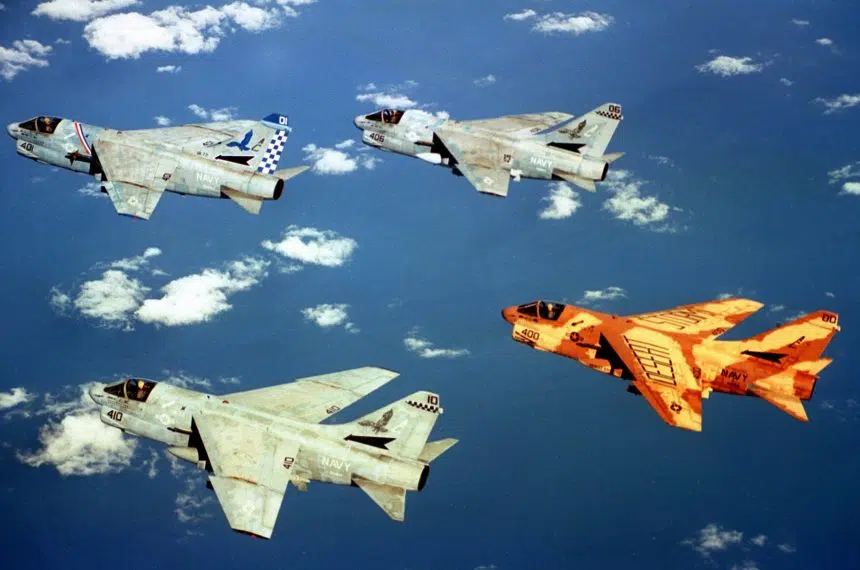

Attack Squadron 72 (VA-72) was one of the longest-serving attack squadrons in the US Navy. It started as a WWII fighter unit and became a Cold War attack force. The squadron completed its last combat missions during Operation Desert Storm. Originally called the “Bearcats,” it later became known as the “Hawks” and finally the “Blue Hawks.” VA-72 served for more than 40 years and used various aircraft as naval aviation changed. Attack Squadron 72 was established as Bomber Fighter Squadron VBF-18 on January 25, 1945. It changed its name to Fighter Squadron VF-8A on November 15, 1946, then to VF-72 on July 28, 1948, and finally to Attack Squadron VA-72 on January 3, 1956. The squadron began with the Grumman F6F-3/5 Hellcat, then moved to the F8F Bearcat, F9F Panther, and eventually the Douglas A-4 Skyhawk. Its first deployment after the war was on the USS Leyte from September to December 1946. During this time, the squadron participated in the carrier’s shakedown cruise in the Caribbean and a goodwill visit to South America for the inauguration of Chilean President Gabriel González Videla. The early years of the squadron saw a rapid change from piston-engine fighters to jets. In March 1951, VA-72 received the F9F-2 Panther and later the F9F-5. In September 1956, it switched to the A4D-1 Skyhawk. By this time, the squadron was shifting to an attack unit instead of a regular fighter squadron. In April 1961, Attack Squadron 72 operated on the USS Independence near Guantanamo Bay during the Bay of Pigs invasion. A year later, from October 22 to November 22, 1962, the squadron participated in the Cuban Quarantine during the Cuban Missile Crisis.

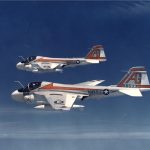
Attack Squadron 72 played a role in the US space program. From May 10 to 16, 1963, a group of three aircraft operated from USS Wasp to deliver supplies during Project Mercury’s Faith 7 mission. Soon after, the squadron took on a more dangerous mission as the US increased its involvement in Vietnam. On February 7, 1965, Attack Squadron 72 participated in Operation Flaming Dart, but their strike was called off because of bad weather. Four days later, the unit took part in Flaming Dart II, attacking military targets in North Vietnam. On March 15, the squadron joined Operation Rolling Thunder, the ongoing US bombing campaign against North Vietnam. On October 17, 1965, four VA-72 A-4E aircraft and two A-6A aircraft from VA-75 attacked a North Vietnamese SA-2 missile site. The strike became the first successful attack on an SA-2 installation. After the Vietnam War, the squadron continued to operate during various Cold War crises. In September 1970, while aboard USS John F. Kennedy in the Caribbean, Attack Squadron 72 was ordered to the Mediterranean due to rising tensions between Jordanian and Palestinian forces. When the Yom Kippur War started in October 1973, the USS Kennedy and its air wing returned to the Mediterranean, where VA-72 conducted flight operations south of Crete. In September 1985, Attack Squadron 72 made history along with other CVW-1 units by becoming the first to conduct carrier flight operations inside a fjord while the USS America was in Norway’s Vestfjorden.

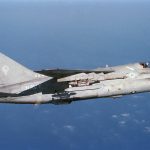
In 1986, Attack Squadron 72 became involved in conflicts with Libya. From March 22 to 27, during Freedom of Navigation exercises in the Gulf of Sidra, the squadron flew patrols to protect the carrier force from Libyan ships and submarines. It provided aerial refueling for combat air patrol fighters. On April 14, during Operation El Dorado Canyon, Attack Squadron 72 supported potential attacks on Libyan air-defense radar sites with air-to-surface missiles. The squadron’s final chapter occurred during the Gulf War. VA-72 took part in Operation Desert Shield when the US and allied forces built up after Iraq invaded Kuwait. When Operation Desert Storm started on January 17, 1991, the squadron’s A-7E Corsair IIs carried out the first combat strike against Iraqi targets in Baghdad. On January 29, Attack Squadron 72 flew its first combat mission in Kuwait, attacking Iraqi troops, tanks, and artillery positions. The Blue Hawks continued flying missions until the last days of the war. On February 27, VA-72 aircraft took part in the final naval airstrike of the conflict, targeting retreating Iraqi forces east of Najaf. During the 43-day war, the squadron completed 362 missions without losing a pilot or an aircraft. On June 8, the squadron’s last two aircraft flew in the victory parade over Washington, DC. Just weeks later, on June 30, 1991, Attack Squadron 72 was disbanded.