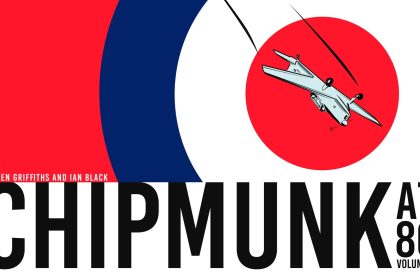


Chipmunk at 80: Volume I by Ben Griffiths and Ian Black, reviewed by Joe May, available at The Aviation Bookshop.
Authors Griffiths and Black created an unusual and marvelous book with Chipmunk at 80 by letting the world know about the remarkable yet unsung de Havilland Chipmunk. Chipmunk at 80 is not a technical book about de Havilland’s remarkable trainer, though there is insightful technical information sprinkled throughout its pages which is not usually found in other books. Chipmunk at 80 honors the reputation and service of Wsiewoted Jakimiuk’s brilliant design and is written by these two pilots who welcome the aroma of avgas, pilots who can write knowingly about the bond between pilot and purpose-built aircraft, as well as two persons who see the history in which the Chipmunk has been such an integral player in a community was created. Chipmunk at 80 brings readers into this extraordinary community.

Griffith and Black each write appreciative as well as inspiring opening chapters, bringing readers into the 80-year span, so far, of the Chipmunk. Beginning in 1956, the Chipmunk’s design (one that could bite, not kill, an impertinent trainee as it was designed to do) would become a significant part of aviation careers numbering in the thousands. Careers culminating with fighter pilots, commercial pilots, bomber pilots, large aircraft pilots, and small aircraft pilots. Thousands of pilots from a de Havilland total production of less than 1500 airframes.

The authors illustrate the Chipmunk’s magnetic draw in four of the book’s chapters. Historically, two chapters stand tall—one on the 11th Chipmunk (G-AKDN) airframe ever built, its restoration experience and two trips across the Atlantic Ocean, as well as its well-deserved fate. The other chapter is of the Chipmunk in imperial red livery, the Royal Chipmunk, flown by British royalty among others.

Will Garner’s Chipmunk is a touching chapter about the ascent of his flying abilities, beginning with Chipmunks and continuing today with his Chipmunk. This chapter is an intimate one. Perhaps uniquely, in a book written by pilots, there is a chapter centering on a maintainer—James Gilmore’s Chipmunk. Perhaps recognizing that mechanics fix what pilots break? It is possible. This chapter also has intriguing insight as well as details.

Surprisingly, the Chipmunk also had a significant, secretive role during the Cold War in the divided city of Berlin, before the wall fell. RAF personnel would fly a Chipmunk within the small, well-defined airspace of West Berlin—always with East German guns trained on them, with occasional shots taken. Some were flights to maintain hours, but many were not. Those that were not were exacting missions and are creative to read. It is not surprising once readers become aware that the Chipmunk was also known as the poor man’s Spitfire.

Each author is highly experienced in flying the de Havilland Chipmunk. Ian Black is an acclaimed aviation photographer as well as writer; Ben Griffiths is a gifted pilot and well-experienced book editor, which shows throughout Chipmunk at 80. Readers can only look forward to Volume II after enjoying Volume I. Photos in all chapters are exquisite, historic, or both. The book itself is top-notch in quality, production, and layout. Chipmunk at 80 is a book equally welcome in a library, on a coffee table, or at an airfield office (FBO), from the most petite operation to the largest. Those who love flying will pour over this book while relishing its photos and devouring its chapters. Chipmunk at 80 is easily available and at a more than reasonable price, as well, at the chipmunkat80.carrd.co website.
| Softcover
Publisher: Independent Publishing Network (2026) Size: 250mm x 300mm (~10” x ~12”) Index: X Bibliography: X Notes: X Photos: ✔︎ (tons) Cost: £37/~$49.55 ISBN: 978-1-80645-308-5 Page Count: 168 Available at The Aviation Bookshop |