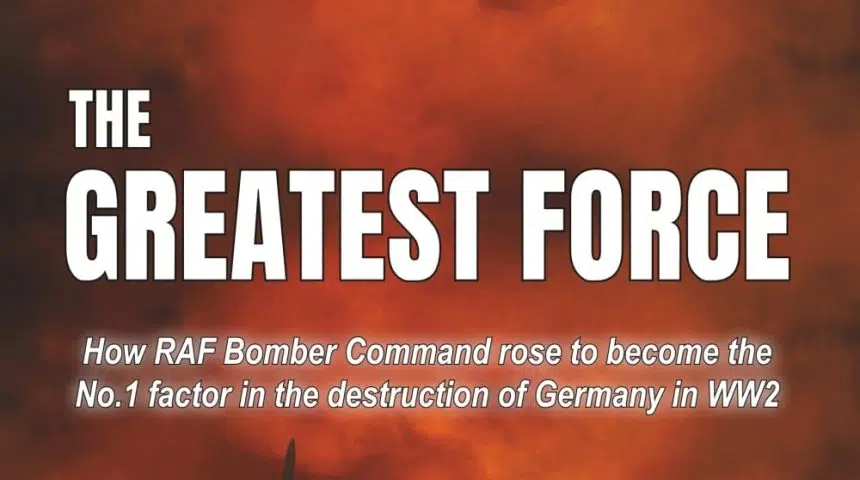

The Greatest Force: How RAF Bomber Command rose to become the No. 1 factor in the destruction of Germany in WW2 by Marcus Gibson, reviewed by Joe May, available on Amazon.
Marcus Gibson worked for a decade, deeply researching the Royal Air Force’s (RAF) Bomber Force and its contribution to the Allied victory ending WWII in Europe. He is brilliant as a writer, economist, as well as a researcher. A self-admitted “serial contrarian,” he cold-forges opinions and is not shy about presenting them. Readers may agree or disagree with his conclusions, here and there, but will recognize these are honestly presented and well cited—extremely well cited. So…was the RAF Bomber Force the primary weapon that destroyed Nazi Germany in WWII, as his thesis so boldly states in the book’s title? Gibson thoroughly and excitedly steps through RAF Bomber Force’s WWII history, victories, defeats, and lessons in support of his thesis. He also pulls no punches, inserts personal experiences as written by combatants of the time, and does not retreat from potentially bruising egos. Those in the United Kingdom (UK) may be intrigued by the RAF being Number 1. Those in the United States, especially in Pooler, Georgia, likely will get their dander up with the author’s assessment that the Eighth Air Force’s daylight bombing effort, intending to complement the RAF’s nocturnal bombing strategy, was much less spectacular than the Eighth would have you believe. Facts, figures, and events are described and analyzed, with conclusions presented—all with the same honest and forthright directness throughout. Readers will not be confused regarding Gibson’s why-is-why and what-is-what thinking. Let the arguments ensue!
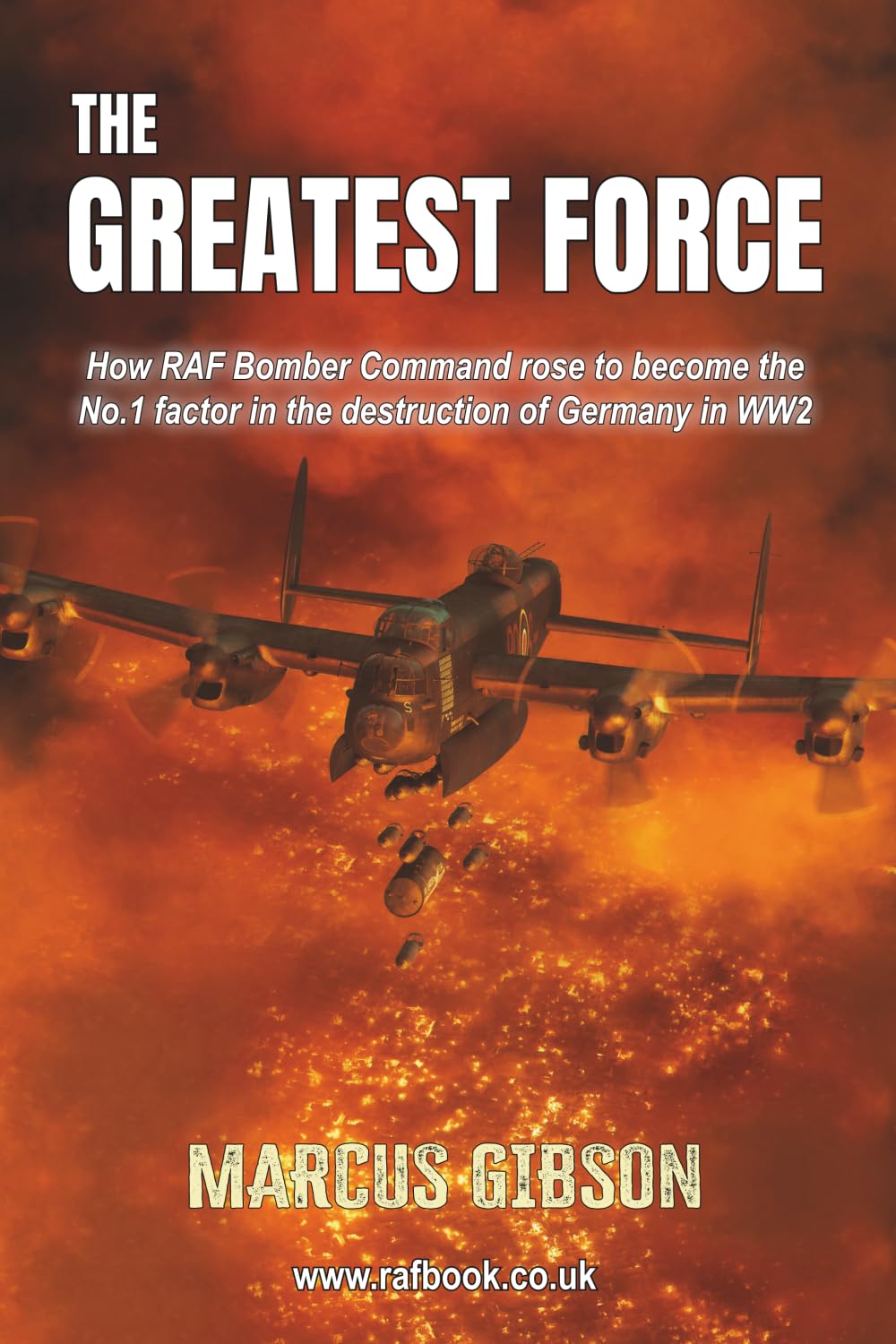
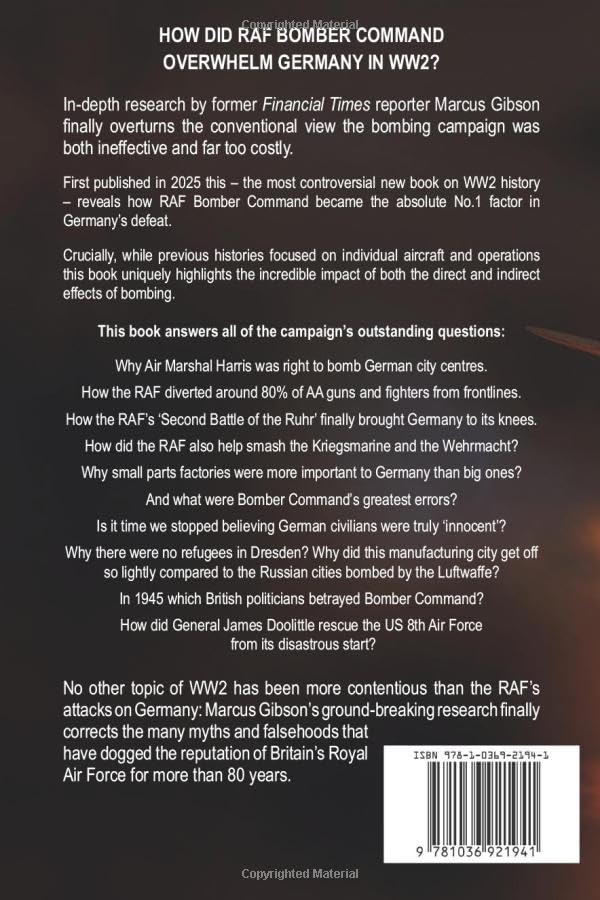
Okay! The 8th AF’s continuing daylight bombing missions over Germany pressured Nazi forces to withdraw 400 daylight fighters from France to Germany, which greatly aided in the success of the D-Day invasion of Europe. Gibson mentions RAF Bomber Command caused the shifting of 800 fighters, but examination of the table he provides shows them to be night fighters—this chiefly affects the RAF night bombing effort. Additionally, it was the 8th AF which destroyed the oil storage and rail junctions of Dresden, not the RAF, which were Russia’s immediate goals as requested of Churchill. Gibson has more on that below. These mentions are not salient regarding his thesis—mere quibbles. But that is the magic of The Greatest Force: How RAF Bomber Command rose to become the No. 1 factor in the destruction of Germany in WW2. Gibson’s book is rich in information and refreshing aspects to vet, to discuss, to chew on. Gibson’s research mined governmental archives through untapped dissertations as well as unpublished monographs. He left no stone unturned, and the richness of The Greatest Force is the better for it.

Gibson, much to his credit, brings in economics, and interestingly so. As an economist, he seizes on a strategic perspective most may miss, which results in significant insights most do miss. For example, Gibson notes that for Nazi Germany to build their massive flak towers, in an unbelievably brief six-month period, train schedules were prioritized to deliver 3000 tons of material per day. All statistics to bandy about, but Gibson then focuses readers on the real point—the total of 70,000 tons of steel going into building six immense flak towers meant 90 U-Boats were not built—offense was shifted to defense. This is what strategic bombing is foundational about…changing the arc of an opponent’s economy, even to amputate it, since a nation without a functioning economy is no longer a force to be reckoned with. Gibson’s work in The Greatest Bomber Force is packed with many more revelations such as this one. Of course, Gibson addresses the fire bombings in terms of effectiveness, ethical use, and public reception. His arguments are thoroughly thought out and buttressed by his research. His arguments also extend into facts most often overlooked by others, but Gibson’s economics training brings an insight that should not be overlooked but incorporated in all considerations of these fire bombings. Gibson discusses in-depth how the now infamous fire bombings wrought by RAF Bomber Command are unusually addressed with their economic impact on secondary industries, those needed to keep strategic industries running. Kudos for this, as Gibson gets into the fabric of industrial flow and its web of supporting players. This, of course, leads to the number of houses destroyed by explosion or by fire, removing workers from the labor force by death or by becoming refugees. It also gets into the creation of a new weapon—firestorms.

Gibson seems to “normalize” firestorms by saying only a small number occurred, which is like trivializing Category 5 Hurricanes since they are so uncommon, as are earthquakes with Richter magnitudes greater than 8. The use of small numbers to minimize actual effect—equating a small value removed from all context—is a nonstarter. Firestorms were engineered large-scale destructive events brought about by careful experimentation by the UK as well as the USA, to be fair. Although firestorm creation was not foretold, the aerial destruction, using strategic bombers, of typical European as well as typical Japanese housing was scientifically researched—well researched. Mixed bomb loads of HE and incendiary, all with variably timed fuse settings, were formulaic in nature to not only destroy structures but to continue to destroy (terrify?) by killing emergency service personnel, first responders, and recovery workers with delayed-action high-explosive bombs (delayed settings of hours to days after the raid). When created, these firestorms literally consumed all the oxygen of a given part of a city, killing citizens who sought safety in air raid shelters. Total war. No innocents.

Gibson should be credited for really getting into this aspect of RAF Bomber Force’s results since he, for the most part, gets to the subject in most ways that are either glossed over or ignored. Casualty figures, the scale of human suffering, and mistakes made are explored and laid bare. Other strategic results are treated just as well. The fire bombing of Dresden chapters encapsulate Gibson’s method of work entirely. The motivation, the effects, the results. All displayed openly like a disassembled engine being rebuilt, with its history there in its parts to be examined by those who know how to look, part by part. Gibson describes Russia’s pleading for the bombing of Dresden’s strategically sized rail network, a prime junction for Nazi Germany’s troop and matériel movements as Russia continued pushing east to Berlin. RAF Bomber Command and the U.S. Army Air Forces (USAAF) Eighth Air Force were tasked with eliminating Dresden as an asset to the Axis cause. The RAF and the USAAF achieved near-total mission success. Then the story twists unexpectedly, with Dresden’s bombing results far exceeding expectations. Exceeding expectations so much that the Allied general public became alarmed at the amount of civilian suffering and cost. In a twisted logic that exists only in wartime, Nazi propagandist (liar) Goebbels then falsely increased the casualty total by a magnitude, and it worked. RAF Bomber Command was vilified. RAF’s head, “Bomber” Harris, was looked upon as an embittered man seething with revenge. Public relations from the Dresden bombing still reverberate negatively. Gibson fixes this and should be admired for doing so. For doing it and doing it well. He underscores Russia’s desire to have Churchill bomb Dresden (recall that Russia had tanks galore and a tactical air force, though not a strategic one). Churchill orders Harris. Harris obeys. The public outcry rises. Harris is scapegoated. But Gibson documents Churchill’s leadership in the matter and his later ignominious retreat.

Gibson also addresses the ethics of the nocturnal strategy of bombing chiefly with the observation that Nazi Germany did it first to Great Britain. An understandable emotional and dramatic argument, even an easy one, but one which does not stand up to a child in a playground stating the same defense. We are all taught not to reflexively push back—we are taught to act and not to react. However, this is where Gibson is absolutely correct, but not for his stated reason, on two points. One point is that bombing cities strategically (purposely targeting civilian infrastructure and housing, if not themselves directly) was not then a war crime as it currently is (not that it seems to matter, to be honest, given recent events). The other point being the legal principles of the Doctrine of Reprisal as well as Military Necessity. Back in the day, the scope of military necessity as then legally described was more expansive than it is today. Gibson could have delved into these legal principles, but thankfully he did not, as the legal world brings itself into other discussions. A mention would have been better than the “they did it first” argument, however. Gibson was also more than kind not to mention that Nazi Germany was continuing to kill millions of civilians with greater speed and efficiency as a governmental priority and had been for years. Thank you, Mr. Dan Grossman (an attorney and historian), for his legal knowledge—if it was not for Marcus Gibson’s writing, I would not have thought to ask him the question. I am better for Gibson’s work.

The Greatest Force: How RAF Bomber Command rose to become the No. 1 factor in the destruction of Germany in WW2 is replete with intriguingly described history, is thoroughly cited, insightful in both ways anticipated and unexpected, as well as somewhat opinionated. When Gibson writes of facts, the citation is there. When he presents an opinion or personal conclusion, there is no citation. He writes with a refreshing honesty. There is no mistaking his direction; there are no surprising feints or distractions. Readers who prefer the red pill will be amply rewarded. Gibson’s thesis is there, and he presents an honorable defense. The radar people, the aircraft engine producers, and the like be damned. Gibson reminds us we need contrarians, serial and otherwise, lest we all get led along the well-paved, easy pathway. Gibson makes readers think and gives them a lot to think about. And kudos to him for standing in defense of the aircrews of RAF Bomber Force. Gibson informs and enlightens about RAF Bomber Force’s worth, bravery, and sacrifice fighting alone, miles from safety, alone and in the dark. For these reasons, and more, this book belongs on bookshelves ranging from history to law as well as the psychology of warfare.
| Paperback
Publisher: Marcus Gibson, using York Publishing Services Ltd. (2025) Size: 9″ x 6″ Index: ✔︎ Bibliography: ✔︎ (thorough) Notes: ✔︎ (extensive) Photos: ✔︎ Cost: $40 ISBN: 978-1-0369-1720-3 Page Count: 580 Available on Amazon |