







A.V. Roe and Company (Avro) was one of the first aircraft builders in the world. It was founded on January 1, 1910, in Manchester by Alliott Verdon Roe and his brother Humphrey. Humphrey handled the financial and organizational tasks, using money from the family’s webbing business. Alliott had already built a successful aircraft called the Roe I Triplane, known as The Bullseye. The location of their first all-British powered flight is still in Lee Valley Park. In 1911, Roy Chadwick joined the company as Alliott’s assistant and became Chief Designer in 1918. The Avro E, also known as the Avro 500, was the first Avro aircraft produced in large numbers. It first flew in March 1912, with a total of 18 aircraft built, mostly for the new Royal Flying Corps. In 1912, the company also developed the world’s first aircraft with an enclosed crew area, the monoplane Type F, and the biplane Avro Type G, but neither progressed beyond the prototype stage. The Type 500 was built into the Avro 504, which first flew in September 1913. Before WWI began, the War Office purchased a small number of these aircraft. The 504 saw some front-line use in the early months of the war but is mainly recognized as a training aircraft, serving in that role until 1933. Over 20 years, a total of 8,340 aircraft were produced. After the increase in orders during WWI, the company faced several financial issues. In August 1920, Crossley Motors bought 68.5% of the company’s shares because it needed more factory space to build automotive bodies.

In 1924, the company moved from Alexandra Park Aerodrome in south Manchester, where it had conducted test flights since 1918. The old site was converted into recreational and housing areas. The company found a new location at New Hall Farm in Woodford, Cheshire, which BAE Systems used until March 2011. In 1928, Crossley Motors sold Avro to Armstrong Siddeley Holdings Ltd. That same year, A.V. Roe resigned from the company he had founded and founded Saunders-Roe. In 1935, Avro became a subsidiary of Hawker Siddeley. In the 1930s, the company improved its skills in designing trainer aircraft by building a stronger biplane called the Avro Tutor, which the Royal Air Force (RAF) purchased in large numbers. The company then created a twin-piston airliner named the Anson. However, as tensions grew in Europe, the company shifted its focus back to combat aircraft. Some famous designs included the Avro Manchester, Lancaster, and Lincoln. Over 7,000 Lancasters were produced, and their bombing capability made them crucial in the famous Dam Busters raid. Nearly half of the Lancasters were made at Avro’s Woodford and Chadderton factories, with about 700 built at a “shadow” factory near Leeds Bradford Airport, which was formerly Yeadon Aerodrome. This factory employed 17,500 workers while the local population was only 10,000. At the time, it was the largest building in Europe, measuring 1.5 million square feet (140,000 square meters). To conceal it from enemy planes, the roof was covered with fields and hedges. The old taxiway connecting the factory to the runway is still visible today. The Avro Lancaster could carry the heaviest bomb payloads of the war, including the Grand Slam bomb.

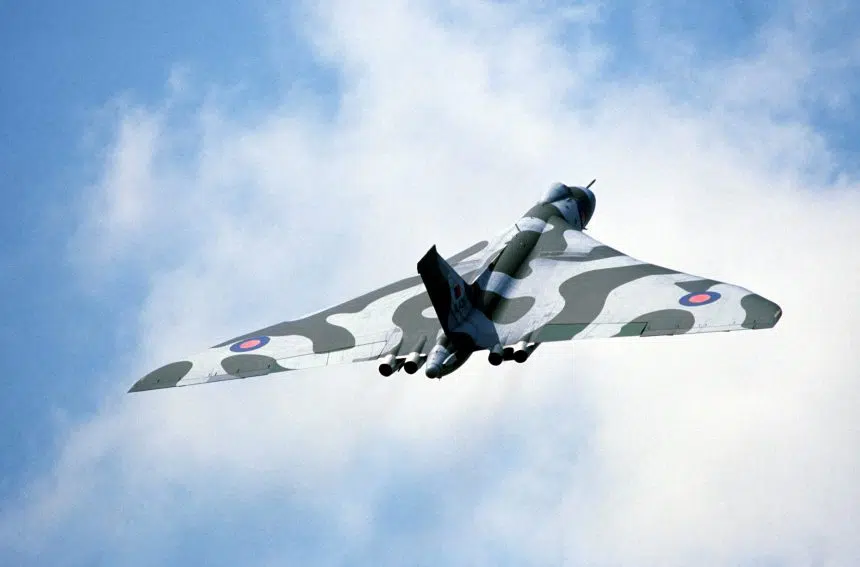
The Lancastrian and Shackleton planes, based on the Lancaster design, were used for civilian and maritime reconnaissance. The Tudor was a pressurized airliner made by Avro, with only 34 units produced. It struggled to compete after its first flight in June 1945, especially after the cancellation of a BOAC order. The Avro York had more success and played an important role in the Berlin Airlift. The Vulcan bomber, designed for nuclear strikes, was important in maintaining the British nuclear deterrent. It also saw action during the Falklands War in 1982, and some have been preserved as museum exhibits. The Avro 748 was a twin-turboprop airliner developed in the 1950s. It sold well and was used by the RAF for the Queen’s Flight and as the Andover variant with a rear-loading ramp. In July 1963, the company was taken over by Hawker Siddeley Aviation and ceased to use the Avro name. The Avro brand had a strong heritage, so British Aerospace used the name “Avro RJ” for some regional jets from 1994 to 2001. These models include the RJ70, RJ85, and RJ100, which were based on the BAe 146-100, BAe 146-200, and BAe 146-300, respectively. This aircraft type is sometimes called the “Avro 146.” The BAe ATP (Advanced Turbo Prop) was developed from the Avro 748 and is still in use for short, mainly domestic flights. Some of the Avro 504s, Ansons, Tutors, and Lancasters are still flying. The Shackleton held the record for the longest active service in the RAF at 39 years until the English Electric Canberra surpassed it in 1998.










It’s so nice to see these histories of vintage aircraft we all grew up with.
Very well documented. Thank you.
A wonderful over view that I enjoyed