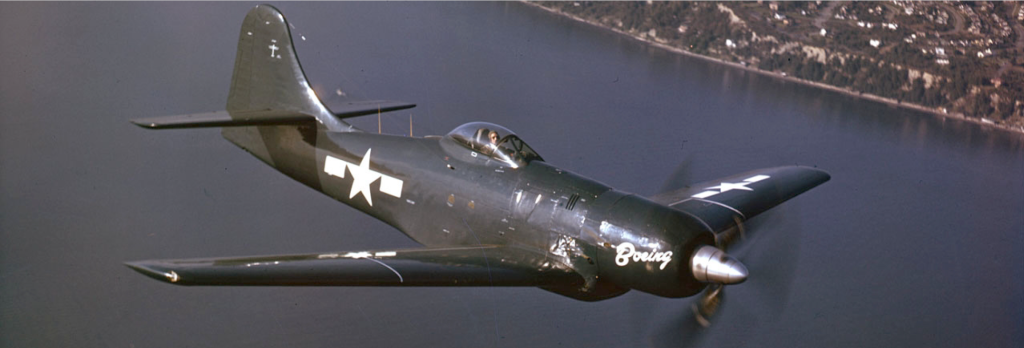
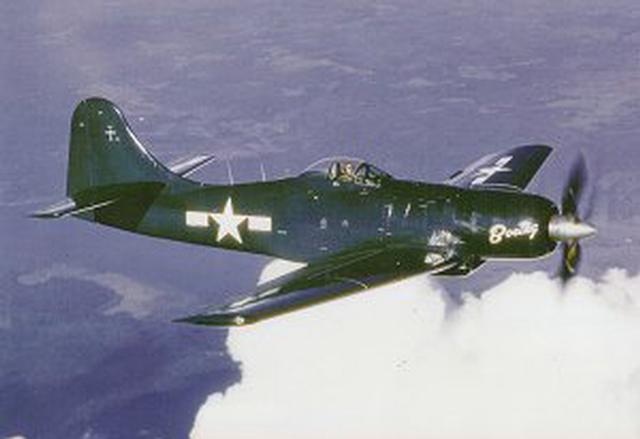

During WWII, the US Navy wanted a long-range fighter aircraft that could launch from aircraft carriers to attack the Japanese home islands. As a result, Boeing developed an aircraft that was the largest and heaviest single-seat, single-engine fighter made in the US at the time. The aircraft, designated the Boeing XF8B, could serve as a fighter, interceptor, torpedo bomber, dive bomber, and level bomber, due to which people also called it the “five-in-one fighter.” The US Navy awarded Boeing a contract for three prototypes on May 4, 1943. However, only one prototype was completed before the war ended, which first flew in November 1944. The two remaining prototypes were finished after the war.
Design of Boeing XF8B
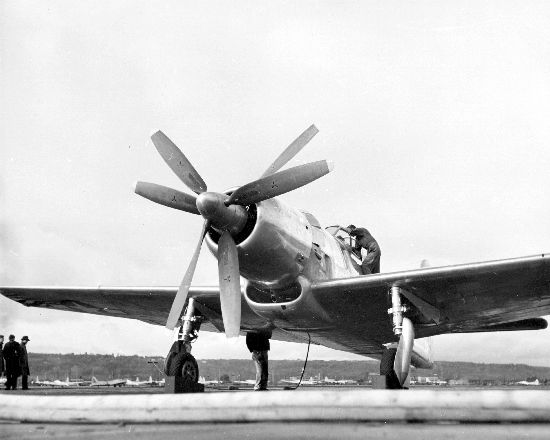
The Boeing XF8B was 43.3 feet long, 16.3 feet high, with a wingspan of 54 feet and a wing area of 489 square feet. The empty weight of the aircraft was 13,519 pounds, the gross weight was 20,508 pounds, and the maximum takeoff weight was 21,691 pounds. The aircraft was powered by a Pratt & Whitney XR-4360-10 28-cylinder air-cooled piston engine, producing 3,000 horsepower for takeoff and 3,600 horsepower in War Emergency Power mode with water injection. The aircraft was equipped with two 3-bladed Aeroprop propellers with a diameter of 13 feet 6 inches. The aircraft was envisioned to have a maximum speed of 450 mph, a cruise speed of 190 mph, a range of 2,800 miles, and a service ceiling of 37,500 feet. The Boeing XF8B could be armed with six 20 mm cannons or six 12.7 mm machine guns. It had provisions for rockets under the outer wings and could carry either 6,400-pound bombs or two 2,000-pound torpedoes. The aircraft had large wings that could fold up at the ends. Its body included an internal space for bombs and large fuel tanks, with additional fuel carried outside.
The Cancellation
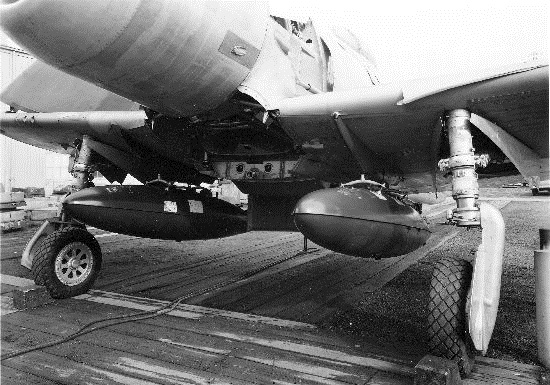
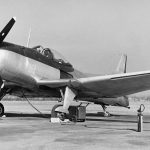
The final design featured a bubble-shaped canopy, strong landing gear that tucked into the wings, and a vertical tail similar to that of the B-29. To speed up testing and evaluation, the first two Boeing XF8B prototypes were equipped with a tandem seat, which allowed a flight engineer to assist in monitoring the test flights. The extra seat fit easily in the spacious cockpit. Boeing continued testing the XF8B concept until 1946 for the US Army Air Forces (USAAF) and 1947 for the US Navy. However, after the war in the Pacific ended, changing strategies led Boeing to focus on building large land-based bombers and transports. The rise of jet fighters caused many wartime projects with piston engines to be canceled. As a result, the US Air Force lost interest in the Boeing XF8B, and the US Navy was only willing to provide a small contract. Finally, Boeing decided to end the XF8B program. During tests at Boeing Field, a test pilot accidentally retracted the aircraft’s landing gear while approaching for a landing, forcing the XF8B to land on its belly. An investigation found that a faulty microswitch caused this mistake. As testing ended, the prototypes were scrapped one by one, the last in 1950. In the Grounded Dreams series, the Boeing XF8B was the victim of the end of WWII and the arrival of the jet age. Read more Grounded Dreams articles HERE.