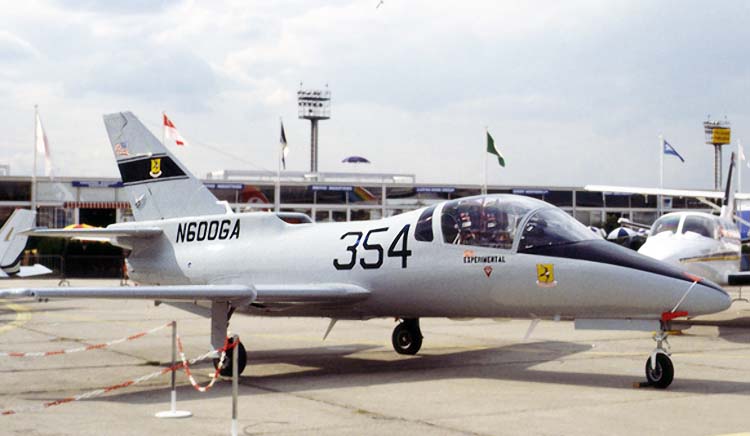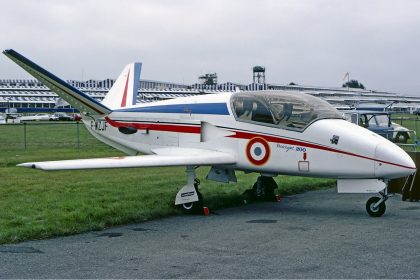
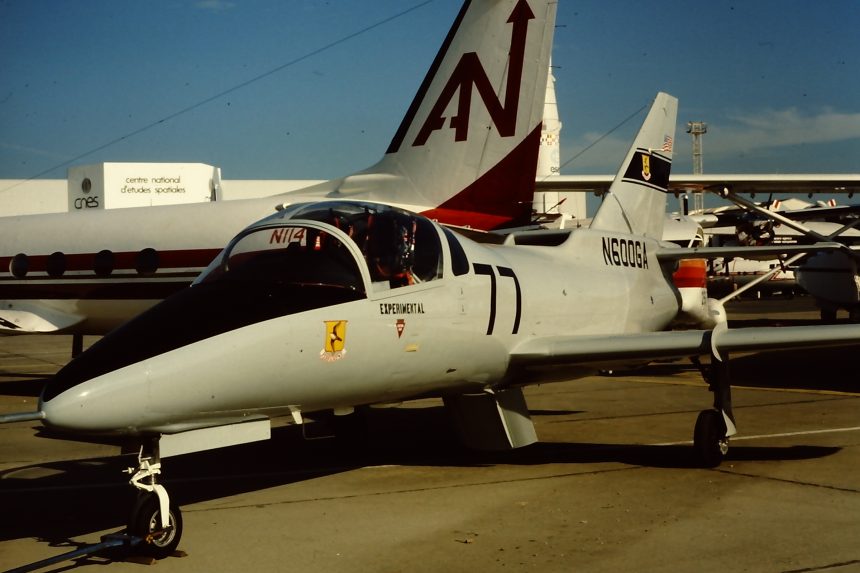

In the 1980s, Gulfstream, known mainly for its business jets, wanted to start making military aircraft. When the US Air Force announced its “Next Generation Trainer” program, Gulfstream chose to improve its American Hustler prototype as a possible option. The American Hustler was a prototype executive plane that used a mixed propulsion system, with a nose-mounted turboprop and a tail-mounted turbofan. Based on the Hustler, the company developed the Gulfstream Peregrine 600. The aircraft had the same wings, tail, and rear fuselage as the Hustler. However, it was equipped with a new front body that allowed the pilot and instructor to sit side by side.
Design of Gulfstream Peregrine 600
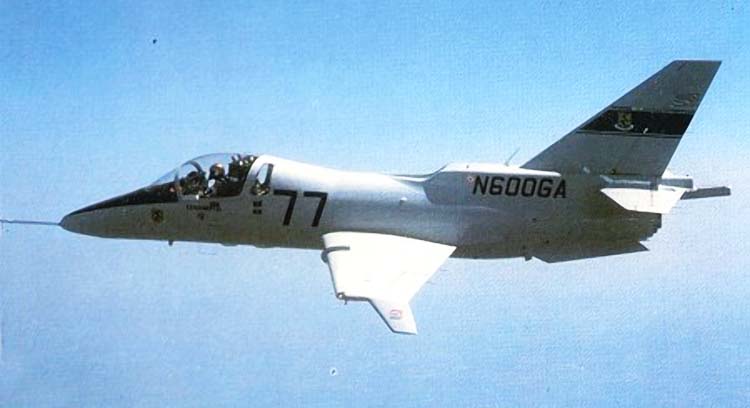
The first and only Gulfstream Peregrine 600 prototype, once the aircraft was converted into a military trainer, took to the skies for the first time on May 22, 1981. The aircraft was a serious contender for the US Air Force’s new trainer search. With a crew of two, the aircraft was 38.4 feet long, 13.5 feet high, with a wingspan of 34.5 feet. The gross weight of the aircraft was 5,254 pounds and the maximum takeoff weight was 6,199 pounds, and the normal landing weight was 4,402 pounds. It was powered by a Pratt & Whitney Canada JT15D-4 turbofan engine, producing 2,500 pounds of thrust. The maximum speed of the Gulfstream Peregrine 600 was expected to be 453 mph at 20,000 feet, with a stall speed of 76 mph, a range of 1,240 miles at 40,000 feet, a service ceiling of 48,000 feet, and a rate of climb of 5,200 feet per minute at sea level. To take off over a 50-foot obstacle, the aircraft needed 489 feet of runway. For landing over a 50-foot obstacle, it only needed 639 ft of runway. There were two versions of the Peregrine. One had side-by-side seating and a single Pratt & Whitney Canada JT15D-4 turbofan engine with 2,500 lbf (11 kN) of thrust. The other had tandem seating and two Williams WR44 turbofan engines, each providing 1,500 lbf (7 kN) of thrust.
The Cancellation
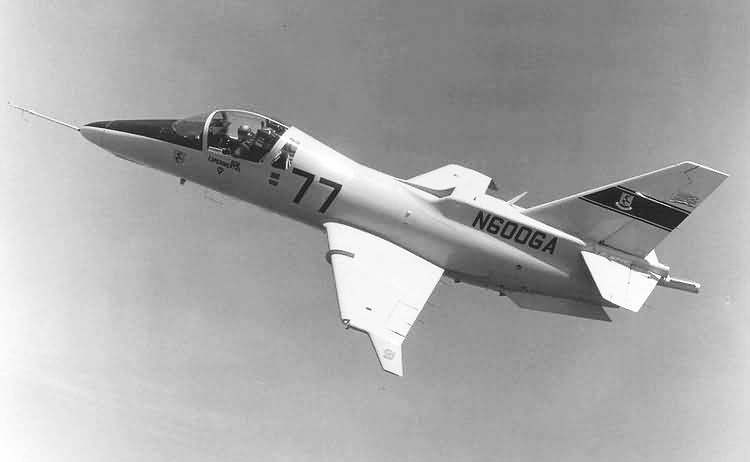
In June 1983, the Gulfstream Peregrine 600 was shown for the first time at the Paris Air Show in Le Bourget. Later, during testing, the aircraft crashed shortly after taking off from Wiley Post Airport on November 23, 1983. The pilot, Bill Lawton, had to eject after losing control of the plane, and the Peregrine project was canceled in 1985 after another setback. Finally, Gulfstream’s Peregrine 600 aircraft was not chosen for production; instead, the Fairchild T-46 was selected, which also did not enter production. To promote the Peregrine 600 program, Gulfstream tried to sell the aircraft to the air forces of Australia, New Zealand, Japan, and China. However, these marketing efforts were not successful. Another popular Gulfstream aircraft at the time was the Commander Fanjet 1500 business jet, which first flew on January 14, 1983. It also visited Le Bourget in June 1983 with the registration. After the cancellation of the Gulfstream Peregrine 600 military trainer, the Fanjet 1500 was renamed Peregrine 550. In 1984, the company announced that it would start production. However, production issues and not enough orders led to the program’s end in 1985. The only plane was retired in March 1992. In the Grounded Dreams series, the Gulfstream Peregrine 600 aircraft could not prove its worth as both a trainer and a business aircraft. Read more Grounded Dreams articles HERE.