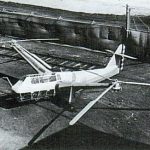
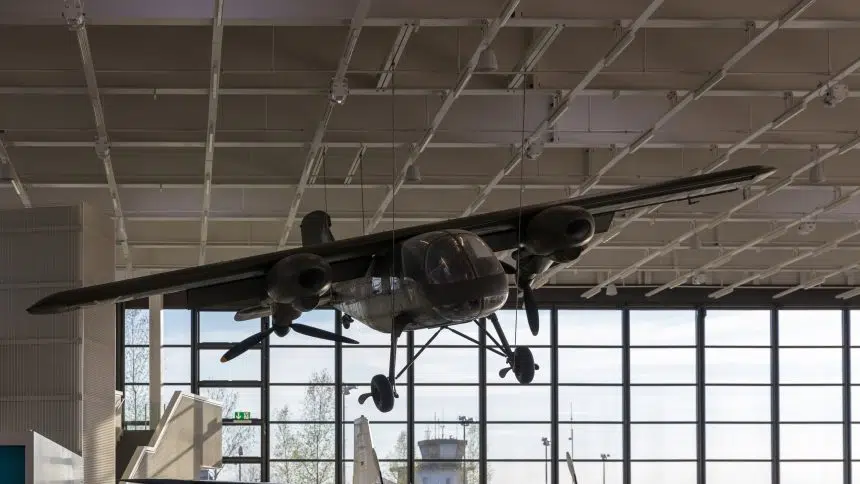


During WWII, engineer Heinrich Focke of the German helicopter company Focke-Achgelis designed a short-takeoff-and-landing aircraft. The plane was meant to use pusher propellers, with one on each wing, to create downward thrust and improve lift. The design was called the Fa 269, but it was not developed because of the war. In the 1950s, renewed interest in short takeoff and landing and vertical takeoff and landing aircraft led to a fresh look at Focke’s ideas. Dornier received a contract to develop an aircraft to demonstrate a tilting propeller system. The company designed the Dornier Do 29, which was based on the Do 27 light transport. The Dornier Do 29 had twin Lycoming GO-480 engines mounted below the wings. These engines drove three-bladed pusher propellers that could tilt downward to an angle of up to 90 degrees. The engines were connected so they could maintain equal thrust even if one engine failed.
Design of Dornier Do 29

The front fuselage was redesigned to include a helicopter-style cockpit. A Martin-Baker ejection seat was added to help the pilot escape in emergencies. The earlier Dornier Do 27 could hold 4 or 5 passengers, while the Dornier Do 29 was expected to carry a similar number, 4 to 6 passengers. The aircraft was 31.2 feet long, 8.10 feet high, with a wingspan of 43.4 feet and a wing area of 235 square feet. Its empty weight was 4,806 pounds, the gross weight was 5,291 pounds, and the maximum takeoff weight was 5,490 pounds. Its maximum speed was envisioned at 180 mph, with a range of 250 miles and a service ceiling of 21,300 feet. Two Dornier Do 29 aircraft were built, and a third was planned but never made. The first prototype flew on December 12, 1958.
The Cancellation

During flight tests, the propeller system only rotated 60 degrees instead of its full 90 degrees, but the aircraft performed very well. Its stalling speed was 15 mph, and it showed excellent short-field performance. However, testing had problems. In July 1962, one of the two Dornier Do 29s was damaged and written off. The second aircraft continued testing for another year before retirement. The aircraft was expected to need an 82-foot takeoff run, but some reports say it required a 262-foot takeoff run and a 147-foot landing run. After testing, the team decided not to continue developing the Dornier Do 29’s tilting-propeller system after the flight test program ended. In the Grounded Dreams series, the flight tests showed that the concept worked well. However, the aircraft was not developed further. Read more Grounded Dreams articles HERE.