
Originally formed as the Seversky Aircraft Company, the Republic Aviation Corporation was located in Farmingdale, New York, on Long Island. Seversky was founded in 1931 by Alexander de Seversky, a Russian who had moved to the United States after WWI. The company hired many engineers from Russia and Georgia. In 1936, it earned its first military contract for the Seversky P-35 fighter. In 1939, the company entered a military competition with an improved model, the AP-4, but lost to the Curtiss P-40. However, the US Army Air Corps still ordered 13 for testing, naming them the XP-43. By April 1939, Seversky had lost $550,000, leading to the founder, Seversky, being removed from the company. The board, led by financier Paul Moore, chose W. Wallace Kellett as the new president. In September 1939, the company became the Republic Aviation Corporation. Seversky continued to fight for control of his company, and he did not reach a satisfactory resolution until September 1942. The AP-4 later became the P-43 Lancer, with 272 units produced. Of these, 108 were sent to China to help fight the Japanese, although many pilots favored the P-40. In the same year, Republic and Curtiss competed to create a lightweight interceptor. They developed the XP-47 and XP-46, both using an Allison V-1710 engine. However, neither design showed sufficient improvement over the P-40, so neither was produced. Further development of the P-43 led to the lightweight XP-44, which initially used a Pratt & Whitney R-2180 radial engine. When that engine underperformed, Republic switched to the Wright R-2600, but it also failed to meet expectations. Eventually, the company redesigned the aircraft to accommodate the powerful Pratt & Whitney R-2800 Double Wasp engine, which produced 1,850 horsepower. The P-44 could reach speeds of 404 mph at 20,000 ft and a climb rate of 4,000 ft per minute.

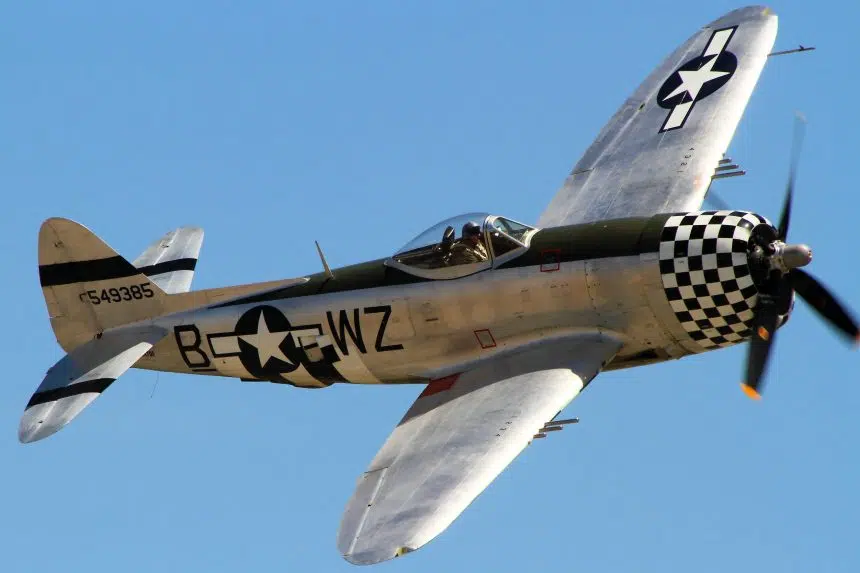
As the air war in Europe continued, the Army needed a long-range fighter to escort bombers. The P-44 was not suitable for this role. The setback led Alexander Kartveli to sketch a new design during his train ride back to New York City. It resulted in the development of the P-47 Thunderbolt. The US Army Air Forces (USAAF) did not fund the development of the XP-47B, so Republic Aviation paid for the first mock-up using the cockpit from the P-43. When the prototype was completed, it weighed more than 12,550 pounds, more than the Army’s limit. But the Army liked its performance, as it could reach speeds of 412 mph at 25,800 feet. When the US entered WWII in December 1941, demand for the XP-47 received a real push. By June 1942, the Army received the first P-47Bs and ordered Republic to expand its factory and build new runways. Throughout the war, the P-47 was continually improved. Production ended in November 1945, with 15,660 P-47s built, making it the most produced US fighter of the war. The long-range P-47N model continued to serve into the mid-1950s, and Republic ranked 24th among US corporations for wartime production contracts. In 1946, Republic switched from military contracts to making the Republic RC-3 Seabee, an all-metal amphibious plane designed by former test pilot Percival “Spence” Spencer. He wanted to create a light sport plane for the many pilots returning from WWII. Although the company expected to sell 5,000 units each year, it actually sold 1,060 Seabees over two years, which was good performance in the market. The Seabee’s low price, ranging from $3,500 to $6,000, helped boost its sales.

Later, Republic developed the YP-84A Thunderjet to meet the Army’s need for a fighter jet capable of reaching a top speed of 600 mph. The first flight took place on February 28, 1946, but development delays pushed back the F-84B’s entry into Air Force service until 1949. The straight-wing F-84D played an important role in the Korean War, completing 86,408 missions. In 1954, the swept-wing F-84F Thunderstreak began service after resolving more development issues. A photo-reconnaissance version, the RF-84F Thunderflash, was also produced. The F-84F remained in service with the Air National Guard until 1971, and several foreign operators used both the F-84F and RF-84F. The F-84F continued to serve in Europe until the 1980s. In 1951, Alexander Kartveli began designing a new fighter aircraft to replace the F-84 Thunderjet. This new aircraft, called the F-105, was a single-engine fighter, larger than any previous Air Force model. By October 1953, the mock-up was finished, and the aircraft was so big that it needed a more powerful engine, the Pratt & Whitney J75. On June 28, 1954, the Air Force ordered 15 F-105A Thunderchief planes. Each aircraft weighed 50,000 pounds and could carry 14,000 pounds of bombs. It could fly at Mach 1 at sea level and reach Mach 2 at higher altitudes. Even with just one engine, the F-105 could carry more bombs than a four-engine WWII bomber and fly faster and farther. The F-105 was the main ground attack aircraft during the Vietnam War, completing over 20,000 missions before the McDonnell Douglas F-4 Phantom II replaced it in November 1970. Out of 833 F-105s built, 397 were lost in the Vietnam War. The F-105 was the last aircraft independently designed by Republic Aviation. A two-seat version, called the F-105G or “Wild Weasel,” was later developed to replace the older “Wild Weasel” F-100. The F-105G first flew on January 15, 1966, and deliveries to Southeast Asia began in June 1966.

In December 1957, Republic Aviation established a helicopter division and began producing the French Aérospatiale Alouette II under license. However, sales were limited. To keep the company afloat, Republic suggested turning a wartime four-engine reconnaissance aircraft, known as the XF-12 Rainbow, into a transport plane. The plane would be fast for a propeller aircraft, but airlines were not interested enough to continue development, so the project was canceled. Republic Aviation then tried to survive by returning to military contracts. In 1960, Republic acquired a minority stake in the Dutch company Fokker and tried to sell a Fokker-designed attack plane (the Fokker/Republic D-24 Alliance) to the Air Force. However, the Air Force showed little interest, and no contracts were made. In the early 1960s, Fairchild, a company owned by Sherman Fairchild, began buying Republic’s stock and eventually took over Republic Aviation in July 1965. By September, Republic became a part of the Republic Aviation Division of Fairchild Hiller. Fairchild Hiller continued the Republic naming system with the A-10 Thunderbolt II, which first flew in May 1972. In the fall of 1987, Fairchild Corporation destroyed Republic’s corporate archives. Joshua Stoff, the curator of the Cradle of Aviation Museum on Long Island, was invited to view the archives one last time. He secretly took one document with him. The document was a contract with Republic for 225 P-47Bs for the US Army Air Corps, costing $16,275,657.50. The contract, dated September 13, 1940, is now kept at the museum. The Long Island Republic Airport Historical Society is located in the lobby of the Republic Airport Main Terminal. It has several photo displays about aviation and aircraft related to Republic.