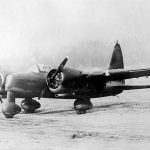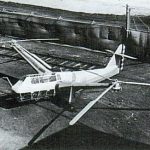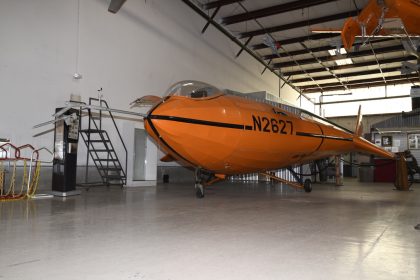
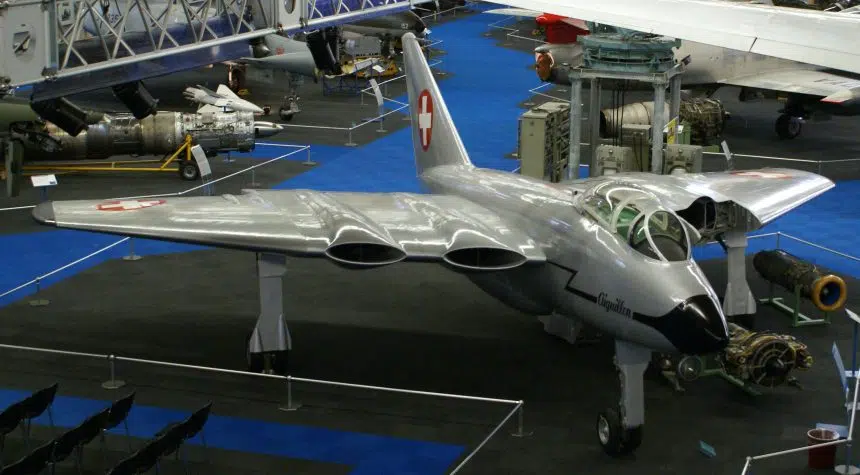

After WWII, the Swiss Federal Aircraft Factory designed Switzerland’s first jet fighter, designated EFW N-20 Aiguillon. The aircraft had four turbofan engines mounted in the wings. In flight, the aircraft could shut down two engines to extend its range. The EFW N-20 Aiguillon was designed to carry its weapons in a removable weapons bay that could hold large items like cannons, rockets, or bombs. The aircraft’s engines were originally planned to be designed and built in Switzerland by Sulzer. However, Sulzer produced only the Sulzer D-45 turbojet engine, which produced 1,660 lbf of thrust. As a result, the Armstrong Siddeley Mamba turboprop powered the N-20 prototype. EFW called the new engine the Swiss Mamba SM-1. A total of six engines were built, with four installed in the EFW N-20 Aiguillon and two as spares. Flight tests began in October 1952 using a de Havilland Mosquito.
Testing of EFW N-20 Aiguillon

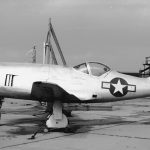
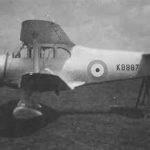
Swiss industry lacked experience with jet aircraft and their aerodynamics, so it created several wind tunnel models. The industry also built a 3/5th scale wooden glider called the EFW N-20.01 to test a new wing shape. This glider flew on April 17, 1948. It had a JATO solid rocket motor that could be started independently to help it reach the required altitude for testing. The nose gear came from a de Havilland Vampire, and the main landing gear from a Messerschmitt Bf 109; both were retractable and electrically operated. The body was made of wood and covered with fabric. However, the N-20.01 was destroyed in a landing accident on July 1, 1949, at Emmen Air Force Base. The glider successfully proved the design. After that, a similar-sized powered test aircraft was introduced, designated the EFW N-20.02 Arbalète. The aircraft was powered by four Turboméca Piméné turbojets, each producing 220 lbf, and mounted above and below the wings. It first flew on November 16, 1951. The Arbalète demonstrated good maneuverability and reached a maximum speed of 466 mph. The full-scale N-20 aircraft was expected to reach a maximum speed of 680 mph.
The Cancellation

However, the first converted Mamba engine, the SM-1, did not produce enough thrust during its 1948 test flight under a de Havilland Mosquito. The engine was the first turbofan to fly but required more development. The final model, the two-shaft SM-5 engine, was designed to generate 3,300 lbf of thrust. The prototype was finished in 1952 and used four SM-1 engines. It flew during a taxi test on April 8, 1952, but the development of this engine and the N-20 aircraft was canceled soon after. During testing, the engines did not produce the needed thrust, leading to cancellation of the project and the start of the N-20.20 project. The aircraft was similar to the N-20 but featured one conventional engine, a Rolls-Royce Avon or Armstrong Siddeley Sapphire turbojet, mounted in each wing root. The wings were slightly thinner, and the main landing gear was positioned closer to the fuselage, as there was no longer a need to place engines within the wings. The N-20.20 was never completed, although some wind tunnel models were made. Read more Grounded Dreams articles HERE.