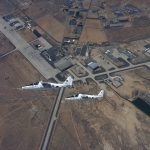
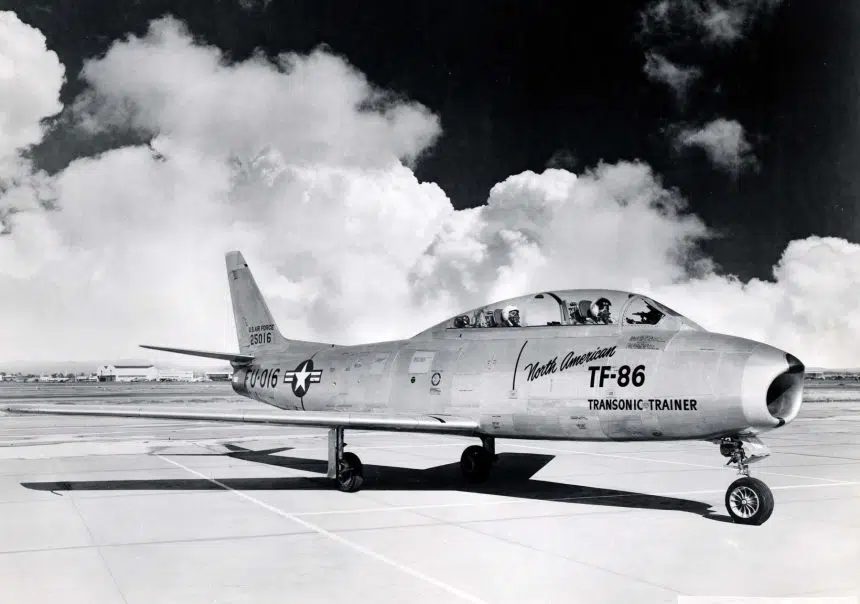

The F-86 Sabre was an effective fighter during the Korean War, where it fought against the MiG-15 fighters from China and North Korea. The F-86F model replaced the earlier F-86A and F-86E models. It had a “6-3” wing design without the slats found on previous models. This wider wing, which had an extra 6 inches at the base and 3 inches at the tip, along with small boundary layer fences, improved its maneuvering performance at high speeds. The F-86F served as both a fighter and a fighter-bomber during the later stages of the war, taking over the roles of the F-80 and F-51 aircraft that were still in use in Korea in 1952. In the 1950s, a two-seat training version of the aircraft was also made, designated the North American TF-86F. On February 3, 1953, North American Aviation (NAA) started designing a two-seat F-86F to replace the USAF’s T-33 trainer.
Design of North American TF-86F

The company began constructing the North American TF-86F, then known as the NA-204, on April 8, 1953. The new aircraft was a modified F-86F-30 with a 63-inch extension to the forward fuselage to accommodate a second cockpit. To balance the aircraft after this change, the designers moved the wings forward by 8 inches. The trainer was envisaged to have a one-piece clamshell canopy instead of the sliding type used in the fighter version. The North American TF-86F carried no weapons. Another difference was the use of a slatted wing, rather than the fixed ‘6-3’ leading edge found on the fighter. The first plane, 52-5016, first flew on December 14, 1953, and had performance similar to the F-86F. On March 17, 1954, NAA test pilot Joe Lynch flew the aircraft for the ninth time from Nellis AFB. During takeoff, he attempted a slow roll, but the plane crashed and exploded, killing Lynch.
The Cancellation

Investigators found that base personnel had filled the fuel tanks to full when they should have only partially filled them according to the flight plan. The extra weight left the pilot with no room for error. Later, the Air Force approved building a second aircraft, called the NA-216. The company converted the last F-86F-35 to this new design, making further changes based on previous tests. The new version of the North American TF-86F included an extended vertical tail and a ventral fin. It also had two .50-caliber guns, underwing pylons, and a slatted wing. The aircraft, 53-1228, first flew on August 5, 1954, but on February 7, 1955, the Air Force announced it would not buy any production models. By the time the second prototype flew, early jet technology was improving, and the military was already focusing on faster jets, like the F-100 Super Sabre, which made it less appealing to buy a slower trainer based on the F-86 design for the long term. On March 10, the aircraft moved to Edwards AFB to serve as a chase plane. It served successfully at Edwards before being retired in November 1958 and scrapped in March 1961. Read more Grounded Dreams articles HERE.