






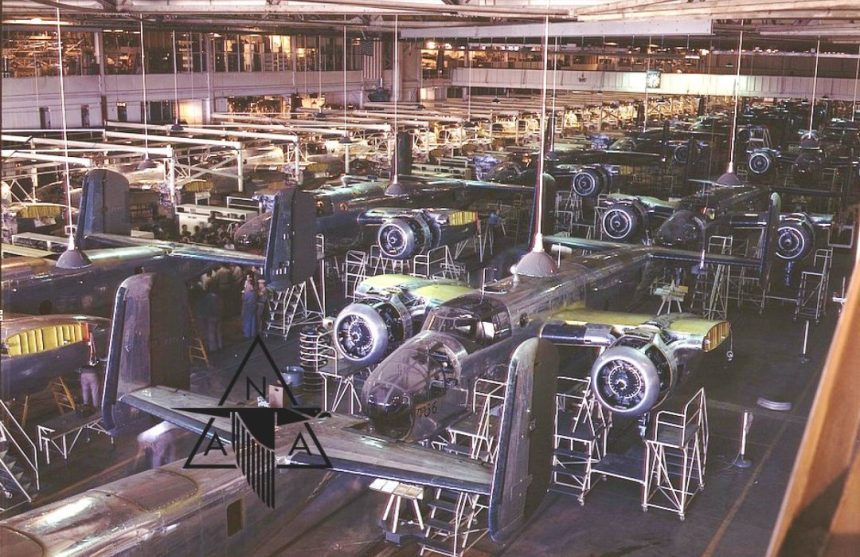

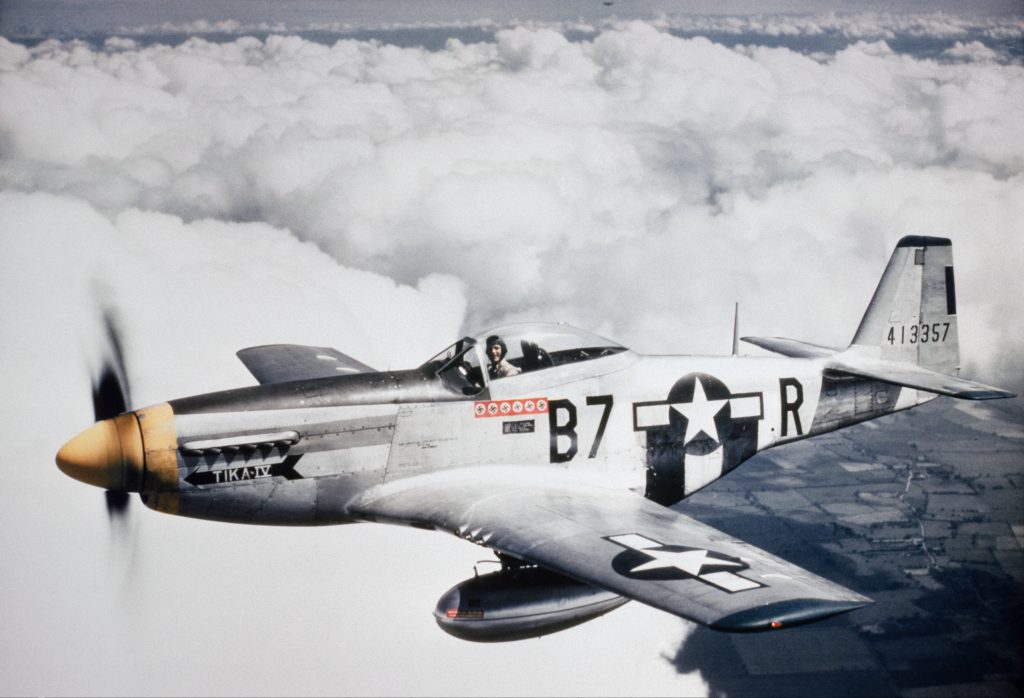
One of the most iconic US aircraft in WWII was the P-51 Mustang. The P-51 could fly with and protect British and American bombers all the way to Berlin and back. By 1944, the Allies had control of the air over Western Europe, mostly because of the Mustang. The company that developed the Mustang was North American Aviation, founded by Clement Melville Keys to hold various airlines on December 6, 1928. After the Air Mail Act of 1934 forced the breakup of such companies, NAA shifted to manufacturing under James H. “Dutch” Kindelberger, who came from Douglas Aircraft. General Motors bought a controlling interest in 1933 and combined NAA with the General Aviation Manufacturing Corporation, keeping the North American Aviation name. Kindelberger moved operations from Maryland to Los Angeles to focus on training aircraft, beginning with the GA-15 and GA-16 models. North American Aviation’s first combat aircraft in 1937 was the BC-1, based on the GA-16. In 1940, the company expanded for wartime production, opening factories in Ohio, Texas, and Kansas, and ranking eleventh in wartime contracts. Its most famous aircraft included the T-6 Texan trainer (17,000 units built) and the B-25 Mitchell bomber (famous for the Doolittle Raid). The P-51 Mustang was initially made for Britain but became a top American fighter by switching to the Rolls-Royce Merlin engine (over 15,000 built). After WWII, North American Aviation’s employment dropped sharply from 91,000 to 5,000 in 1946. On V-J Day, North American Aviation had orders from the US government for 8,000 aircraft. However, a few months later, those orders fell to only 24. In 1948, General Motors sold North American Aviation as a public company. Still, the company designed the T-28 Trojan trainer, the F-82 Twin Mustang fighter, the B-45 Tornado jet bomber, the FJ Fury fighter, the AJ Savage, the XB-70 Valkyrie Mach-3 strategic bomber, the Shrike Commander, and the T-39 Sabreliner business jet.
North American Aviation’s Columbus, Ohio division built numerous aircraft, including the A-5 Vigilante used for naval reconnaissance during the Vietnam War, the OV-10 Bronco, and the T-2 Buckeye trainer. The T-2 Buckeye, which trained many Naval Aviators from the late 1950s until 2008, was named after Ohio’s state tree and the mascot of Ohio State University. The North American F-86 Sabre, initially a modified Fury, became famous for shooting down MiGs during the Korean War. More than 9,000 F-86 Sabres were built, making it the West’s most produced military aircraft after WWII. The F-100 Super Sabre, its successor, was also successful. North American built 6,656 F-86s in the United States. To keep pace with rising demand, the firm expanded in Columbus and constructed a new facility in Downey, California. By the close of 1952, total sales exceeded $315 million, and employment increased from 1,600 to 18,000. Nevertheless, the firm’s projections were hindered by the termination of the F-107, F-108, and Navaho programs in the late 1950s. North American Aviation formed Atomics International in 1955 from the Atomic Energy Research Department, which had been established in 1948 to support the development of early nuclear technology, including California’s first nuclear reactor, the Sodium Reactor Experiment. This reactor was the first one to supply power to a commercial grid in the US. Atomics International also created the SNAP-10A, the first nuclear reactor sent into space. As interest in nuclear power decreased, the company shifted to other energy projects like coal gasification. In 1978, it merged with Rocketdyne. In addition, Autonetics was founded in 1955 at North American’s Technical Research Laboratory. The division worked on guidance systems for the Minuteman ballistic missile. In 1963, it moved to Anaheim.
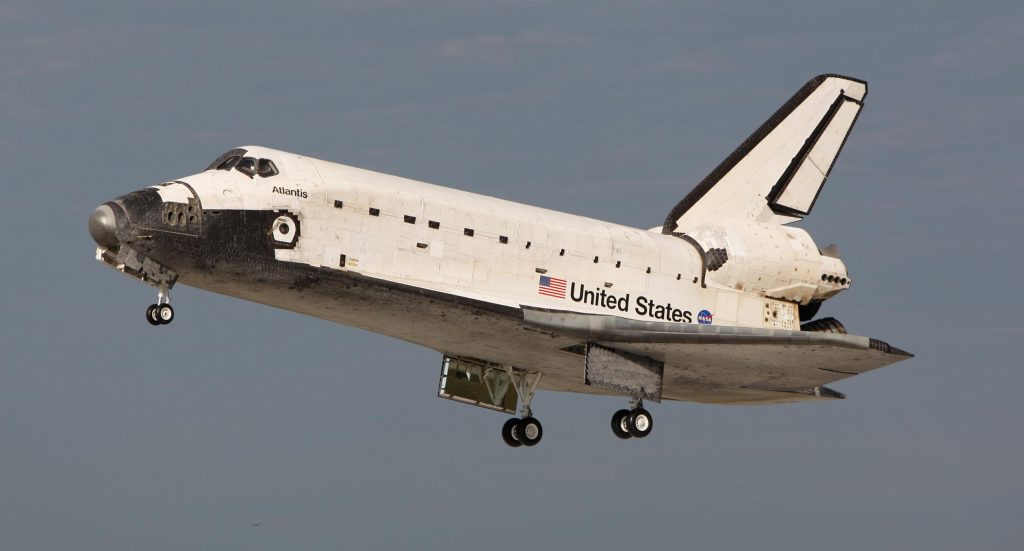
In 1955, North American Aviation established Rocketdyne as a separate company to make engines for missile programs and NASA’s Saturn rockets. North American also built the X-15 aircraft, tested Little Joe boosters for the Project Mercury spacecraft, and became the main contractor for the Apollo command and service module and other Apollo parts under CEO Lee Atwood in 1960. In January 1967, a fire on the Apollo 1 mission led to the deaths of three astronauts. Initially, the media blamed the company responsible. However, a later congressional hearing decided differently. In September of that year, the company merged with Rockwell-Standard, and the new name became North American Aviation Rockwell. The company continued to work on the Apollo program by building the Command and Service modules for all 11 missions. Within two years, they began exploring ideas for the Space Shuttle and won the contract for the orbiter in July 1972. In February 1973, the company changed its name to Rockwell International and renamed its aircraft division North American Aircraft Operations. In December 1996, Boeing bought Rockwell International’s defense and space divisions, which included the North American Aviation divisions Autonetics and Rocketdyne. The new group was initially named Boeing North American and was merged with Boeing’s Defense division. In 2005, Boeing sold Rocketdyne to UTC Pratt & Whitney. Later, in 2013, UTC sold Rocketdyne to Aerojet (GenCorp).North American Aviation produced trainer family included the NA-16, BT-9, BC-1, Harvard, BT-14, T-6 Texan, SNJ, NA-64 Yale, T-28 Trojan, XSN2J, and T-2 Buckeye.At the same time, its combat aircraft featured designs such as the P-51 Mustang, B-25 Mitchell, A-36 Apache, F-82 Twin Mustang, FJ Fury series, F-86 Sabre and F-86D Sabre, F-100 Super Sabre, A-5 Vigilante, OV-10 Bronco, and the Sabreliner business jet.
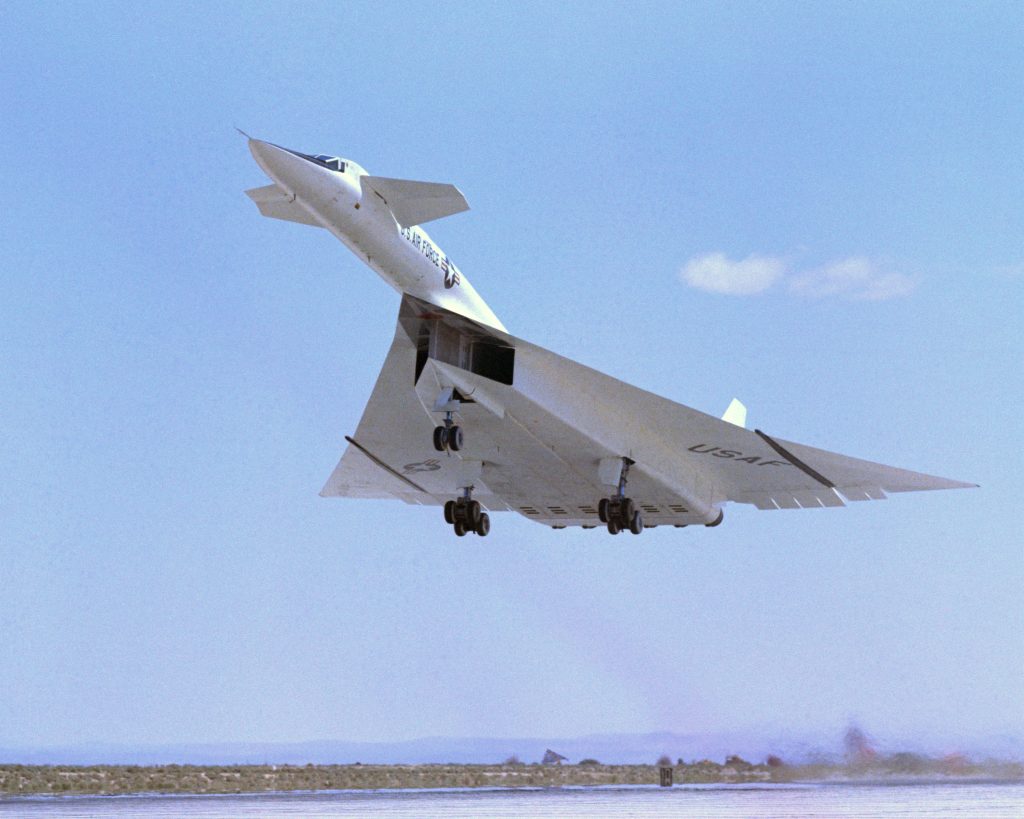
North American Aviation also built aircraft including the O-47, P-64, A-27, Navion, AJ Savage, B-45 Tornado, and experimental types such as the XB-21, XB-28, YF-93, XA2J Super Savage, F-107, X-10, X-15, and the Mach 3-capable XB-70 Valkyrie. Earlier prototypes and concepts included the NA-35 and numerous unbuilt projects such as the NA-116, NA-148, NA-237, NA-323, NA-365, NA-400, NA-420, NAC-60, and XF-108 Rapier.North American made several important space and missile systems, including the Apollo Command and Service Module, the Skylab Rescue spacecraft, and the Space Shuttle orbiter. North American Aviation also created the S-II second stage of the Saturn V rocket, as well as the Little Joe and Little Joe II launch vehicles. In the field of missiles, it produced systems like the AGM-28 Hound Dog, AGM-64 Hornet, RTV-A-3 NATIV, and SM-64 Navaho. North American also developed the MQM-42 Redhead-Roadrunner unmanned aerial vehicle.
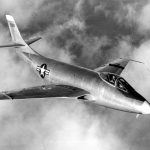
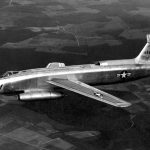
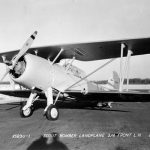
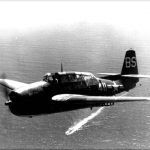


My father Dr Edward Van Driest was director of North American’s Downey Missile Division Space Sciences Laboratory that did original research on missile & booster rocket design with assistance of Caltech’s JPL wind tunnel and did research on moon & Mars habitation!
I’m sorry, but the Harvard, AT-6, and SNJ are the SAME aircraft, the same thing with the A-36, and P-51, once again they’re the same aircraft, along with the F-86D, that IS NOT A SEPARATE DESIGN FROM THE BASIC F-86 Sabre design. Now, the F-86 IS NOT A MODIFIED FJ Fury design, instead, the FJ Fury is derived from the original XP-86 design which had straight wings. The T-39 Sabreliner was first developed for the USAF’s UTX Competition, it was later further developed into a biz jet. Now, the XSN2J-1 was further developed into the T-28 Trojan.
I’m sorry, but you’re incorrect about Mustangs escorting British bombers, by the time the RAF began to fly their equivalents of the P-51B, and C Models, the RAF had been flying night bombing missions for three years, and as such they didn’t need escorts. Only USAAF bombers were escorted by Mustangs over Central, Eastern, Southern Europe, and in the CBI Theater. Plus, starting in March 1945, after Iwo Jima had been declared secured, 7th Air Force moved its Mustangs to Iwo Jima, so they could start escorting B-29 Superfortress bombers over Japan.