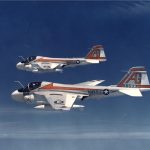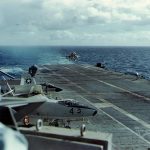

Attack Squadron 44 (VA-44) was established twice by the US Navy. The first VA-44 was established during the final stages of WWII but existed only briefly before being disbanded in 1950. The second squadron, created in the same year, fought in the Korean War and later became an important training unit for attack aircraft. The original VA-44 started as Bombing Squadron VB-75 on June 1, 1945. The squadron began operations just three days later, on June 4. After the war, it was renamed Attack Squadron VA-3B on November 15, 1946, and finally became Attack Squadron 44 on September 1, 1948. One of its most important missions occurred in January and February 1946, when VB-75 deployed on the USS Franklin D. Roosevelt for a shakedown cruise to the Caribbean and Brazil. During a stop in Rio de Janeiro, the squadron, along with the carrier and its air group, represented the United States at the inauguration of Brazilian President Eurico Dutra. However, the first Attack Squadron 44 had a short career after the war and was disbanded on June 8, 1950.

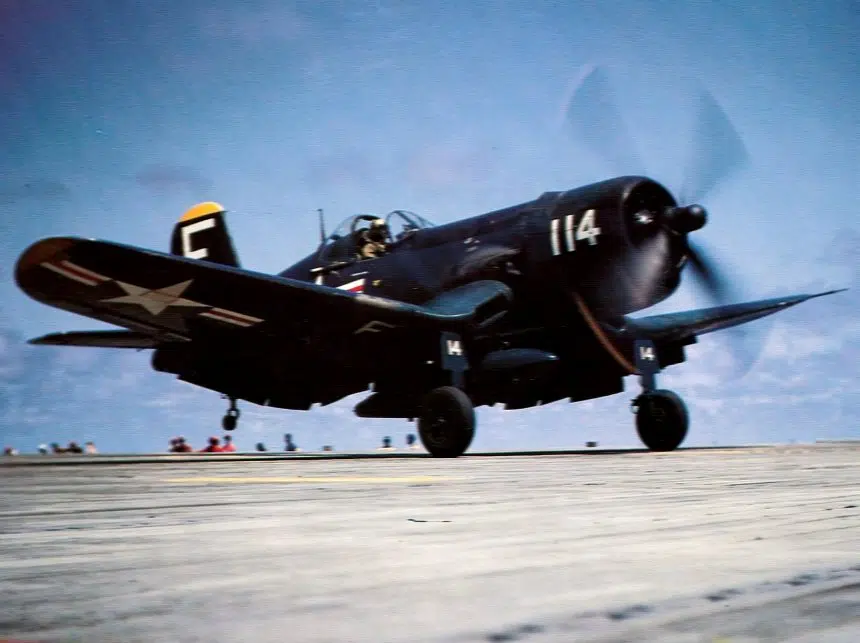
Just three months later, the Navy created a second Attack Squadron 44 on September 1, 1950. The new unit started as Fighter Squadron VF-44 and became known as the Hornets. The squadron began its service during a major transition in naval aviation, as piston-engine fighters were being replaced by jets. It first flew the Vought F4U-4 Corsair, and its first major combat deployment was in the Korean War. From March 30 to November 28, 1953, VF-44 served in Air Task Group 1 aboard the USS Boxer, conducting operations in Korea and the Western Pacific. On June 13, 1953, the squadron carried out its first combat operations, attacking targets in Korea. The deployment put the Hornets in the middle of the final stages of the Korean War, as US and United Nations forces fought against North Korean and Chinese forces. The squadron’s role changed after the Korean War. During a deployment on the USS Wasp in September and October 1957, its mission shifted from attack to fighter operations. The Hornets provided air protection for anti-submarine warfare squadrons operating from the carrier. On June 1, 1958, the Navy changed Attack Squadron 44’s mission from a light attack squadron to a Fleet Replacement Training Squadron. Its primary mission shifted from combat operations to training pilots and enlisted maintenance personnel for the Navy’s A4D squadrons on the East Coast. It made Attack Squadron 44 an important link between formal training and active naval aviation. Pilots in East Coast A-4 squadrons finished their flight training with VA-44 before joining their fleet units, while maintenance personnel received specialized training.

The transformation accelerated on June 6, 1958, when Fleet All Weather Training Unit Detachment ALFA was disbanded, and its personnel and aircraft were reassigned to Attack Squadron 44. Just two months later, on August 8, the squadron graduated its first replacement pilot under the new training program for attack aircraft. The squadron took on more training roles as the Navy introduced new attack aircraft. In January 1959, Attack Squadron 44 got its first Douglas AD Skyraiders and started training new personnel for the Skyraider and the A4D Skyhawk. The Skyhawk became the squadron’s main focus. VA-44’s training program expanded during the 1960s. On November 15, 1961, the squadron graduated its 1,000th enlisted maintenance trainee on the A4D Skyhawk, showing how much its training mission had expanded. In February 1963, the squadron’s role changed again. On February 15, the propeller-training section was removed from VA-44 and became a separate squadron called VA-45. With the propeller aircraft training mission separated, VA-44 focused on jet training. It became a jet squadron that operated aircraft including the A-4B, A-4C, and TF-9J Cougar. It marked a major shift from the squadron that had entered combat over Korea ten years earlier. Attack Squadron 44 evolved from a fighter and attack unit into a training organization responsible for preparing pilots and maintainers for the Navy’s growing fleet of jet attack aircraft. The second VA-44 stayed active until May 1, 1970, when it was disbanded.