

(Image credit: VAN)
Seventy-three years ago today (September 28, 1952), the Dassault Mystère IV took to the skies for the first time. This French-built fighter-bomber became the French Air Force’s first transonic aircraft, marking a significant milestone in postwar European aviation. The Mystère IV was developed from the earlier Mystère II, featuring a wing sweep increased from 30° to 38°, thinner wing profiles, and refined aerodynamics. The historic flight took place at Aérodrome de Melun Villaroche, with test pilot Kostia Rozanoff at the controls, lasting 25 minutes for the prototype MD.454 Mystère IV.

The Mystère IV entered service with the French Air Force in April 1953. The initial 50 aircraft were powered by British Rolls-Royce Tay turbojets, while the remainder flew with the Hispano-Suiza Verdon 350 engine, producing 7,720 pounds of thrust. The aircraft could reach a maximum speed of 690 mph, climb at 7,900 feet per minute, and operate up to 49,000 feet. Its combat payload included two 30 mm DEFA cannons with 150 rounds each, up to 55 air-to-air rockets, and 2,200 pounds of bombs or other ordnance on four external hardpoints. With external fuel tanks, the Mystère IV had a range of 1,230 nautical miles.
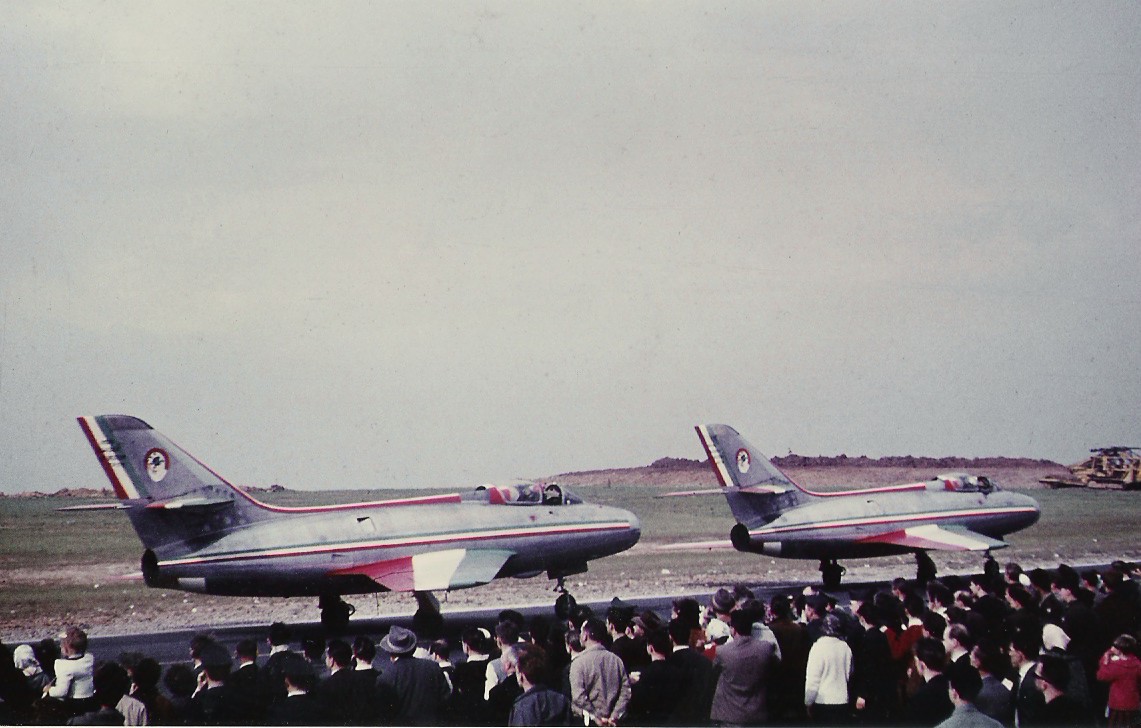
Beyond France, the Mystère IV served in the Indian and Israeli Air Forces. It saw combat during the Arab–Israeli wars and was deployed alongside French Mystères during the Suez Crisis. The aircraft remained in Israeli service until 1971 and in France through the 1980s. From 1953 to 1958, Dassault produced 411 Mystère IVs, including prototypes, the IVA fighter-bomber, the IVB with an afterburning engine, and the IVN two-seat all-weather interceptor. The Mystère IV also laid the foundation for the supersonic Super Mystère, which first flew in 1954. Several Mystère IVs survive today in museums. Notably, Mystère IVA s/n 57 is on display at the Pima Air & Space Museum in Tucson, Arizona, preserving the legacy of this pioneering transonic fighter.