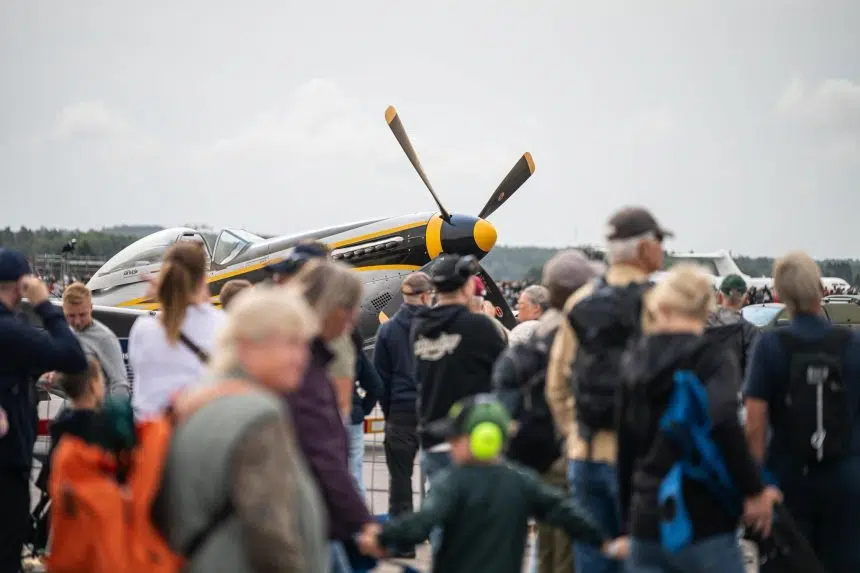

One of the most anticipated aviation events in the Nordic region for 2026, the Swedish Flygdagarna was certainly a huge success, attracting approximately 230,000 visitors over the course of two days. The event offered military personnel, civilians, curious onlookers, and aviation enthusiasts a veritable aerial feast, featuring extensive air and ground displays from both military and civilian organizations, besides showcasing Sweden’s defense capabilities. Visitors also had the opportunity to meet pilots, soldiers, technicians, and other Armed Forces personnel while learning more about their work. Amid numerous flyovers by classic aircraft, displays by aerobatic teams, and even mock dogfights between fighters, Flygdagarna marked the climax of the Swedish Air Force’s (Flygvapnet) jubilee year, taking place at one of the most hallowed sites for the Arm: Malmen Air Base in Linköping, the same site where in August 1912 one of the “fathers” of Swedish military aviation, Carl Cederström, established the first flying school in Swedish Territory, laying the foundations for the modern Swedish Air Force.

Morning Events
Both the 22nd and 23rd featured the same program, so visitors were able to enjoy the event’s attractions twice over. The activities began with a flyby of various trainer aircraft models used by the Swedish Air Force throughout its history, including the de Havilland DH 60T Moth Trainer (SK9), the de Havilland D.H. 82A Tiger Moth (SK 11), the Bücker Bü 181 Bestmann (SK 25), and the Saab 108 (SK 60). In all, 10 aircraft made up this first aerial demonstration.

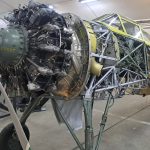
Next up were solo displays by two aircraft of very distinct phases of the Swedish Air Force: first, the Grob G 120TP (SK 40), incorporated in 2023 as its new Basic Trainer Aircraft, substituting the old Saab 105. The machine was followed in the skies by a living legend of the Swedish Air Force, the Saab B 17A. Developed as a single-engine recon/dive-bomber, the machine was the backbone of Sweden’s force of light bombers during WWII, serving up in the force’s ranks up till early 50s.

Next up was another formation display, this time performed by Team 50, consisting of five Saab Safir SK 50 trainers. Soon after came the program’s first jet fighter flyby, performed by Swedish Air Force Historic Flight (SwAFHF) J32B Lansen. The Lansen display was just a preview of the day’s first aerobatic show, which was to be performed by the Finnish team Midnight Hawks, flying BAe Hawks. The event was followed by another half dozen flying demonstrations, including a four-ship display of D.H. 82A Tiger Moths (SK 11), and even a flypast by a Thulin/Blériot XI.

Another highlight of the morning shows was the performance of a Supermarine Spitfire PR Mk. XIX. This WWII veteran, serial no. PS853, actually belongs to the Rolls-Royce Heritage Flight based at East Midlands Airport (UK), taking part in the Flygdagarna thanks to an agreement between the British company and Swedish authorities. For the occasion only, the aircraft received a special livery based on the recon Spitfires, known locally as S 31, that were operated by the Swedish Air Force’s F 11 Wing (Nyköping) in the late 40s.

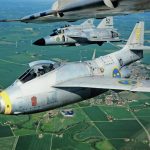
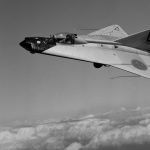
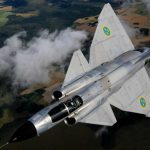
However, it is undeniable that the two highlights of the morning program were the flying demonstrations by the Swedish Air Force Historic Flight and the British aerobatic team Red Arrows. The first, which took to the skies in a formation of six Swedish-made jets (J29F Tunnan, J32B Lansen, J 35J Draken, AJS 37 Viggen, Saab 105 SK 60, and JAS 39 Grippen), demonstrated the evolution of the Swedish aeronautical industry and air power over the decades, while the second, showcasing its world-renowned professionalism, put on an amazing show that brought the morning’s activities to a close.

Afternoon Demonstrations
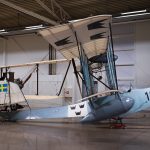
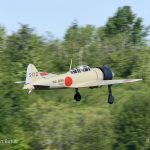
The break that followed was welcome to everyone present, who were able to catch their breath after so many thrills. But just before two o’clock, it was time to turn the eyes back to the skies, and what a sight! Announcing its arrival with the characteristic sound of a rotary engine, a reproduction of a 1920s FVM Ö1 Tummelisa performed several flybys over Malmen Airbase, reminding those present of the long-gone golden age of aviation.

Other demonstrations featuring classic aircraft followed, one of which showcased a formation flight between Flygande Veterans Association Douglas C-47A-60-DL “Daisy” and Duxford’s collection Catalina “Canso A.” Another highlight of the afternoon program was a display of three early Cold War-era fighters—a PZL-Mielec Lim-2 (Polish licensed version of the MiG-15bis), a Canadair CL-13B Sabre Mk.6 (Canadian-made F-86), and a Saab J29F Tunnan—during which, in addition to flybys, attendees had the opportunity to witness brief mock dogfights between the MiG and Canadair jets.

The famous Italian Frecce Tricolori squadron was also present at the event, and, living up to its unofficial title as the world’s best aerobatic team, delivered flawless performances that thrilled the audience with the precision of every movement in the aerial ballet performed by the nine Aermacchi MB-339 jets. But it was still only mid-afternoon, and several attractions were yet to come…

After a flypast of various aircraft operated by the Swedish Army Aviation (including fixed-wing and rotary-wing aircraft), it was time for modernity to shine, with a Typhoon, followed by a J37, performing solo displays. But the historic warbirds needed a proper send-off from the event, and this was provided by the Biltema Nordic Services Airshow unit, featuring a Spitfire LF Mk.XVIe and a Cavalier F-51D Mustang. After that, the program reached the home stretch, with other jet demonstrations wrapping up the presentations for both days.

Following Celebrations
Flygdagarna was just one of the events marking the Swedish Air Force’s centennial year, which also included celebrations at various locations across the country as well as a special flyover of Stockholm held in early July. The celebrations, however, will continue throughout the fall, with the Air Force Command visiting former and current Air Force bases across Sweden. At each stop, wreath-laying ceremonies will be held at memorials to honor past generations while recognizing the commitment of today’s personnel and those who will shape the future of the Air Force.