






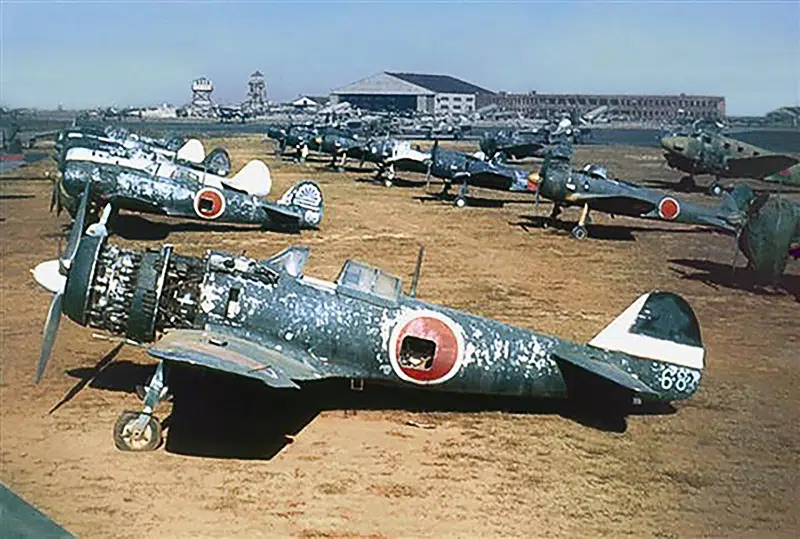

In 1918, naval engineer Chikuhei Nakajima and textile manufacturer Seibei Kawanishi founded Japan’s first aircraft manufacturer, called Nihon Hikoki (Nippon Aircraft). In 1919, the two founders of the company separated, and Nakajima took over Nihon Aircraft’s factory with some support from the Imperial Japanese Army. That same year, he renamed the company Nakajima Aircraft Company. Nakajima began by building aircraft himself and faced many failures before developing the Type IV. Its good performance led the Army to order 20 aircraft in 1919, allowing Nakajima Aircraft to begin large-scale production. In 1924, he opened a factory in Tokyo and started producing engines. After establishing his business, Nakajima entered politics. He was first elected to the House of Representatives in 1930 and later served as a cabinet minister in the Konoe and Higashikuni cabinets. Just about the time Nakajima resigned as president, the world began to show signs of trouble. Various airlines in Japan were asked to develop prototypes and compete to increase fighter plane production. In 1932, the Type 91 fighter plane developed by Nakajima Aircraft was officially adopted by the Army. In 1937, when the Sino-Japanese War began, the Type 97 fighter plane, the Army’s first all-metal low-wing monoplane, became the standard aircraft. In 1941, the Type 1 fighter plane known as the Hayabusa was officially adopted by the Army, and in 1944, the Type 4 fighter plane known as the Hayate was adopted.

Nakajima Aircraft was responsible for making the Army’s main fighter plane. Meanwhile, the Navy chose the Type 96 Carrier Fighter from Mitsubishi Heavy Industries. The Mitsubishi A6M Zero Fighter became the Navy’s main fighter aircraft from 1940. The Zero Fighter used an air-cooled 14-cylinder radial engine of Nakajima Aircraft called “Sakae”. Nakajima Aircraft also had a license to produce the aircraft. Out of the 10,425 aircraft made, more than 60%, or 6,545, were built by Nakajima. The Nakajima Aircraft Company became a large weapons manufacturer during WWII. Along with Mitsubishi Heavy Industries, it was one of Japan’s two largest aircraft makers. Between 1927 and 1945, Japan produced a total of 30,578 fighter aircraft, and more than half of them, 16,763, were made by Nakajima Aircraft. However, Nakajima Aircraft became a target for strategic bombing in WWII. The company’s Ota plant, located near Ōta Station, was damaged by American bombing on February 10, 1945. The Koizumi plant, near Nishi-Koizumi Station, was also damaged by American bombing on April 3, 1945. After Japan lost WWII, Nakajima, one of the country’s largest aircraft manufacturers, had to close. The Supreme Commander for the Allied Powers halted all aircraft production, and Nakajima suffered as a consequence. Mitsubishi Heavy Industries diversified into shipbuilding and other forms of machinery, but Nakajima did not. Instead, it broke apart into smaller companies founded by its former managers, engineers, and workers.

The company was reestablished in 1953 as Fuji Heavy Industries. It made Fuji Rabbit scooters and Subaru cars. Another part of the company, Fuji Precision Industries, later became Prince Motor Company, which merged with Nissan in August 1966. In the mid-1950s, Fuji began producing military training planes and helicopters for the Japan Self-Defense Forces. In 2017, the company changed its name to Subaru Corporation. Nakajima produced many military aircraft, starting with early carrier fighters like the A1N, A2N, and A4N. Later, it made the A6M2-N Rufe float fighter, the J1N Gekkō night fighter, the J5N Tenrai interceptor, and the Kikka, Japan’s first jet aircraft. Its torpedo bombers included the B5N Kate and B6N Tenzan. For reconnaissance, the company created the E2N, E4N, E8N, and C6N Saiun. Nakajima also built dive bombers and heavy bombers, like the G5N Shinzan and G8N Renzan. It produced transports, including the L2D, and several Army fighters such as the Ki-27, Ki-43 Hayabusa, Ki-44 Shōki, and Ki-84 Hayate. Toward the end of the war, Nakajima worked on projects like the Ki-201 Karyū jet fighter and the Ki-115 Tsurugi special-attack aircraft. In addition to military work, Nakajima developed civilian aircraft, including the AT-2 passenger transport, the license-built Douglas DC-2, the Fokker Super Universal, and several modified military aircraft. The company also manufactured aircraft engines. It produced the Kotobuki, Hikari, Sakae, Homare, Mamoru, and Ha-5 engines, as well as later Ha-series engines. The Sakae engine powered both the Mitsubishi A6M Zero and the Nakajima Ki-43 Oscar, making Nakajima’s engine business important to Japan’s wartime aviation industry.








Love the article
Fuji Kogyo (a scooter manufacturer famous for the Rabbit scooter)Fuji Jidosha Kogyo (a coachbuilder specializing in car bodies)Omiya Fuji Kogyo (an engine manufacturing firm)Utsunomiya Sharyo (a builder of chassis and rolling stock/frames)Tokyo Fuji Sangyo (a corporate trading company)The Origin of the LogoThe iconic six-star Subaru logo represents the unity of these predecessor companies combined with the parent corporation itself, referencing the Pleiades star cluster (known as “Subaru” in Japanese). It was nice to learn about how it started. Thought this might help the story a little. Also, Fuji heavy industry decided to drop Datsun. That became the beginning of Nissan.