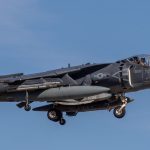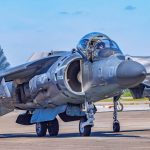
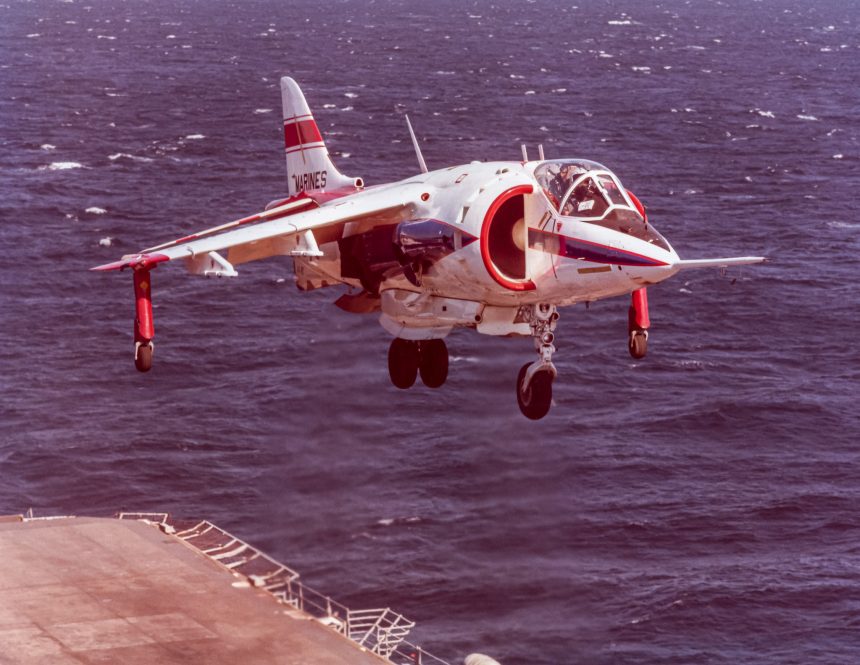

After fifty-five years of service, Marine Attack Squadron Two Twenty-Three (VMA-223) Bulldogs, based at Marine Corps Air Station (MCAS) Cherry Point, North Carolina, is in the final months as the last operator of the McDonnell Douglas (Boeing from 1997) AV-8B Harrier II. Having the final Harrier squadron operating out of Cherry Point is most apropos, as the very first Harrier squadron, VMA-513 Flying Nightmares, was activated at the air station on April 15, 1971, and accepted the first of 102 AV-8As and eight two-seat TAV-8As.
On November 9, 1978, just seven years after the AV-8A entered service, its replacement took to the sky for the first time. On that cold morning at Lambert Field in St. Louis, Missouri, McDonnell Douglas test pilot Charles Plummer performed a brief, seven-minute flight in YAV-8B #1 (converted from AV-8A 158394). This aircraft was followed by a second prototype (YAV-8B 158395) and four Full-Scale Development (FSD) aircraft (AV-8Bs 161396/399). The first production Harrier IIs were delivered to Marine Attack Training Squadron Two Zero Three (VMAT-203), the fleet training squadron, in December 1983, with the first operational squadron, VMA-331 Bumblebees, receiving its first aircraft in January 1985. Just eight months later, on August 2, 1985, VMA-231 Spades flew the final Marine Corps AV-8A flight. All of these squadrons were based at Cherry Point, the spiritual home of the Marine Corps Harrier community. Among the five single-seat and two dual-seat Harriers models operated by the Marine Corps over the last five decades, one variant, the AV-8C, served as an important gap between the first generation British-built Harriers and the home-grown Harrier IIs, but literature on this model is quite sparse, so VintageAviationNews sat down with former McDonnell Douglas test pilot, Jack Jackson for an inside look at the AV-8C program.
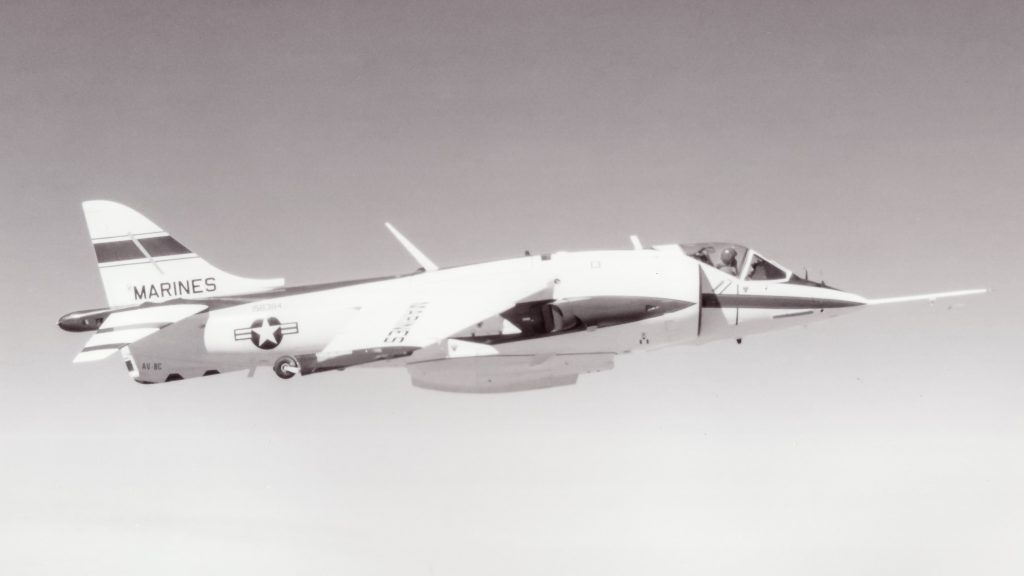
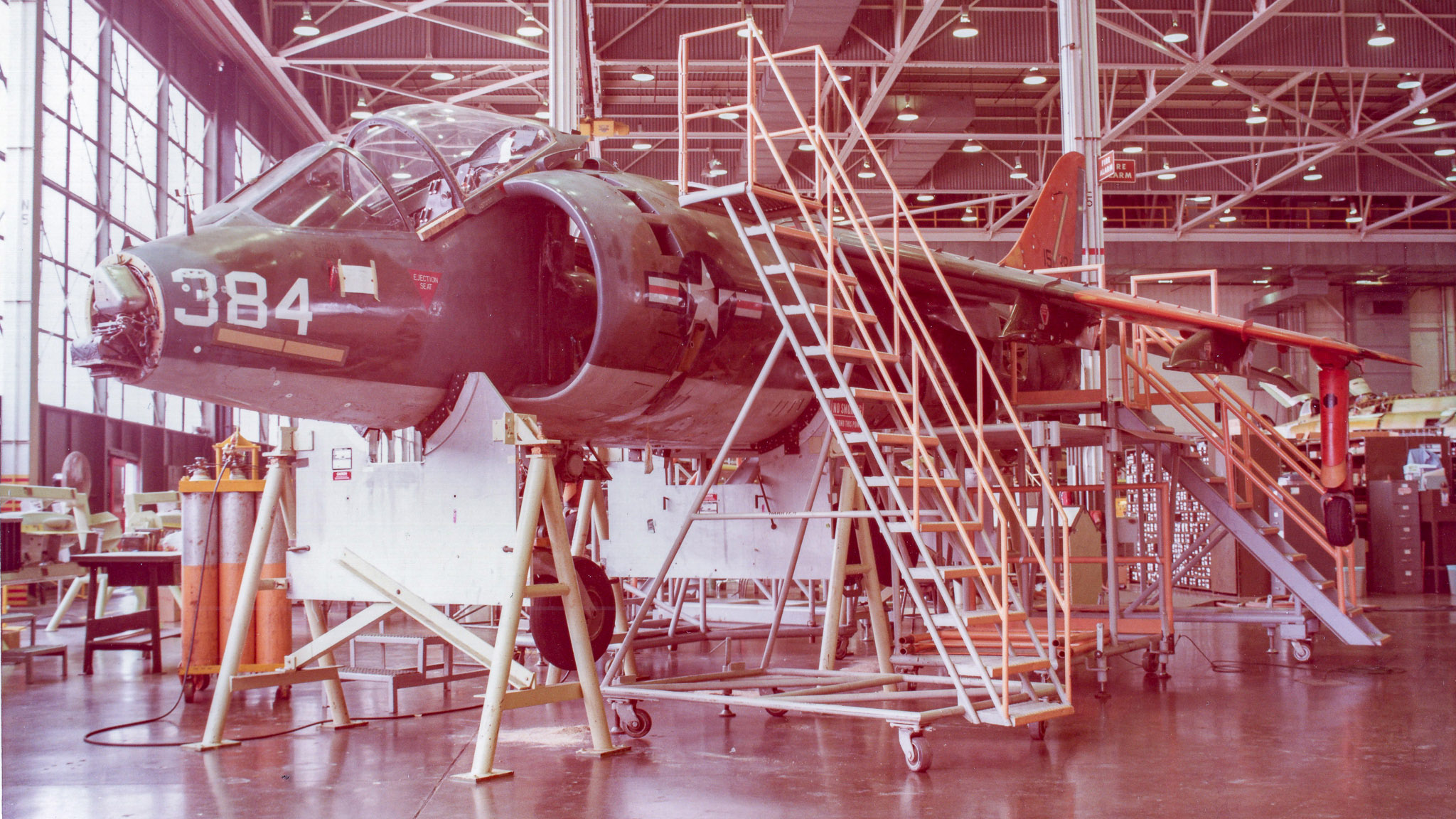
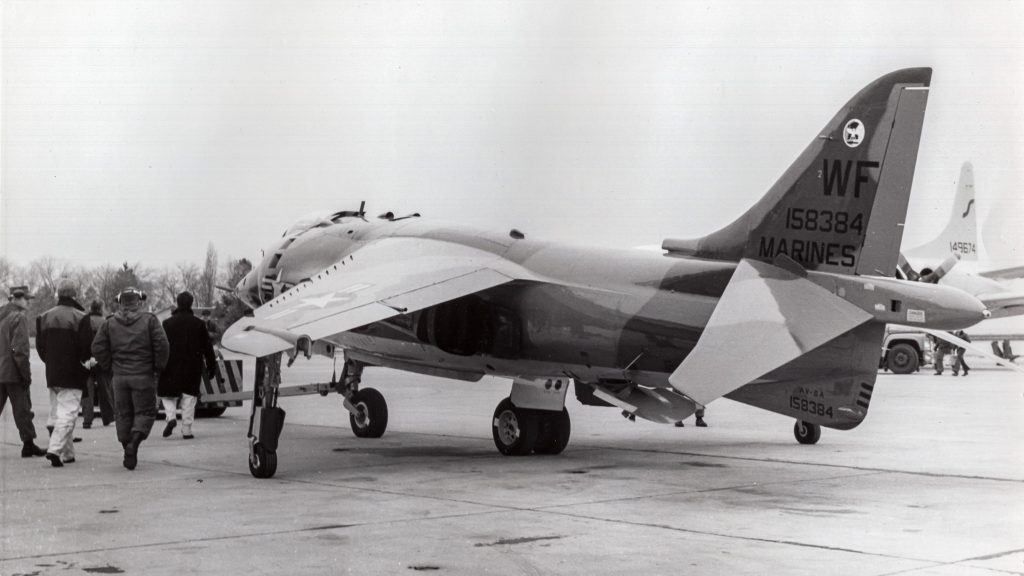
After completing two tours in Vietnam, where he was awarded four Distinguished Flying Crosses, then-Capt. Jack Jackson went through the Navy Test Pilot School at NAS Patuxent River, Maryland. Upon graduation, he was assigned to Cherry Point, where he became just the 74th pilot to check out in the AV-8A, which means he learned to master the Harrier without the benefit of a two-seat trainer. Jackson explained how he made the transition between the Marine Corps and McDonnell Douglas, “I ran into a gentleman at a symposium of The Society of Experimental Test Pilots. He said, ‘We’re going to start building the Harrier. If you decide to get out, here’s my business card.’ When I got home from that symposium, my fingers couldn’t get on that telephone fast enough. He hired me as a test pilot. They were just getting started on the AV-8B.” When Jack arrived in St. Louis, the two YAV-8Bs were already being flown by two senior pilots, so he was assigned to evaluate the AV-8C. He ended up making over thirty flights in the aircraft. The prototype AV-8C was AV-8A BuNo 158384, which had served with VMA-513 Flying Nightmares.
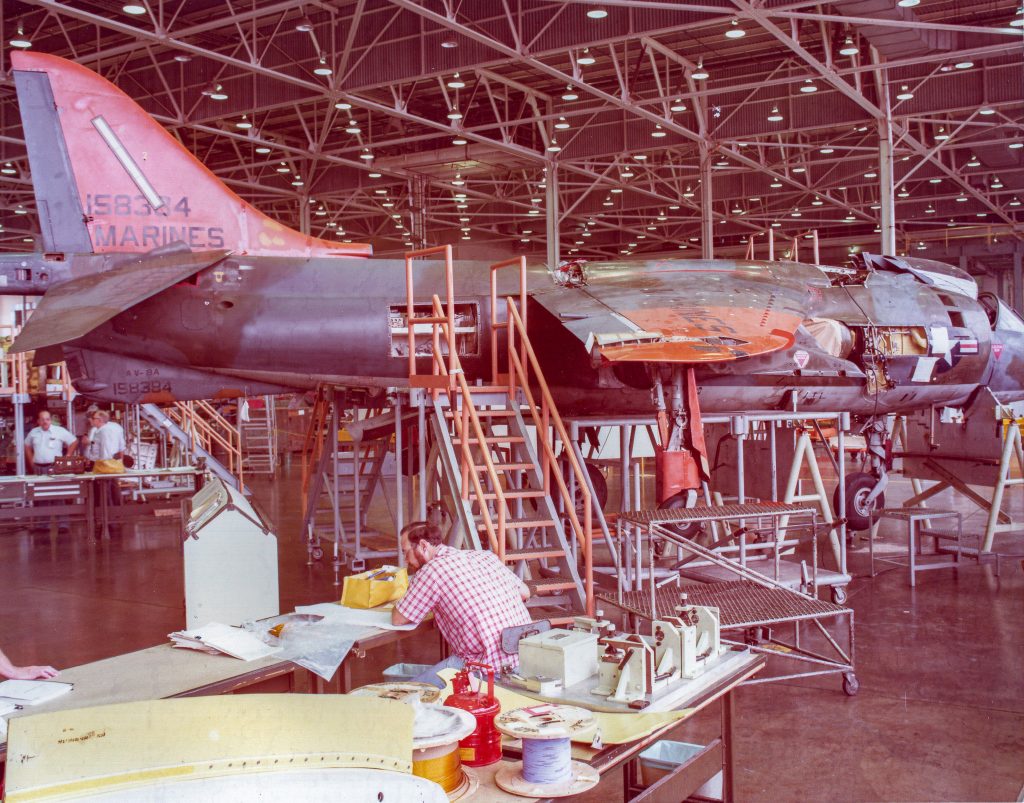
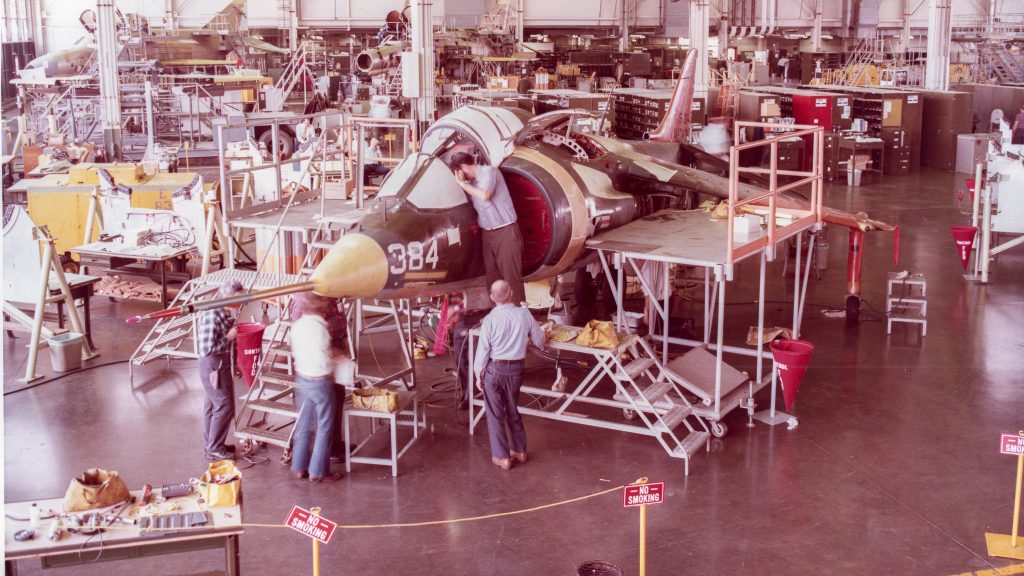
As Jackson will explain, the initial goal of the AV-8C program was to fit the aircraft with and onboard oxygen generation system, chaff/flare dispensers, and upgraded avionics, including radar warning receivers (RWR), that would be installed around the airframe, “One of the things that was very interesting to me in that test program, were the sensors out on the wing tips and other places. They were about the size of golf balls, a little bigger maybe. On the wings, they fit right on the leading edge of the wings at the tips, and we weren’t sure how that would change the flight characteristics, i.e., stalls, recoveries, and overall performance. Did they increase drag? Did they disrupt the flow over the vortex generators? We also wanted to evaluate how the increased weight affected the CG. I made about thirty flights and found that, other than stalls, there was very little change in handling and performance of the aircraft. So, we told NAVAIR and the Marines that it would be fine.” Jackson said. That is how the program began, but to represent how the aircraft would be configured in combat, the company fitted faux gun pods on the belly. Contrary to what some might believe, the 25mm Aden gun pod system did not consist of two guns. Only the right-hand pod housed the gun itself; the left-hand pod housed 100 rounds of ammunition. The fitment of these pods had an unintended consequence.
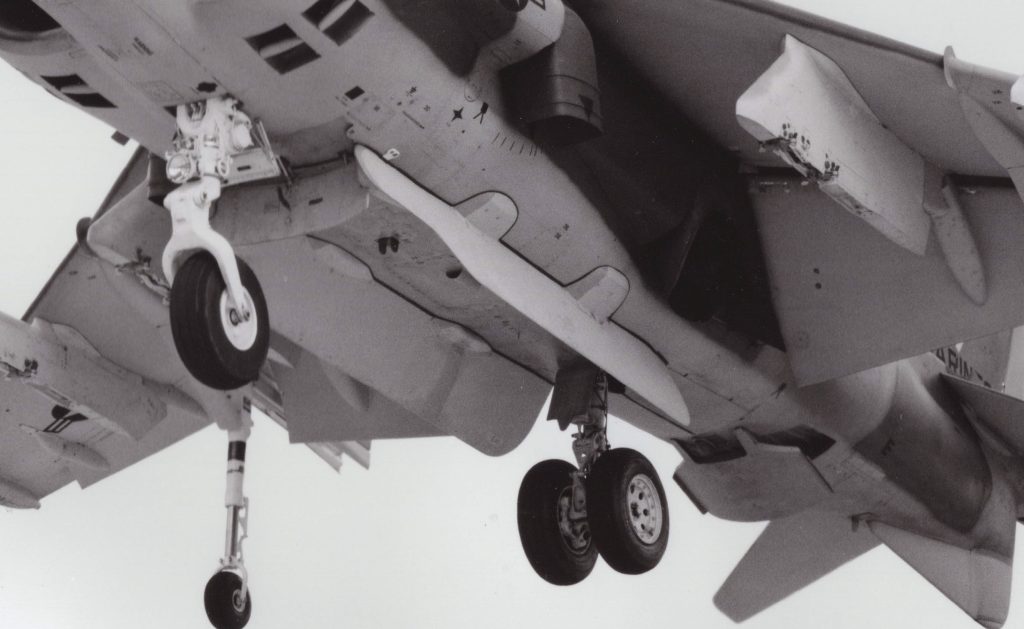
Before explaining those consequences, Jackson first related how the AV-8A handled when landing vertically. “Normally, in the AV-8A, when you start coming down out of clean air, you get into what we call cobblestone, which is nothing more than a term that relates to the exhaust bouncing off the runway and back up on the wings. When you enter that area, it feels like you’re riding on a hard-wheeled wheelbarrow on a cobblestone street. In the A-model, when you get into that cobblestone, you start to lose lift, and you have to add power. When I started flying the C with those strakes, I noticed it wasn’t there, so I kept pulling power and pulling power, and when I touched down, the nose would always hit a little before the back end. When we saw that, we were pulling back the power at the right time to get it to settle down. The ride was much smoother because we didn’t have that exhaust bouncing off the belly and the wings.” Jackson said.
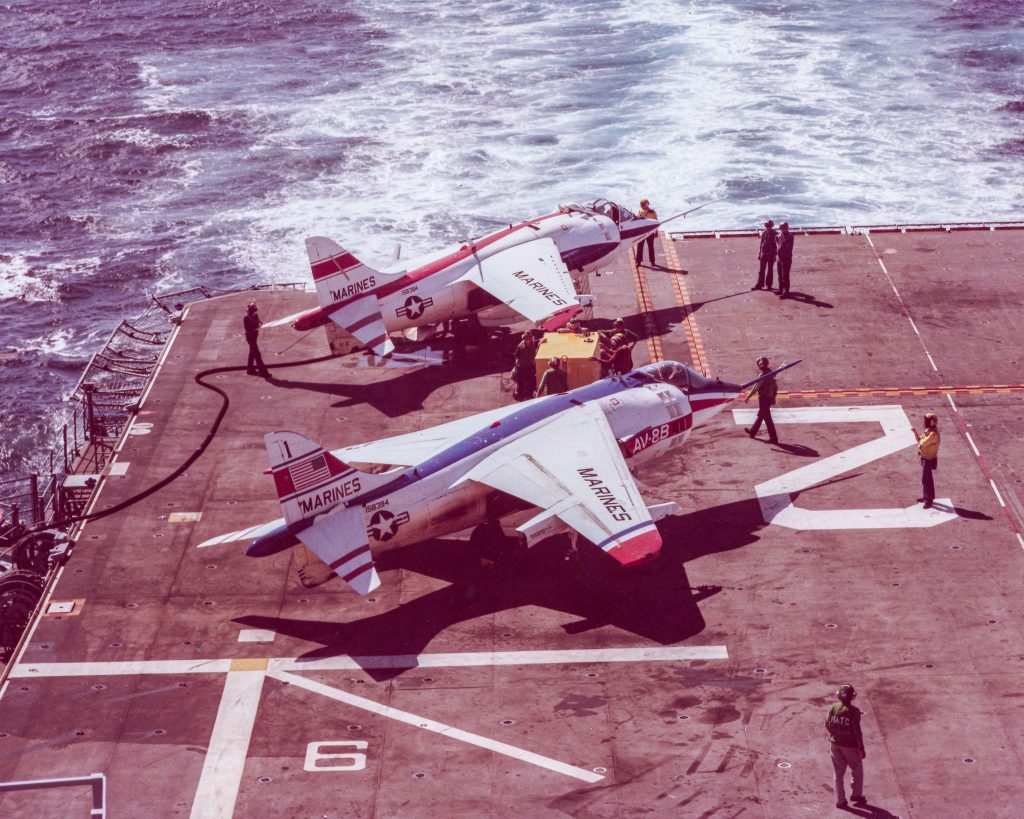
As mentioned earlier, the YAV-8Bs were being tested in St. Louis at the same time as the AV-8C, and a feature on the former was a fence that sat flush behind the nose gear. When the landing gear was extended, that fence extended as well to help capture air. Jackson continued, “When we added that fence to the C, it, along with the strakes and the speed brake, created a box of air under the aircraft, and it resulted in an additional 1,200 pounds of lift. It was very noticeable.” Since the fence and the ventral strakes, which became officially known as Lift-Improvement Devices (LIDs), resulted in what was essentially “free-horsepower,” they were added to the conversion program.
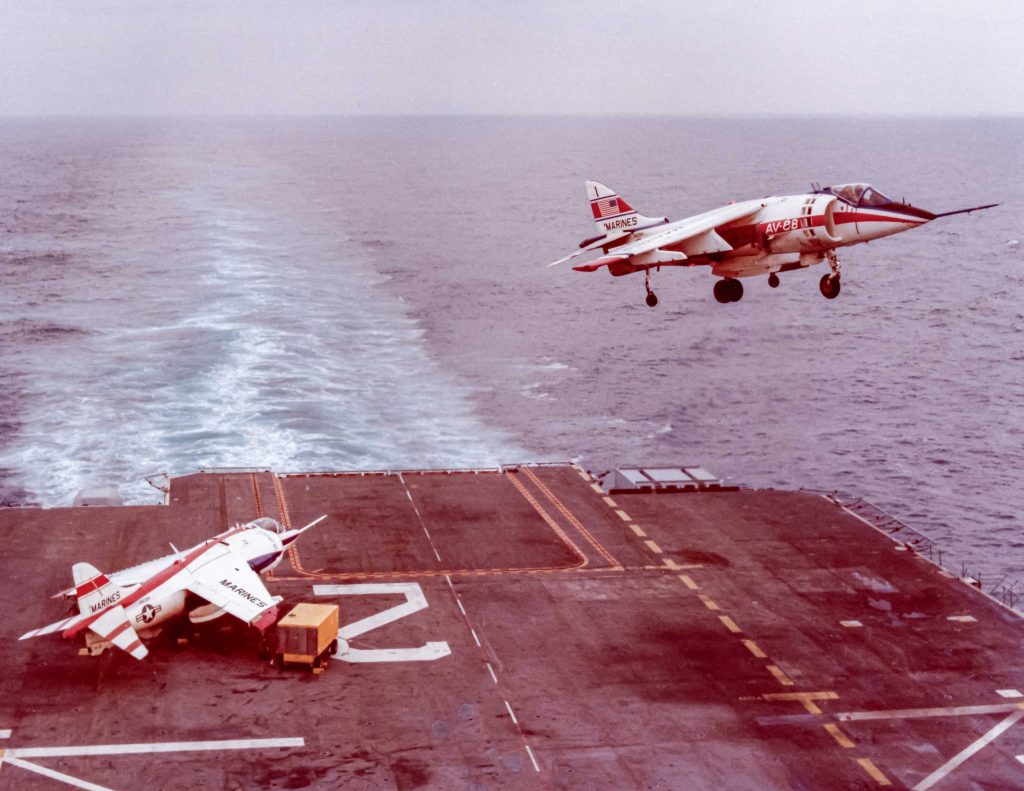
Throughout 1979 and 1980, Jackson continued to evaluate the AV-8C in St. Louis, Pax River, and at sea, aboard Iwo Jima and Tarawa-class amphibious assault carriers, including Guadalcanal (LPH-7), Tarawa (LHA-1), and Saipan (LHA-2). Evaluation of the AV-8C ended abruptly off the coast of San Diego on September 8, 1980, when the aircraft lost power while taking off from Tarawa, forcing the pilot to safely eject from the aircraft. Happily, Jack Jackson went on to have a stellar 27-year career at McDonnell Douglas, all of which was spent in the cockpit. “I did nothing but test-fly new airplanes. Said Jackson. “I was pretty much a Harrier guy. I qualified the ski jump for some of the Spanish airplanes, I went to Russia, at their invitation, to fly the Yak-38, I flew the F-15 and F-16, and near the end of my career, I flew the F-35B.” Though the sole AV-8C prototype was lost, its work had been done. The forty-seven aircraft to undergo the AV-8C conversion were the harbingers of the performance Marine Corps pilots could expect from the new AV-8B that entered service in 1985. Those aircraft, 337 in total, the pilots who flew them, and the maintainers who kept them airworthy for five decades and projected American power in combat over the Middle East, Balkans, Northern Africa, and Southwest Asia, firmly established the Harrier as one of the most iconic aircraft in Marine Corps aviation history.