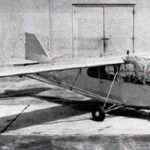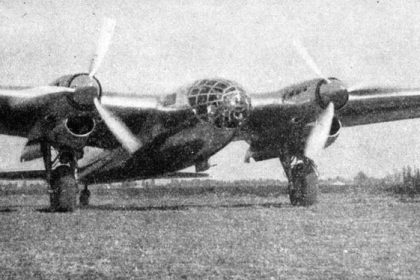
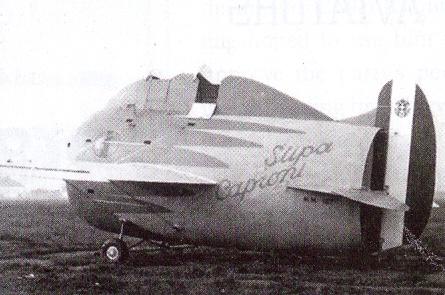


In the 1930s, Italian engineer Luigi Stipa had ideas about fluid motion and developed the “intubed propeller”. Stipa’s main idea was to place the engine and propeller inside a fuselage that acted as a tapered duct, or venturi tube. To prove the concept, the Stipa-Caproni was developed in 1932 by the Caproni aviation company as a test of new technology. The design compressed the airflow from the propeller and the engine’s exhaust before releasing it at the back of the aircraft. The approach used Bernoulli’s principle to improve the efficiency of the propeller. It was similar to how turbofan engines work, but Stipa used a piston engine instead of a gas turbine. Later, Stipa believed that German rocket and jet technology, particularly the V-1 flying bomb, was using his patented invention without giving him credit. However, his ducted-fan design had little mechanical similarity to turbojet engines and had nothing in common with the pulsejet used in the V-1. Stipa worked for years on a mathematical study while at the Engineering Division of the Italian Air Force. He found that the inner surface of a venturi tube needed to be shaped like an airfoil for maximum efficiency. He also computed the ideal shape of the propeller, the ideal distance from the tube’s leading edge to the propeller, and the most efficient rate of revolution. After his research, he asked the Italian Fascist government to build a prototype aircraft. The government at that time wanted to showcase Italy’s achievements in aviation, so in 1932 it commissioned Caproni to build the aircraft. The Stipa-Caproni, also known as the Caproni Stipa, was a mid-wing monoplane mainly made of wood. Its fuselage was a short, fat tube that opened at both ends, creating a tapered duct. Twin cockpits were mounted in a hump on top of the fuselage. The wings were elliptical, and the main beams ran through the duct, with the engine inside it.
Design of Stipa-Caproni

The duct had a shape similar to the wings, with a small rudder and elevators at the back edge, which helped improve handling by directing airflow over them as the propeller pushed air out. The propeller was installed inside the fuselage, aligned with the front edge, while the 120-horsepower de Havilland Gipsy III engine was located within the duct in the middle of the fuselage. The Stipa-Caproni had fixed main landing gear with spats and a tailwheel. It was painted blue and cream, resembling the racing aircraft of that time, and its rudder featured the colors of the Italian flag. The aircraft was 19.10 feet long, 10.8 feet high, with a wingspan of 46.11 feet and a wing area of 200 square feet. The empty weight was 1,257 pounds, and the gross weight was 1,874 pounds. The Stipa-Caproni aircraft first flew on October 7, 1932, with test pilot Domenico Antonini of Caproni at the controls. Initial tests showed that the propeller design improved engine efficiency, as Stipa had expected. The airfoil shape of the duct helped the aircraft achieve a very low landing speed of only 42 mph and allowed it to climb faster than other planes with similar power and wing loading. The rudder and elevators were positioned to face the wind from the propeller, which made the plane stable in flight. However, these parts were later enlarged to improve handling further. The Stipa-Caproni was also quieter than other planes of its time. But the propeller shape created a lot of aerodynamic drag, negating the efficiency gains.
The Cancellation

As a result, the Stipa-Caproni’s top speed was only 81 mph. After initial testing, the Italian Air Force took over the aircraft and moved it to Guidonia Montecelio for additional test flights. Test pilots found the plane extremely stable, making it hard to change direction. They were impressed by the very low landing speed, resulting in a short landing run. Since the Stipa-Caproni did not perform significantly better than traditional aircraft, the air force decided not to continue its development, and no more prototypes were built. Although none of Stipa’s flying wing designs were built, the lessons learned from the Stipa-Caproni helped develop the Caproni Campini N.1, which used a motorjet engine. The test flights of the Stipa-Caproni generated interest in aviation research. Stipa’s work was studied in France, Germany, Italy, and the United Kingdom, as well as by the National Advisory Committee for Aeronautics in the United States. In the mid-1930s, France designed but never built an advanced night bomber based on a Stipa design. Some aircraft, such as the German Heinkel “T” fighter from 1940, are believed to have incorporated ideas from Stipa’s work, as shown by the Stipa-Caproni. Today’s Kort nozzle ducted fan, designed in Germany in 1934, uses many of Stipa’s principles. Some aviation historians believe the modern turbofan engine is a descendant of the intubed propeller shown in the Stipa-Caproni. Read more Grounded Dreams articles HERE.