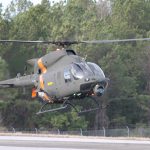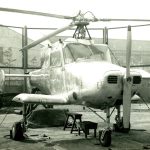
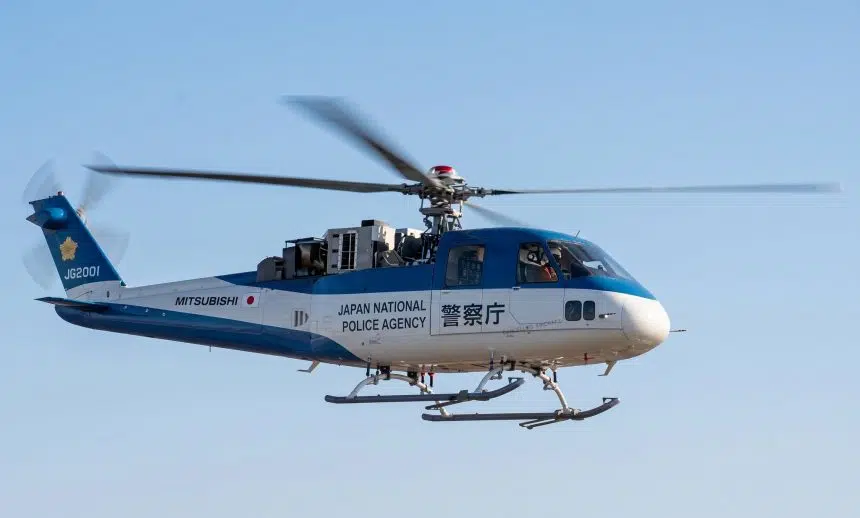


During the Cold War, Japan’s Mitsubishi Heavy Industries (MHI) participated in many aerospace programs. These were mainly production agreements for the Japan Self-Defense Force (JSDF). In the 1990s, MHI wanted to start its own projects, including developing Japan’s first commercial helicopter. Research showed that buyers wanted helicopters that were quieter, safer, smoother, and less expensive. MHI perceived the need for more heliports and support for less demanding rules to boost demand. In July 1992, MHI started developing a twin-engine helicopter under a secret research program. The helicopter, the Mitsubishi RP-1, was a preliminary step to test the basic technologies required before full-scale production. Mitsubishi built the RP-1 using a modified Sikorsky S-76 airframe. Rather than designing a new fuselage, Mitsubishi adapted an existing Sikorsky S-76 airframe as a proof-of-concept testbed. MHI used RP-1 to evaluate rotary wing systems, including lightweight rotor blades, new dynamic gearboxes, integrated flight control systems, and a special cabin damping system with a floating floor.
Design of Mitsubishi RP-1

The Mitsubishi RP-1 differed from the normal S-76s in that it had two Mitsubishi MG5-series turboshafts, each rated at 600 hp. These engines were Japan’s design for the OH-1 light observation helicopter program. The helicopter was 49.2 feet long and 14.1 feet high. The Mitsubishi RP-1 was first shown to the public in April 1994, just before it began hover trials. The helicopter first flew on September 14, 1994. The experience and data from flying the S-76-based Mitsubishi RP-1 testbed helped create the Mitsubishi MH2000. The MH2000 took its first flight in 1996 and is Japan’s first completely locally developed and commercially made twin-turbine helicopter. By mid-1997, production of the MH2000 began. Later testing flights included both prototype and production models, which received approval for new procedures in September 1999. In the late 1990s, Mitsubishi announced its goal to sell 100 MH2000s by 2010. The company stated that each helicopter would cost $3.5 million, making it 15-20 percent cheaper than similar models.
The Cancellation

On October 1, 1999, MHI delivered the first MH2000 model and had produced three more standard versions by then. The company planned to focus early sales on the domestic market. Once it received enough positive feedback, MHI would then start selling the MH2000 internationally. MHI also aimed to improve the MH2000 with a more comfortable cabin, less vibration and noise, better quality interiors, an upgraded autopilot for instrument flying, a higher cruising speed, and easier maintenance. In the early 2000s, Shinichiro Sakamoto, the business development director of MH2000, said the company was discussing military uses for the aircraft with the Japanese Ministry of Defense. It also delivered an MH2000 to Japan’s National Aerospace Laboratory.However, Mitsubishi recalled the MH2000 because of an engine cover problem. Additionally, a demonstration aircraft crashed in 2000, and investigators found issues with the rotor blade developed in Japan. In November 2004, Mitsubishi announced that, because potential buyers showed little interest, it would stop sales efforts for the MH2000. Mitsubishi built only 8 MH2000 utility helicopters before canceling the program. So what began as an Mitsubishi RP-1 became the MH2000 after being successful, but couldn’t be produced in large numbers because of a lack of interest. Read more Grounded Dreams articles HERE.