






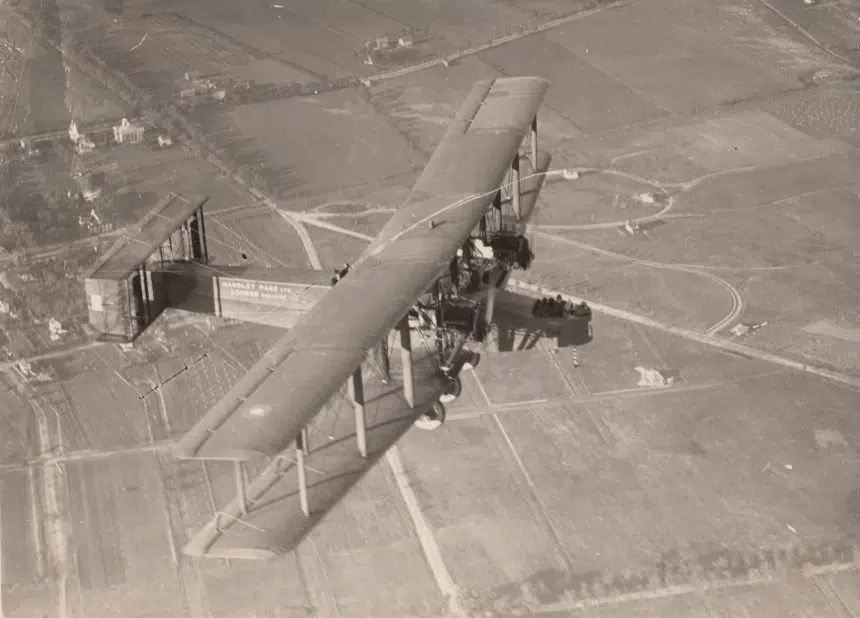

The first publicly traded aircraft manufacturing company in the United Kingdom, Handley Page Limited, was founded by Frederick Handley Page, later known as Sir Frederick, in 1909. Sir Frederick built several biplanes and monoplanes at locations in Woolwich, Fambridge, and Barking Creek. He founded Handley Page Limited on June 17, 1909. In 1912, Handley Page opened an aircraft factory at Cricklewood after moving from Barking. The company built aircraft there and flew them from the nearby Cricklewood Aerodrome, which was also used by Handley Page Transport. Later, the factory was sold to Oswald Stoll and turned into Cricklewood Studios, the largest film studio in Britain. During WWI, Handley Page made heavy bombers for the Royal Navy. The planes were designed to bomb German Zeppelin factories and ultimately to attack Berlin in retaliation for Zeppelin raids on London. The Admiralty asked Handley Page to create a powerful bomber, and the important aircraft included the O/100 from 1915, the O/400 from 1918, and the four-engine V/1500, which could reach Berlin. The V/1500 had just begun flying when the war ended in 1918. At the Handley Page factory at Radlett Aerodrome, women worked as part of the war effort, and the site received visits from royalty.

In 1919, a Handley Page V/1500 aircraft called Atlantic was sent to Newfoundland for the world’s first non-stop Transatlantic flight. However, it was beaten by a Vickers Vimy piloted by Alcock and Brown in June that year. The Atlantic later flew to New York City via Canada on October 9, 1919, delivering the first airmail from Canada to the United States. After WWI, Handley Page modified some O/400 aircraft for passenger use, serving the London-Paris route as Handley Page Transport. The V/1500 was too large to be practical at the time, but many of its design features were later used in an O/400 airframe to create the W.8, which led to a series of similar airliners. These planes had two or three engines and were used by Handley Page Transport and also exported to Belgium. In 1924, Handley Page Transport combined with two airlines to form Imperial Airways, the UK’s national airline. They continued to use several models from the W.8, W.9, and W.10 series. Handley Page also developed large biplane airliners, like the luxurious H.P.42, for routes to Africa and India. Then the company developed the Handley Page Slat, which improved airflow at high angles of attack and improved low-speed handling. The Slat was also designed by German aerodynamicist Gustav Lachmann, who later worked for Handley Page. It was so successful that licensing fees from other companies became a main source of income in the early 1920s.

In 1929, Handley Page closed Cricklewood Aerodrome and moved aircraft assembly to Radlett Aerodrome. Cricklewood Aerodrome became Cricklewood Studios, the largest film studio in the UK at that time. Aircraft parts and sub-assemblies were still made at Cricklewood until 1964, when the site was sold. Today, a Wickes home renovation store occupies that location. As WWII approached, Handley Page created the HP.52 Hampden bomber, which participated in the first British raid on Berlin. In 1936, the government asked for heavier, longer-range aircraft, and Handley Page submitted the HP.56 design, powered by twin Rolls-Royce Vulture engines. The design was selected alongside the Avro Manchester. However, the Vulture engines had serious issues. Years before Rolls-Royce stopped making them in 1940, the Royal Air Force decided to modify the HP.56 to use four engines instead. Before the prototype was built, the design changed into the four-engined HP.57 Halifax. The Halifax became the second-most-produced British heavy bomber of the war, following the Avro Lancaster, which was itself a four-engine version of the Manchester. Although the Halifax had some advantages, such as better crew survivability, it struggled to perform at high altitudes. Towards the end of the war, it was repurposed as a heavy transport and glider tug, with several versions specifically made for these roles, including the HP.70 Halton. After the war, the British Government looked for bids to create jet bombers to carry the country’s nuclear weapons. Three types were made, known as the V-Bombers. Handley Page produced the HP.80 Victor, a four-engine bomber with crescent wings. The aircraft continued to serve as a tanker long after the company that built it had closed.

In 1947, Handley Page purchased assets from the bankrupt Miles Aircraft Company, including designs, tools, and equipment, particularly for the Miles M.52 supersonic research aircraft. The company also acquired the Miles site at Woodley, near Reading. The new operation was named Handley Page (Reading) Ltd. The company was set up to operate the assets of the inactive Handley Page Transport Ltd. The most distinctive design inherited from this was the Herald airliner. Designs from the Reading site featured the initials HPR, which stood for Handley Page (Reading). Handley Page, unlike other large British aircraft manufacturers, did not merge with larger companies due to government pressure. By the late 1960s, two companies, Hawker Siddeley and the British Aircraft Corporation, dominated the British aviation industry. Handley Page struggled to compete for government contracts or to make large commercial aircraft, so it created its last important design, the Jetstream. It was a small turboprop-powered, pressurized-cabin commuter aircraft for 12 to 18 passengers, primarily targeted at the US “feederliner” market. Although the Jetstream was successful, it came too late to save Handley Page. The company entered voluntary liquidation in March 1970 after 61 years of operation under the same name. The Jetstream design continued when Scottish Aviation purchased it and produced the aircraft at Prestwick, even after British Aerospace bought Scottish Aviation in 1977.







You missed out the HP Victor. Among its successes was the ability to refuel the Vulcans during the Falklands was