
More than 100 types of aircraft, more than 18,000 planes, were designed and manufactured by a designer of civilian and military aircraft who influenced Russian and Soviet aviation. Andrei Tupolev founded the Tupolev OKB in 1922. In the 1920s, it developed all-metal airplanes based on Hugo Junkers’ work during WWI. In its early years, Tupolev made contributions to aviation with two important all-metal heavy bombers that had corrugated duralumin skins. The first was the ANT-4 twin-engine bomber, which first flew in 1925. The second was the four-engine ANT-6, introduced in 1932, from which aircraft like the ANT-20 were developed. The designs set important trends for the development of heavy aircraft in both military and civil aviation. During WWII, the twin-engine Tu-2 became one of the best bombers used by the Soviet Union. From 1942, several versions of the Tu-2 were produced in large quantities. Due to metal shortages during the war, some models had wooden rear fuselages. After the war, Tupolev developed the Tu-4, which was a copy of the American B-29 Superfortress. Then came the jet-powered Tu-16 bomber, designed with a swept-back wing to perform well at subsonic speeds. The Soviets wanted a long-range bomber. This led the company to develop the Tu-20 (called the Tu-95). It was a design based on the Tu-4 but with four large Kuznetsov NK-12 turboprop engines. The combination gave it both fast speeds and the ability to travel long distances.

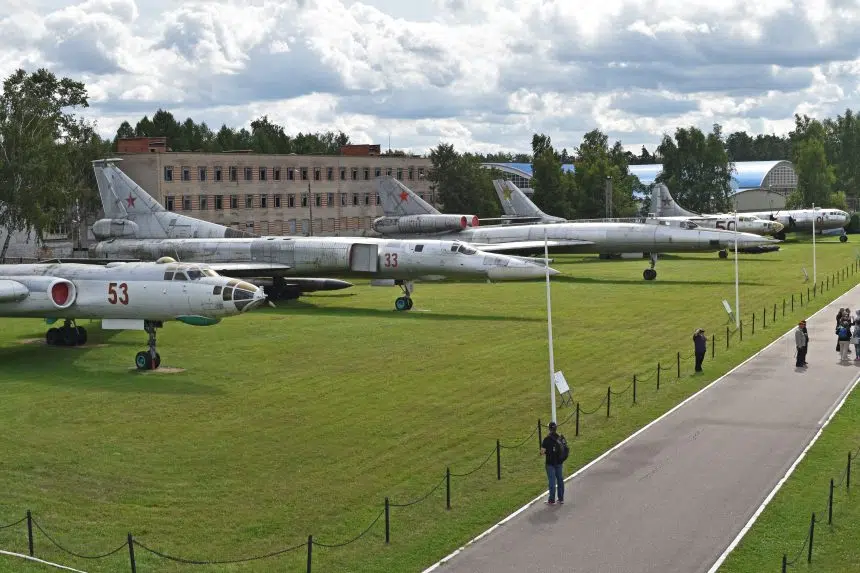
The Tu-95 became the main Soviet bomber for intercontinental missions and performed tasks similar to the American Boeing B-52 Stratofortress. It was used for various roles, such as strategic bombing, reconnaissance, and anti-submarine warfare. The Tu-16 was turned into the civil aircraft Tu-104. The Tu-95 became the basis for the Tu-114, which was the fastest turboprop airliner. Many large subsonic Tupolev jets had large pods extending back from the wings to support the landing gear. It enabled the planes to use large, low-pressure tires, which were especially helpful on the rough runways common in the Soviet Union. For example, the Tu-154 airliner, which is similar to the Boeing 727, had 14 tires, the same number as Boeing’s much larger 777-200. Before the first flights of the Tu-16 and Tu-95, Tupolev was developing supersonic bombers. Although the Tu-98 never entered service, it helped develop the Tu-102 prototype, which later became the Tu-28 interceptor, and the Tu-105, which became the supersonic Tu-22 bomber in the mid-1960s. The Tu-22 was meant to compete with the Convair B-58 Hustler, but it turned out to be less capable. However, it remained in service for much longer than the American aircraft. At the same time, the “K” Department was formed in the Design Bureau to design unmanned aircraft, including the Tu-139 and the Tu-143 unmanned reconnaissance aircraft.

In the 1960s, A.N. Tupolev’s son, A.A. Tupolev, took on a role in the organization. He worked on the development of the world’s first supersonic airliner, the Tu-144, as well as the popular Tu-154 and the Tupolev Tu-22M strategic bomber. These projects helped the Soviet Union achieve military and civil aviation equality with the West. The Tu-144 was a disappointment, and crashes in 1973 and 1978 led to its retirement from passenger service that same year. In the 1970s, Tupolev concentrated on developing the Tu-22M bombers, with several variants, including maritime versions. The Tu-154 was improved in efficiency and performance, and the Tu-154M was developed. In the 1980s, the design bureau produced the supersonic Tu-160 strategic bomber with variable-geometry wings. After the Cold War, the company shifted its focus to building subsonic civil aircraft. It made progress in fly-by-wire technology and high-bypass turbofan engines. The company designed transport aircraft such as the Tu-204, Tu-214, Tu-330, and Tu-334. The company also developed the Tu-330 cargo aircraft and the Tu-324 for regional and executive travel. In addition, Tupolev explored alternative aircraft fuels and planned upgrades for the Russian Navy and Air Force. At the MAKS-2003 airshow, Tupolev introduced the Tu-444 supersonic business jet concept, with plans to start development in early 2004. In 2006, Tupolev became part of the United Aircraft Corporation when it merged with Mikoyan, Ilyushin, Irkut, Sukhoi, and Yakovlev. Although the company still exists today, Tupolev is no longer independent. It now operates as part of Russia’s state-controlled United Aircraft Corporation.