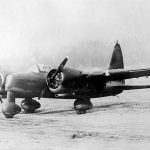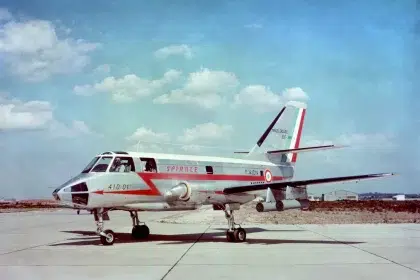
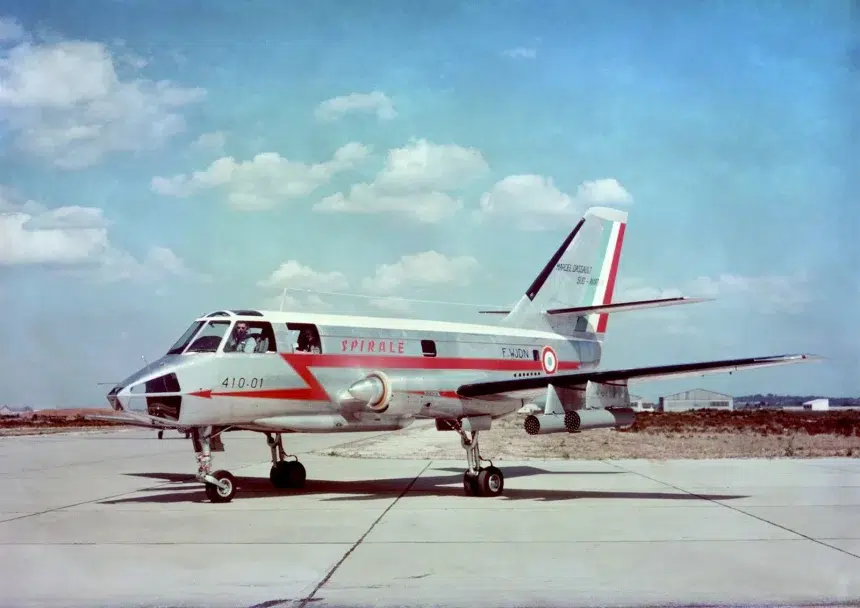

When the war started in Algeria, the French government asked for a new type of aircraft. The service needed a stronger, better-protected twin-engine plane. In September 1954, the Air Force created a list of requirements for this aircraft. It should weigh less than 5 tonnes, have a range of 1,080 nautical miles, and cruise at 216 knots. The aircraft should carry two 30-mm cannons, bombs, rockets, or air-to-ground missiles. Later, the service also needed the plane to support transport and training missions in addition to its fire-support role. As a result, by the end of 1957, Dassault’s Mérignac design office had developed two aircraft types using the same airframe. The first was the MD 415 Communauté, which was intended for liaison missions, with fire support as a secondary mission. The second was the Dassault MD 410 Spirale, designed primarily for fire support, with liaison capability as a secondary function.
Design of Dassault MD 410 Spirale

On May 26, 1959, Marcel Dassault and Sud-Aviation CEO Georges Héreil decided to work together. Both companies were developing similar aircraft, the Voltigeur and the Communauté, and by joining, they aimed to improve efficiency and cut costs. They planned to build a twin-engine aircraft for liaison and training, as well as ground attack. If the military chose the ground attack version, both companies would focus on developing the Spirale. If the military wanted a larger liaison aircraft with wing-mounted load capacity, they would work together on the Communauté. The Dassault MD 410 Spirale was designed for short takeoffs and landings. The version, developed by the Communauté, was meant for observation and tactical support missions. It could also transport supplies for the vertical-takeoff Mirages. The Dassault MD 410 Spirale kept the same wings and engines as the Communauté but had a narrower body, making it better suited for ground-attack missions. It weighed 5.5 tonnes and shared about 90% of its parts with the Communauté. In March 1960, due to the ongoing Algerian War and the need for fire-support aircraft, the Air Force decided to buy surplus American planes, specifically AD Skyraiders and T28As.
The Cancellation

The choice meant the service would not use any French products. Despite this, the Dassault MD 410 Spirale had its first flight at Bordeaux-Mérignac on April 8, 1960. Paul Boudier and Gilles Brecq were the pilots. The Air Force wanted an aircraft that could be used by different military branches, so it introduced another project, the Spirale III, a version 1.3 times larger than the Spirale. This military transport was designed for light short takeoff and landing operations. It was meant to have two Turboméca Turmo III D turboprop engines, each with 1,295 horsepower. The aircraft met the needs of the Air Force and small companies for their regional flights. In January 1962, the defense procurement committee chose the Spirale III model. It ordered two prototypes on April 24, but canceled the contract on August 20 because of a lack of funding. Despite interest from Italy, Australia, and South Africa, the project did not move forward since the war in Algeria had ended. The Dassault MD 410 Spirale was a good aircraft that proved itself in flight tests but failed to receive enough funding. Read more Grounded Dreams articles HERE.