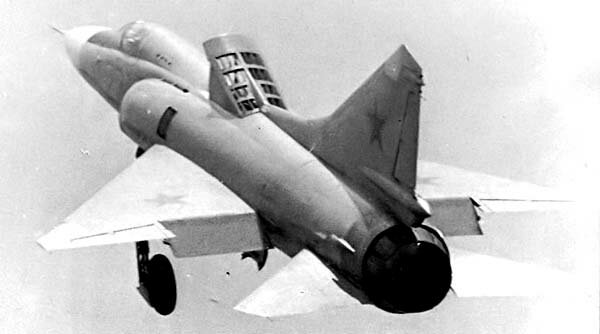


In the 1960s, the Soviet Air Force wanted a successor to the MiG-21 that could operate from short airstrips. As a result, the Mikoyan-Gurevich design bureau began developing a new short takeoff and landing aircraft. The aircraft, designated the Mikoyan-Gurevich 23-01 (MiG-23-01), was based on the MiG-21S model, with one cruise engine and two lift engines to help shorten takeoff and landing distances. The construction of the MiG-23-01 aircraft began in March 1966, and it was transferred to the OKB flight test station in Zhukovsky on November 30, 1966. On April 3, 1967, test pilot P. M. Ostapenko flew the aircraft for the first time.
Design of MiG-23-01
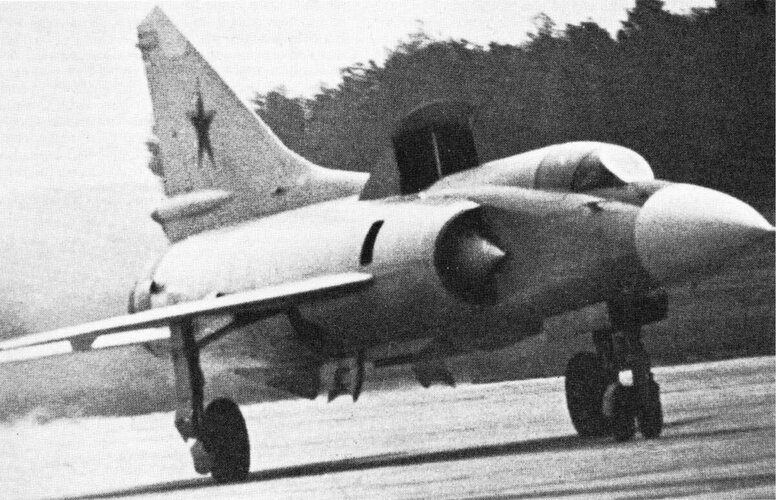
The single-seat MiG-23-01 was 55.1 feet long, with a wingspan of 25.4 feet and a wing area of 430 square feet. The empty weight of the aircraft was 26,500 pounds, and the gross weight was 35,274 pounds. The aircraft was powered by a Tumansky R-27-300 afterburning turbojet engine, producing 17,196 pounds of thrust with afterburner, and two Rybinsk RD-36-35 turbojet lift engines, each producing 10,362 pounds of thrust to support STOL operations. The takeoff run of the aircraft was expected to be between 591 and 656 feet at a light all-up weight (AUW). For landing, the required distance was about 820 feet, including the use of a brake parachute to assist with deceleration. The delta-wing MiG-23-01 could be armed with Vympel R-23R and R-23T missiles on two underwing pylons and had provisions for a large fire-control radar in the nose. To support the engines, the aircraft was equipped with a retractable air intake located on top of the fuselage, behind the cockpit. There were also special engine nozzles with grilles that could change the direction of the gas flow. During takeoff, the gas stream would be deflected back by 10 degrees, and during landing, it would be directed forward by 5 degrees.
The Cancellation
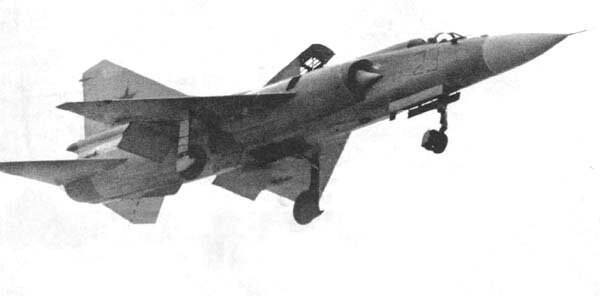
The MiG-23-01 prototype completed several test flights. It took off for the last time on July 9, 1967, during a demonstration at the Domodedovo air parade. After this flight, all work on the project was stopped because the lift engines made the design too complicated. The engines also used up space in the fuselage, reduced fuel capacity, and lowered the payload. At the same time, the Soviet researchers were developing variable-sweep wing aircraft, and after the MiG-23-01 aircraft program ended, the team focused on the 23-11 aircraft. The 23-11 prototype had a variable-sweep wing arrangement, meaning wings could move back for fast flights or extend forward for better handling and takeoff. The aircraft performed well and was selected for mass production. The aircraft later became the famous MiG-23, and over 5,000 MiG-23 Floggers were built. In the Grounded Dreams series, the MiG-23-01 was canceled due to the weight disadvantage of carrying extra engines. Yet it helped provide the MiG-23 program with a clear path to select a variable-sweep wing arrangement. Read more Grounded Dreams articles HERE.