






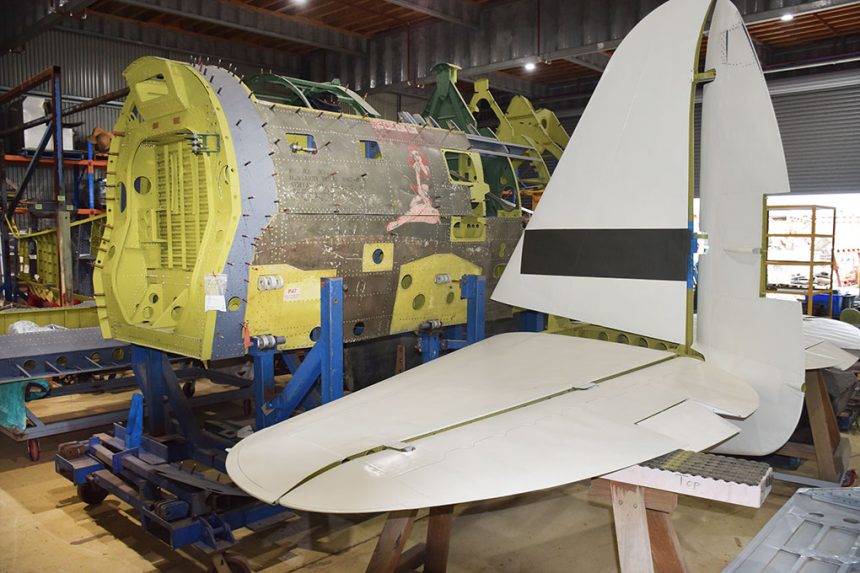

Restoration work on several Republic P-47 Thunderbolt airframes continues to progress in Australia in this partner article by Vintage Aviation News contributor John Parker of Warbirds Online. Robert Greinert and the team at Warbird Restorations Pty Ltd are currently advancing three separate P-47D projects toward distinctly different outcomes. Restoration work on several Republic P-47 Thunderbolt airframes continues to progress in Australia, where Robert Greinert and the team at Warbird Restorations Pty Ltd are advancing three separate P-47D projects toward distinctly different outcomes. More than a decade has passed since activity surrounding these aircraft was last widely reported. In the intervening years, one Thunderbolt has departed the workshop while additional airframes have entered restoration, reflecting both the scale and long-term commitment required to return one of the Second World II’s largest single-engine fighters to display or flight condition. The P-47’s size, structural complexity, and engineering robustness make restoration an especially demanding undertaking. Even so, recent observations indicate an acceleration of work across the three aircraft currently in progress.
Three Aircraft, Three Restoration Paths
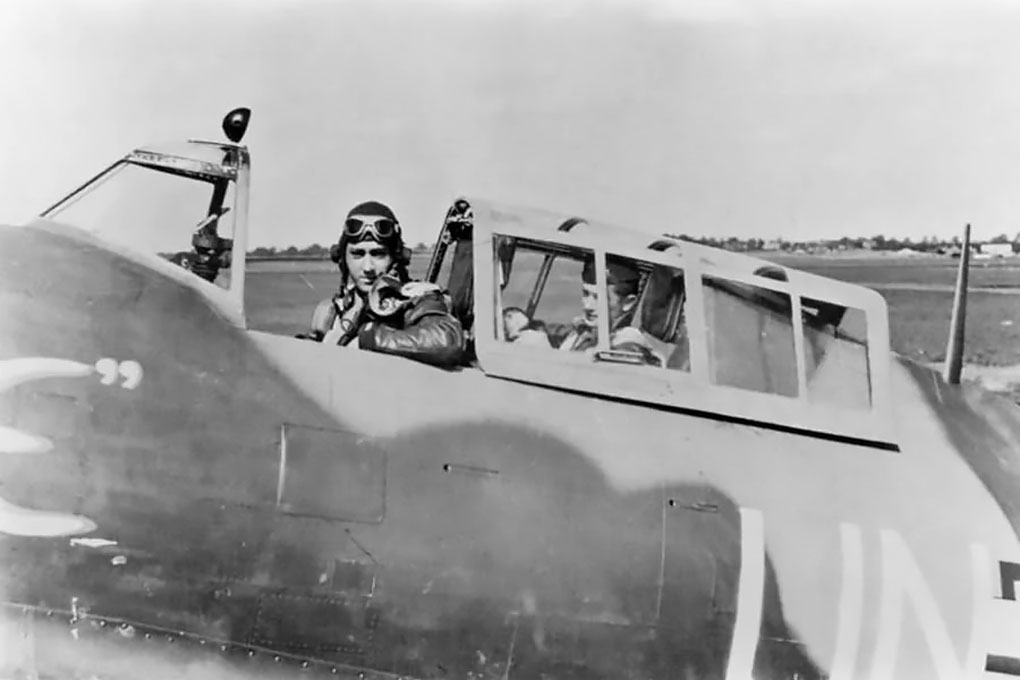
Each of the airframes under restoration is a P-47D variant, though their intended futures differ. One aircraft is being completed as a museum-quality static display example, another is being progressed with the long-term aim of airworthy restoration, and a third may ultimately form the basis of a rare two-seat Thunderbolt conversion, commonly referred to as a “Doublebolt.” Within the warbird community, the informal nickname “Doublebolt” is used to describe two-seat P-47 Thunderbolt conversions incorporating an extended canopy and dual-cockpit configuration.
P-47D Razorback 42-8066 “Carter’s Li’l Pill”
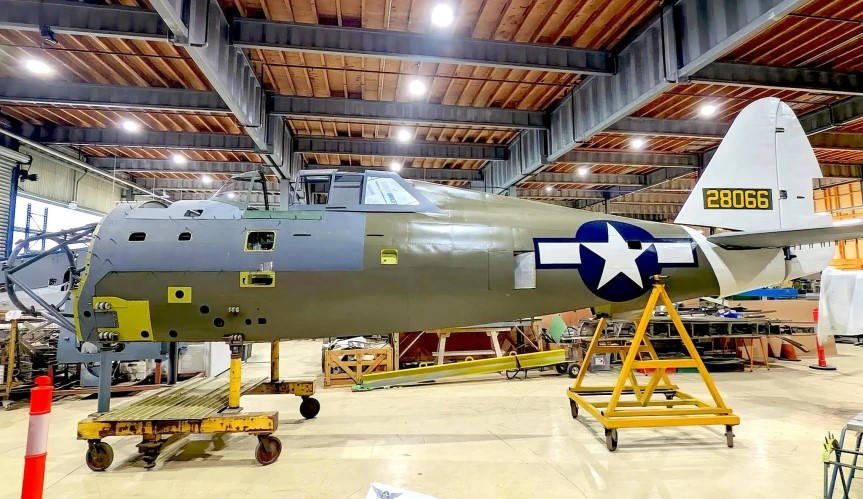
P-47D razorback 42-8066, known as Carter’s Li’l Pill, was recovered from the Waigani Swamp near Port Moresby, Papua New Guinea, in 1966. After passing through several owners, the aircraft was restored to static display condition by the Museum of Transport & Technology in Auckland in 1975 and exhibited there until 1991, when it transferred to the RNZAF Museum at Wigram for storage. Robert Greinert acquired the airframe in 1995 and relocated it to Albion Park, New South Wales. Although once intended for return to flying condition for a South African customer, restoration plans have since been revised. The aircraft is now being completed as a museum-quality static example destined for the Pima Air & Space Museum in the United States, replacing an earlier allocation of a different Thunderbolt from the same collection. Extensive structural restoration has already been completed, particularly within the fuselage. Remaining work includes the wings, empennage, engine installation, and propeller prior to final assembly. Completion is anticipated within approximately a year, after which the aircraft will join other restorations from the same workshop, including P-40 and P-38 aircraft already delivered to Pima.
P-47D 42-8130 “Frankie”
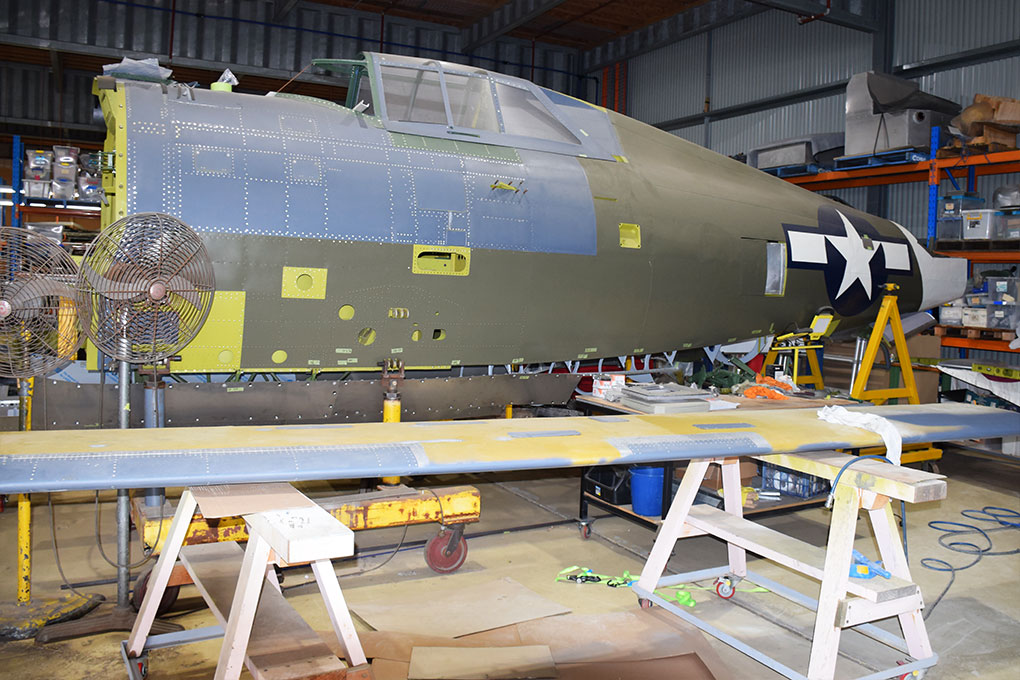
P-47D 42-8130, nicknamed Frankie, crash-landed at Hood Point east of Port Moresby in 1943. The wreckage was recovered in 1966 by a collector in Papua New Guinea and later passed through several owners before entering Greinert’s care around 2001. Since that time, Frankie has undergone extensive restoration work with the long-term aim of returning the aircraft to flying condition. Current efforts are focused on the completion of the fuselage before progressing to other primary assemblies, a long and complex task. The project remains available for completion in a configuration to be determined by a future owner.
P-47D 42-22687 – Combat History Preserved
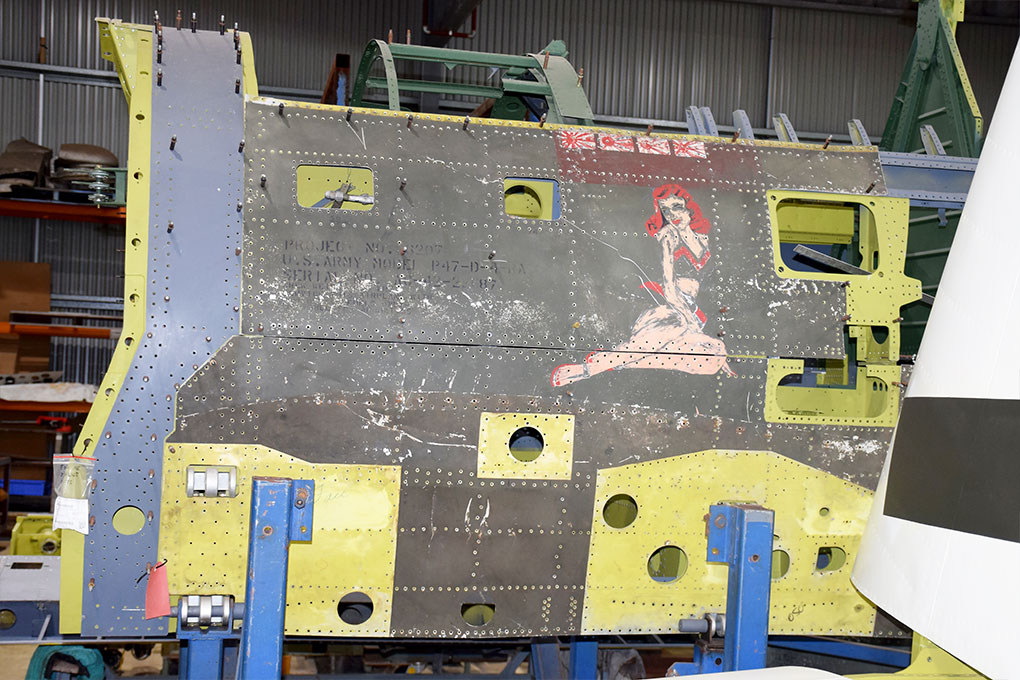
P-47D 42-22687 crashed on mountainous terrain at approximately 8,200 feet near Gusap, Papua New Guinea, on 29 April 1944. The wreckage remained undiscovered until 1979, when it was located near Tauta village. Recovery of the fuselage took place in October 2004, after which it was transported to Australia for restoration. Despite the severity of the original impact, surviving metal components remain in notably good condition. Wartime fuselage artwork has also endured, including four Japanese victory markings beneath the cockpit. Reconstruction of the airframe is well advanced, and a potential return to flight is envisaged. As with the other Thunderbolt restorations in the workshop, the project aims to retain as many original components as practicable while meeting modern safety expectations. The aircraft is likewise available for completion to airworthy condition.
Development of a Two-Seat Thunderbolt, the “Doublebolt”
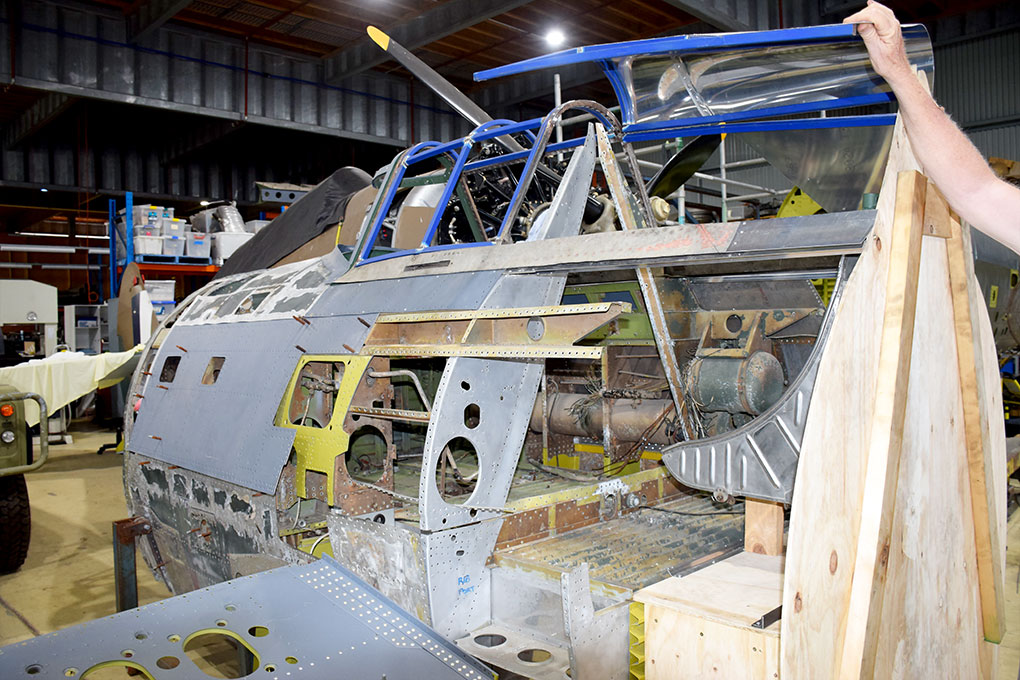
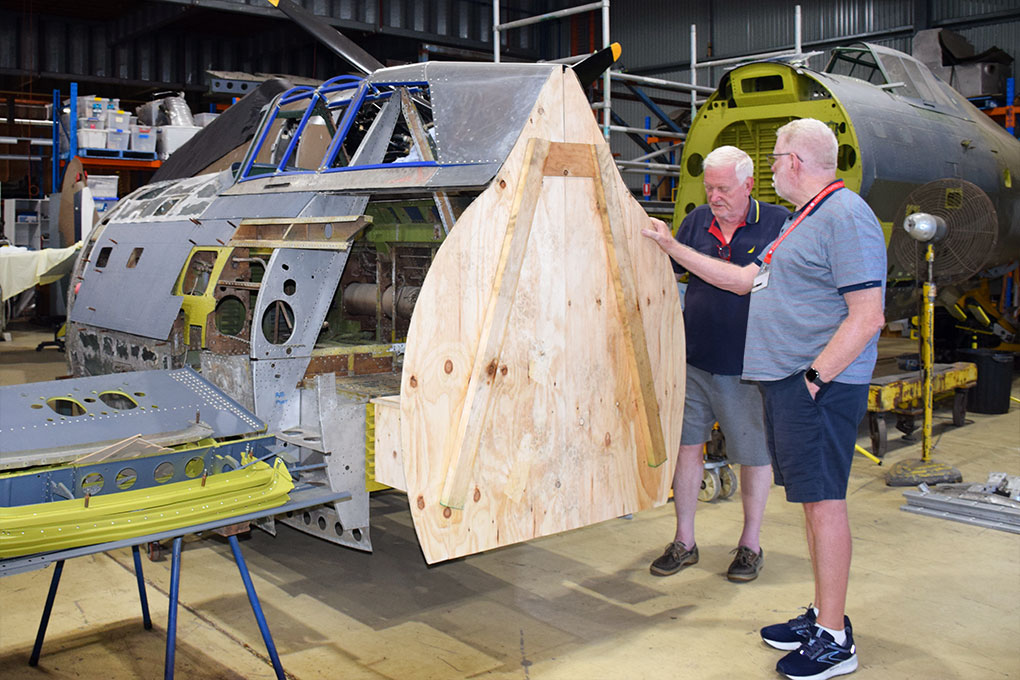
Among the most significant developments associated with the collection is the ongoing prototyping of a two-seat P-47 Thunderbolt configuration. A stored razorback fuselage has been adapted as a proof-of-concept structure incorporating researched structural modifications intended to validate the feasibility of the design. One of the restoration airframes, possibly 42-22687, may ultimately be converted using this approach. Two-seat conversions of Second World II fighters have become increasingly prominent in recent years, allowing non-pilots to experience flight in historic combat aircraft. While two-seat Spitfires, Hurricanes, P-51 Mustangs, and other notable warbirds are already in operation, a two-seat P-47 would represent an exceptionally uncommon opportunity given the aircraft’s size, power, and relatively small number of surviving examples.
For anyone interested in a P-47D or a two-seat P-47 Thunderbolt Doublebolt conversion, now is an ideal time to make contact. Robert Greinert and Warbird Restorations Pty Ltd at Albion Park, New South Wales, can be reached at [email protected] for further information or to discuss available opportunities. Warbirds Online and Vintage Aviation News are extremely grateful to Robert Greinert and his team for their time, generosity, and for allowing insight into one of the world’s most ambitious and historically significant P-47 Thunderbolt restoration programs.


The good thing about Mr. Greinert-is First-he is an Aussie & will take no “Bull-Shit”-second=He has “Been there &done that”-as far as W.W.2-Aircraft are concerned–third=Those P-47’s-are in good hands-He knows what he’s doing-!-Not like what happend to that Nakajima “Oscar”-(ex-Sid Marshalls)-that left our shores-& suffered a dreadful “restoration”-at the hands of some “dim-wit”-i n the U-S-A-!!
It is a terrible shame that the artwork on this P-47D 42-22687 has been unprofessionally “touched up”. I have visited the crash-site before the aircraft was removed, and the artwork is/was quite remarkable. The lady should have been properly protected from the time leading up to its recovery until the location where it was ultimately held. I have actually met the original pilot of this aircraft and we maintained contact for a number of years, with James (W. Harris III) with James sending my photographs of his aircraft and its artwork. I have been into multiple American WW2 aircraft, B-24s, B-17s, B-25s, C-47s, P-39 and P-400, P-40, P-38 aircraft during my 26 years working in Papua New Guinea, firstly in the Department of Agriculture, then the National Museum (where I established the “War Museum” and ultimately named the Department of Modern History, and finally as a contractor to the US Army Central Identification Laboratory. My major find was B-24D 42-41081 containing the remains of 22 Airmen, the aircraft being used as a transport between Port Moresby and Nadzab. That aircraft disappeared on 22 March 1944. The crew and passengers were subsequently identified and given a military funeral. A book on this was later published called A MISSING PLANE, by Susan Sheehan. I also solved the disappearance of a B-17E 41-2505, that had actually been visited in 1961 by a team from the American Graves Registration Service but misidentified. I first reached the crash-site on 15 June 1986, with the US team starting their recovery work on 5 July, concluding on the 9th, with another effort taking place the following year.