

(Image credit: VAN)
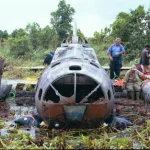
On this day in aviation history, 83 years ago (December 27, 1942), the Mitsubishi Ki-67 flew for the first time. The Ki-67 was a twin-engined bomber that served with the Imperial Japanese Army and Navy Air Services during World War II. Named the Hiryū by the Japanese, the Ki-67 was known as the Peggy to Allied forces during the war. The original designation of Mitsubishi’s aircraft was the Army Type 4 Heavy Bomber. A naval variant, the Q2M Tai’yō, was also developed by Mitsubishi; however, the design remained on paper due to the issues facing Japan towards the end of World War II. Mitsubishi designed the Hiryū in response to a 1941 Japanese army specification that sought a replacement for the Nakajima Ki-49 Donryū (Storm Dragon). This specification required that the new aircraft be a twin-engined heavy bomber capable of attaining high airspeeds. Additionally, the bomber was to be suitable for possible battles with the Soviet Union on the Manchurian-Siberian border. Despite the conventional Japanese warplane design trend of the period, the new bomber was to have solid defensive armament and the ability to take heavy damage in battle.
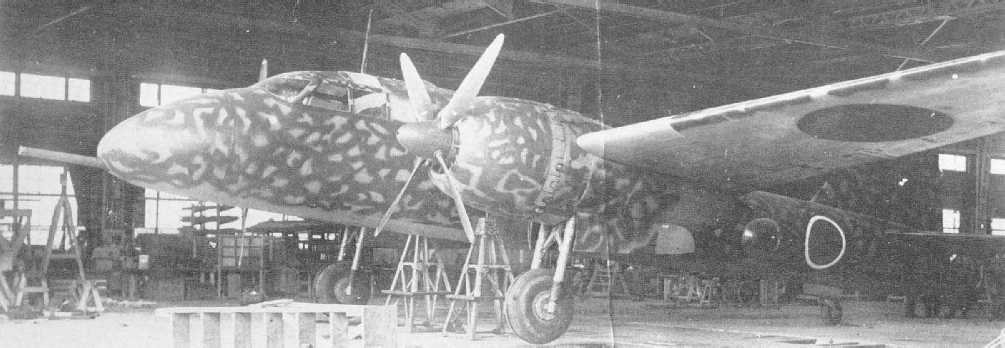
During the Second World War, the Ki-67 saw extensive use in level bombing and torpedo bombing. Hiryūs participated in strikes against Formosa and the Ryukyu Islands. Ki-67s were later flown in combat at Okinawa, Mainland China, French Indochina, Karafuto, and in Saipan and Tinian, against B-29 bases. A special variant of the Ki-67 was developed for Giretsu sorties, which featured three remote-control 20 millimeter cannons (angled at 30° for firing toward the ground), a 20 millimeter cannon in the tail, 13.2 millimeter Type 3 machine guns in the lateral and upper positions, and an enhanced fuel load. The Mitsubishi Ki-67 was flown by a crew of 6 to 8 personnel. The aircraft was powered by two 1,900-horsepower (at takeoff) Mitsubishi Ha104 18-cylinder radial engines. The Ki-67-Ib variant could attain a maximum airspeed of 334 mph, had a range of 1,500 nautical miles, and a service ceiling of 31,070 feet. Hiryūs were armed with a 20 millimeter Ho-5 cannon in the dorsal turret, and five 12.7 millimeter Ho-103 machine guns in the nose, tail, and in each beam position. Up to 1,764 pounds of bombs, or one torpedo, could be loaded in the Ki-67’s internal weapons bay. Mitsubishi built 767 Hiryūs during the Second World War, although none are known to survive today.