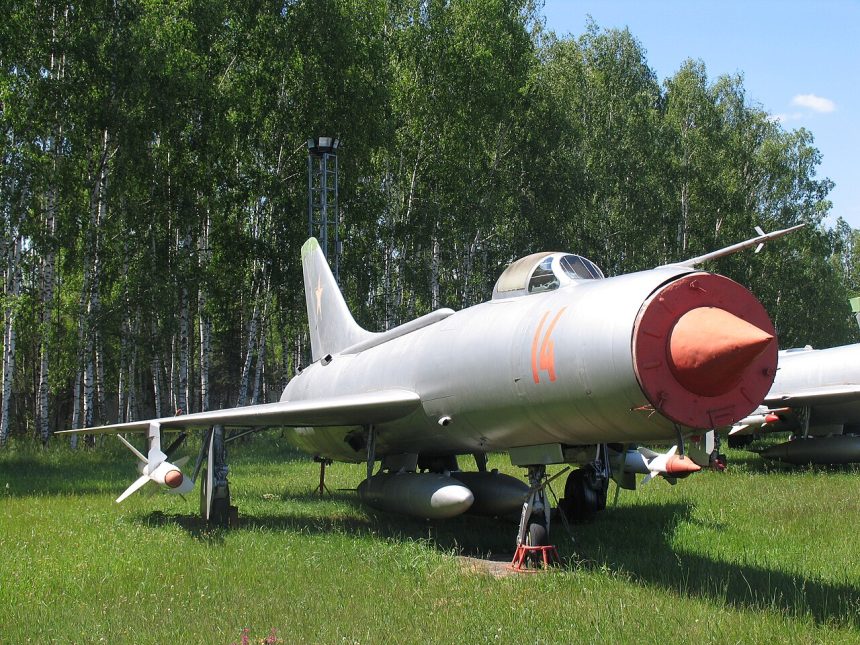


(Image credit: VAN)
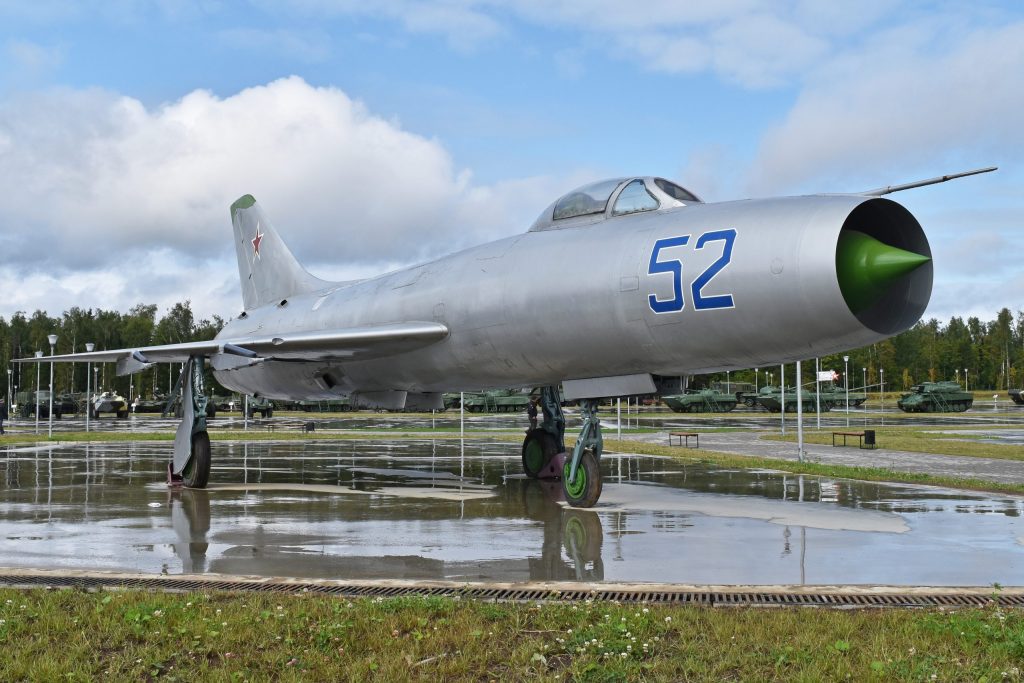
On this day in aviation history, 67 years ago (December 25, 1958), the first flight of the Sukhoi Su-11 Fishpot-C took place. The Su-11 was a further development of the original Su-9 Fishpot, and the aircraft served in the same role within the Soviet Union as an interceptor during the Cold War. The Su-9 was developed in tandem with the Su-7 Fitter bomber by the OKB. Legacy Fishpot interceptors exhibited fundamental limitations, and work was begun on an upgraded version of the aircraft. Akin to the Su-7 and Su-9, the Su-11 shared a swept-wing and tailplanes. The fuselage resembled a cigar in shape and scale, with the signature circular nose-intake for the engine, also seen on the Su-7/Su-9. The Su-11’s nose was slightly longer than its predecessors due to the installation of an Oryol (Eagle, NATO name Skip Spin) radar. The engine of the Fishpot-C was also upgraded to a Lyulka AL-7F-1 turbojet. When viewing the Su-9 and Su-11 side-by-side, another distinguishing feature of the Fishpot-C is the external fuel pipes atop the fuselage, aft of the cockpit.
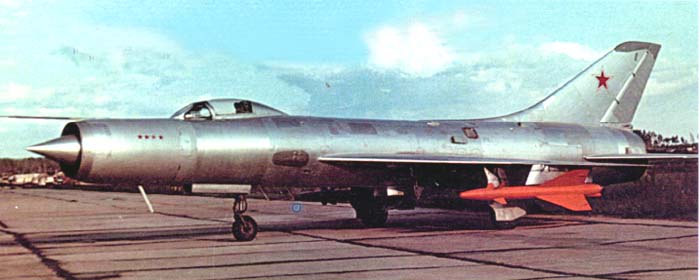
The Sukhoi Su-11’s Lyulka AL-7F-2 afterburning turbojet engine produced 22,270 pounds of thrust, propelling the aircraft to a maximum speed of Mach 2.2 (1,450 mph). The Fishpot-C had a combat range of 310 nautical miles and a service ceiling of 59,000 feet. Su-11s had a thrust-to-weight ratio of 0.71 and a 26,910 feet per minute rate of climb. Fishpot-Cs were armed with two K-8 air-to-air missiles. Between 1962 and 1965, Sukhoi built 108 Su-11s. One such Su-11 survives today, s/n 0115307. This Fishpot-C is displayed outdoors at the Central Air Force Museum in Monino, Russia.